The first coffee of the morning is one of those things we know best without knowing much about it at all. We recognise the sound it makes as it bubbles up through the moka pot, the cup we want to drink it from, how much sugar to add – assuming we’re the kind of people who add sugar, and that alone could start a civil war – and we can even tell the exact moment when it’s hot enough to drink without scalding ourselves. We can activate all these senses with our eyes barely open; whatever came before belongs to a story we don’t usually need in order to have breakfast. What we need to know is how it tastes. Which, of course, we already know. But perhaps the opposite is true.
To perceive it, we activate a whole variety of receptors that aren’t located only in the mouth – through the process of recognising molecules known as chemoreception – which affects our wellbeing and also responds to epigenetic environmental factors. A matter of taste, of course, but also a matter of how we talk about taste. After all, we don’t drink resveratrol and terpenes for a living, and the ecumenical virtuosity of technical wine language seems to be doing its part as a weapon for driving enthusiasts away. To venture further into this black hole of reasoning, there is certainly plenty of good essay writing to draw from, including recent and accessible books that don’t require a science degree, such as De Gustibus by Gabriella Morini and Davide Risso (Topic Edizioni, 2024), to name one. But first, we need to take a step back – almost a semantic one, which might even sound a little silly.
We use these terms almost interchangeably (even Treccani – Italy’s most famous dictionary – does), but do we know taste or flavour? Taste is also ours: it depends on who is tasting, on their preferences, on their own idea of what is good. Flavour, on the other hand, seems to reside in the thing itself. Or at least that’s how we like to think about it. So is there something in the flavour we perceive that we can, however liminally, consider objective, beyond individual preferences?
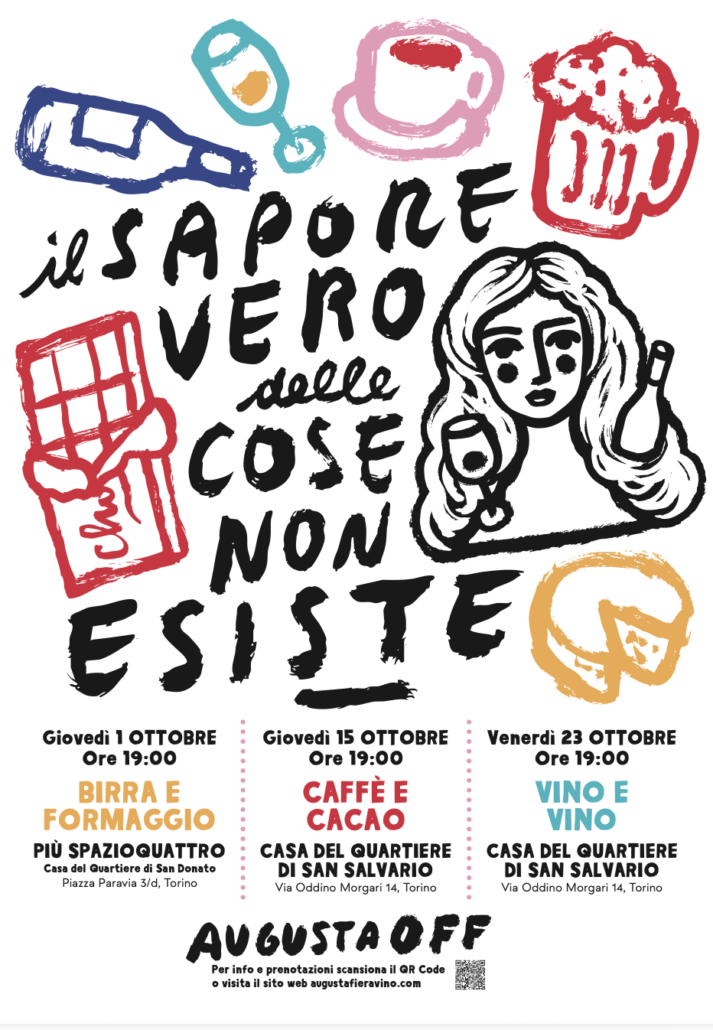
It’s a question that Augusta has chosen not to answer, but to put to the taste, through a series of events leading up to the natural wine fair itself, taking place at the Bunker in Turin on November 8 and 9. Not to resolve it, but to anticipate the theory: that The True Flavour of Things Does Not Exist. A deliberately provocative title that openly declares the point of view behind the latest project in the rich programme of Augusta OFF, the fair’s ancillary programme designed to offer the public a cultural project through which to explore the world of natural wine and approach its stories and ideas through the people who make it and the wines they produce.

“For the next edition of Augusta, we wanted to create a series of events leading up to the fair, designed both for those who already love natural wine and for those who want to discover it more deeply, including through tasting products that share its values and sensibilities. Augusta is coming to the Case del Quartiere, community spaces dedicated to meeting and active citizenship, to reflect on the production and conscious consumption of food and wine. We will also expand the fair’s cultural programme with book presentations and conversations featuring highly respected Italian and international guests, taking place both in the run-up to and during the event,” explains Piero Crocenzi, founder and curator of Augusta, as the project continues to sharpen and define its direction.
“The true flavour of things does not exist; we imagine it into being,” explains journalist Eugenio Signoroni, who will moderate the three conversations.
“We’re not here to teach people everything. Quite the opposite: what matters is the process of discovery. We want to take people on a journey.” Nothing to do, then, with the pretence of tracing things back to some supposed original purity, or of deciding who is right about what they taste. “The flavour of things comes from a series of choices made all along the supply chain.”
And there it is: the objective element in a product’s flavour that we might never have thought of. So where does flavour come from? Who are the people who have helped bring it to us? What is their vision? How much does the place it comes from matter, and how much does the way it’s made? What role do history and memory play? What about the soil, or the positive impact it leaves behind?
All these questions will find different, multiple answers on October 1, 15 and 23, at two of Turin’s Case del Quartiere community spaces: San Donato for the first event, and San Salvario for the following two. The idea is to work backwards, following the thread from the product to the story behind it, through a journey of tastings. These events are a way of approaching Augusta not only in chronological terms – because they take place before the fair – but also in terms of method, and almost of philosophy. Each of the three gatherings starts from something we think we know, from that shared, almost instinctive idea we have of what something is supposed to taste like, and builds a tasting journey from there.
The kind of beer we picture when we think of beer. An “ordinary” cheese. Coffee. Chocolate. Familiar flavours, the ones we can all more or less recognise. Then come two tastings that take us “towards what Augusta actually wants to represent through that product. Because the idea is that the true flavour of things doesn’t exist – or perhaps it does, but it’s the one furthest removed from what we imagine when we close our eyes and picture a particular thing,” Signoroni continues.
The three evenings at the Case del Quartiere are also designed to broaden Augusta’s audience, bringing into the conversation people who are already sensitive to and curious about these themes, and perhaps technically familiar with them, but who have yet to engage with them from a gastronomic and sensory perspective – or with the meaning behind the words themselves.
We tend to treat words as if they had a fixed, recognisable meaning, as though our job were to pin that meaning down and, once we’ve found it, protect it. That’s how many of the words we now use to talk about food came about: artisanal, traditional, natural, authentic. Useful words, until they start sounding like verdicts. The first event, on October 1 at Più SpazioQuattro, takes one of these words as its starting point: “artisanal”, set against its supposed opposite, “industrial”. The beers from Cantina Errante in Barberino Tavarnelle (Florence) and the cheeses from La Servaja in Castelnuovo di Ceva (Cuneo) will provide the starting point for exploring the difference between artisanal and industrial production, tracing the journey of these products backwards, from the shelves to the cellars. Looking beyond the associations carried by those two adjectives.
On October 15, the journey shifts landscape and hemisphere, bringing coffee and cacao together with Caffè Santaromero and Cacao Disidente, two Turin–Colombia ventures. The first is the Turin-based micro-roastery founded by Gabriela Montañez and Francesco Anastasi, roasting Colombian coffees from small producers selected at origin. The second is based in Bogotá, but was founded by Turin-born food expert Manlio Larotonda, who works tree to table and bean to bar with cacao sourced from areas of Colombia where the project has a strong social impact, while working to strip away the constraints the industry has imposed on cacao. Here, the point is less about distinguishing one kind of production from another than about paying attention to distance, and to the long, intricate supply chain that separates these products from where they come from – a distance that shapes the final result, with consequences that go far beyond, and run much deeper than, the taste of burnt coffee.
On October 23, the focus shifts to wine – the kind of wine you’ll find at Augusta. Since wine is perhaps the product our metabolism is most familiar with, this is a chance to look beyond the things that are, of course, hugely important: grape variety, soil, exposure, vintage, malolactic fermentation, terroir. And to linger instead on the idea of “natural” – an intuitive, elusive and slippery word. With Martina Panarese of Cascina Barbàn in Figino (Alessandria) and Erica Perrino of Testalonga in Dolceacqua (Imperia), Augusta looks into where wine comes from, asking why it has become so important today to set off again in search of an authentic kind of naturalness – one that, from the soil to the cellar to the bottle, turns a fruit into a political and social gesture. The real challenge of “natural” lies in moving beyond the argument that “it can’t be natural because wine doesn’t make itself in nature”. (For the record, most of the things we consider good have been touched a great deal: selected, cultivated, tended, transformed, preserved.) Humans have been intervening for as long as we know; what matters is understanding how we intervene, and what consequences those choices produce. A reflection that takes wine far beyond wine itself, and well beyond its true flavour – which, as we know, doesn’t exist.
Augusta thinks about wine
Once you open the door marked “wine”, it’s only natural to mention that this year Augusta will bring together around one hundred natural wine producers, alongside farmers and artisans who work the land, raise animals and transform what they grow and make. Around the fair, November will also bring another strand of the Augusta OFF cultural programme. Called Augusta pensa il vino, it unfolds over four days of conversations, talks and book presentations that take wine as their starting point, but don’t necessarily stop there.
On Friday, November 6, at the University of Gastronomic Sciences in Pollenzo, Valentin Morel will present Another Wine, the English title of Un Autre Vin, published by TTC Editions in 2026. A Jura winemaker and founder of Les Pieds Sur Terre, Morel will talk about his decision to change his life and return to his family vineyard, as well as the challenges of farming land shaped by harsh winters, scorching summers and the increasingly tangible, everyday effects of climate change. On Saturday 7, American journalist and winemaker Rachel Signer will present her new book, Bere il vino naturale, an accessible, hands-on guide to the world of natural wine. On Sunday 8, at the Bunker, Nicola Perullo and Alice Feiring will meet vignerons Elena Pantaleoni and Franz Strohmeier to explore the relationship between natural wine and climate. And then, on Monday 9, Fuori di vino: an elegant way to close the circle and talk about sustainability, conscious production and our relationship with the planet without talking about wine at all. Instead, the conversation will turn to producers from the agricultural market: Francesco d’Alessandro of Sgranocchia Forno Contemporaneo, Lorenzo de Laugier of Miele San Lorenzo and Maria Stella Carbone of Semi di Tuscia.
Thinking about wine, then, will be another way of following that same thread: from the product to its story, and from its story to the people, the land and the choices that brought it to us.
Let’s go back to that morning coffee, the one we know so well we can drink it half asleep. And yet, the familiar flavour we recognise is the result of a story that began long before us: someone grew it, picked it, processed it, roasted it, selected it. We simply arrived at the end of the story and decided that this was, for us, what coffee tastes like. But if flavour is the sum of a story, a place and a series of choices, then perhaps even the things that seem most obvious deserve a second taste.
Without even knowing it, Italian band Ex-Otago had already given us the perfect soundtrack on their 2019 album Corochinato: “Our own identity, our belief / that we’re always right / But maybe the opposite is true.” Because flavour can become a belief, too. And beliefs, as we know, are very good at disguising themselves as truths — and they don’t always do us any good.