When trying to understand how a wine is born, we usually begin with geology. Chalk, fossils, exposure. All essential elements, yet we rarely stop to consider the relationship that the person behind the wine has with time itself. And yet wine, before it is agriculture, is a way of managing time.
Anyone who runs knows this well: you do not finish a marathon by sprinting through the first kilometer. There is pace, unpredictability, fatigue, adaptability, doubt. Above all, there is the awareness that the final result never depends entirely on you.
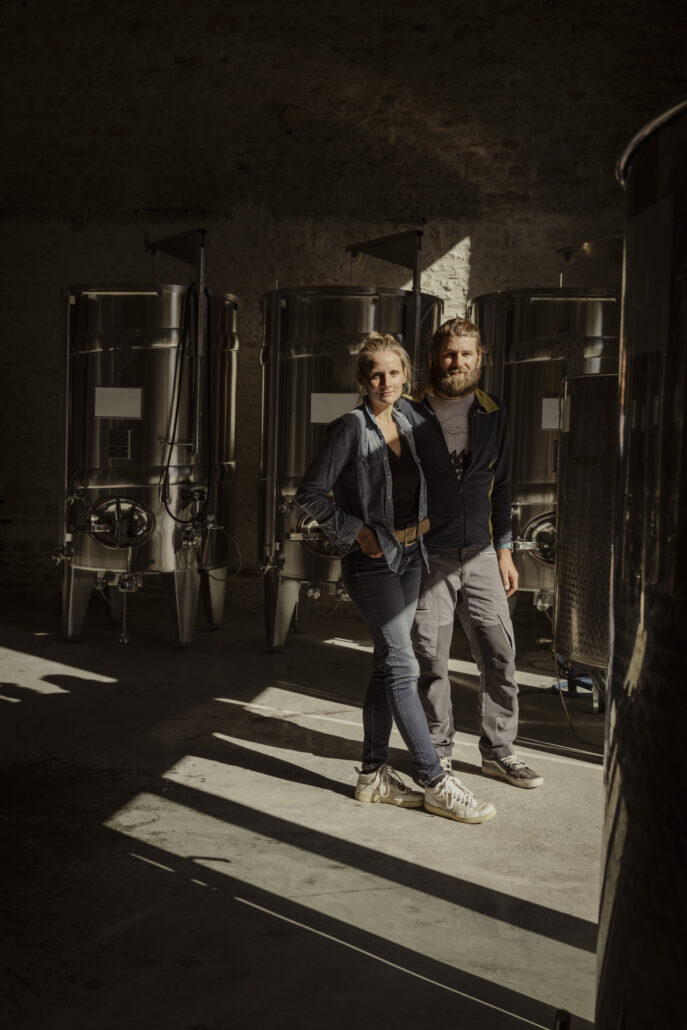
As we listen to Hannah Boesel and Raphaël Piconnet speak about their Domaine de Bichery in Neuville-sur-Seine, in the Aube, we are struck by the feeling that endurance sports and artisanal viticulture can merge into a single philosophy of life. This is not a forced comparison. It is simply a fact.
When we first meet them, we do not talk about Champagne. We talk about running. She runs on road. He runs on trails. And as a runner myself, I am immediately drawn into the conversation. We meet in Turin, among the tasting tables of Augusta, the natural wine fair. It was Augusta founder Piero Crocenzi who suggested we seek them out. “Besides making extraordinary Champagnes you absolutely shouldn’t miss,” he told us, “they’re serious athletes.” After a quick look through their Instagram profiles to make sure Piero was not exaggerating, we headed over to their stand. Admittedly, with a certain amount of hesitation. Asking a winemaker for a tasting and the story behind their wines is one thing; asking about their wines through the lens of running is something else entirely.
With Hannah and Raphaël, however, it worked immediately. Within minutes, the conversation had happily veered away from the usual wine-world discussions of dosage levels and fermentation protocols and toward something far more interesting: endurance.
“Guiding a vineyard through an entire growing season requires endurance,” Hannah explains, “but above all it requires balance between performance and resilience. There are moments when you have to accept slowing down, and others when you need to give everything you have. You also have to accept that external conditions will inevitably influence a race, a harvest, and life itself. What we can choose is how we respond.”
She is answering a question about whether the mental discipline and attention to detail demanded by running help her manage the Domaine. The connection between sport and viticulture becomes immediately clear: both require accepting your limits.
Domaine de Bichery lies in the Côte des Bar, the southernmost part of Champagne. For decades, the region has been overlooked, considered something of a peripheral outpost. Today, in a delightful twist of fate, it has become perhaps the most vibrant center of artisanal winemaking in the entire appellation. This is a different Champagne. “It’s a landscape shaped by forests, meadows, and farmland,” Hannah explains. “We are far from northern Champagne, and perhaps not only geographically. Burgundy is just fifteen kilometers from our home, and in many ways we feel closer to Burgundian culture than to central Champagne.”
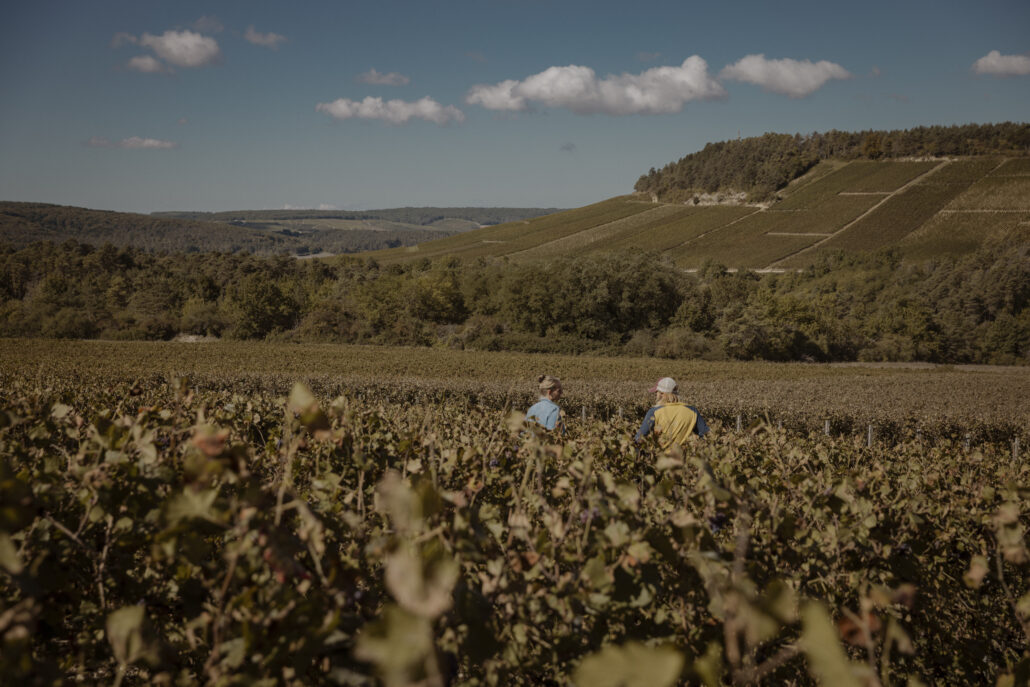
If the northern territories of the great historic maisons evoke the disciplined linearity of road running, then the Côte des Bar belongs to trail running. It is a landscape that adapts to slopes and contours, demanding a different rhythm – more flexible, more responsive, capable of working with the terrain rather than imposing itself upon it.
The soils here are Kimmeridgian: a layer of clay ranging from 30 to 60 centimeters deep resting above fractured limestone. Sound familiar? It is the very same geological foundation that underpins some of Burgundy’s greatest terroirs. The result in the glass is distinctive. These wines possess all the electricity and tension associated with southern Champagne, marked by a strong mineral character, yet they also carry an earthy depth, structure, and sense of energy that comes directly from their limestone soils and unmistakably nods toward Beaune.
The story of Domaine de Bichery may be a young estate, but as is often the case in wine, young stories are rooted in old traditions. For generations, Raphaël’s family had been supplying grapes to the local cooperative. It was a logical and safe choice, so much so that Raphaël’s father was actually one of the founding members. While today’s romantic narrative may demand the image of a young rebel sparking a revolution, the reality is, fortunately, much more cultured and interesting – it’s about conscious evolution. Raphaël studied oenology between Changins and Beaune, gaining experiences across Switzerland, Bordeaux, and Burgundy. Hannah, originally from Germany, specialized in international tourism in Bordeaux. They met there in 2012 and began to envision a project that would blend their family roots with contemporary sensibilities. It was there that they built the concept of Domaine de Bichery, aiming to fulfill their dormant desire to produce a Champagne that truly reflects their terroir, sourced from their family-owned vineyards. In 2013, they decide to return to Raphaël’s home.
Their baptism by fire arrived in 2015. That summer, a tiny, ageing winery building was renovated and transformed into the beating heart of the project. The first release was microscopic but meaningful: just 4,500 bottles divided among three cuvées. Today, such numbers may seem charmingly small to enthusiasts. At the time, they were simply terrifying. When I ask Raphaël what he remembers most vividly about that first harvest, he does not reach for words such as “poetry,” “magic,” or “dream.” His answer is refreshingly honest: “stress.” Real wine is built on doubt, investment, risk, and sleepless nights, not fairy tales. Rather like signing up for your first marathon. Everyone celebrates the photo at the finish line with a medal around your neck. Nobody talks about the long, brutal training sessions in November rain.
“In 2015 we had no direct experience making Champagne,” Raphaël recalls. “Everything was a first. We were starting from scratch, without a single bottle on the market and without really knowing where the journey would take us. Today our wines are perhaps calmer, more confident. And probably so are we. We’ve gained confidence, but more importantly, we now know exactly where we want to go – and what we don’t want to find in our wines.”
Their winemaking philosophy is rooted in protecting and respecting both the land and the fruit.
The entire eight-hectare estate has been converted to organic farming, while biodynamic principles guide every stage of vineyard work. Every decision – from vine to bottle – is approached with patience and care. Yet the most important work happens among the rows of vines. It is here that the essence of their approach to Champagne takes shape: a relentless pursuit of terroir expression.
“We spend as much time as possible in the vineyard,” Raphaël explains. “In the cellar, our role is simply to accompany the wine and intervene as little as possible. We use little or no sulfur, indigenous yeasts from our own vineyards, no filtration, and no fining. We try to give the wine every opportunity to evolve as naturally as possible.” Their motto is Pas d’histoire, du naturel – meaning no stories, just nature. It is a philosophy that extends beyond viticulture and into the way they talk about wine itself.
“Everyone experiences wine differently. It doesn’t matter how much you explain or how elaborate the story becomes—the perception of the person tasting it will always be personal and unique. That’s what matters most. Not what we tell people they should feel, but what they actually feel. We don’t want to talk too much about our wines. We would rather let the wines speak for themselves.”
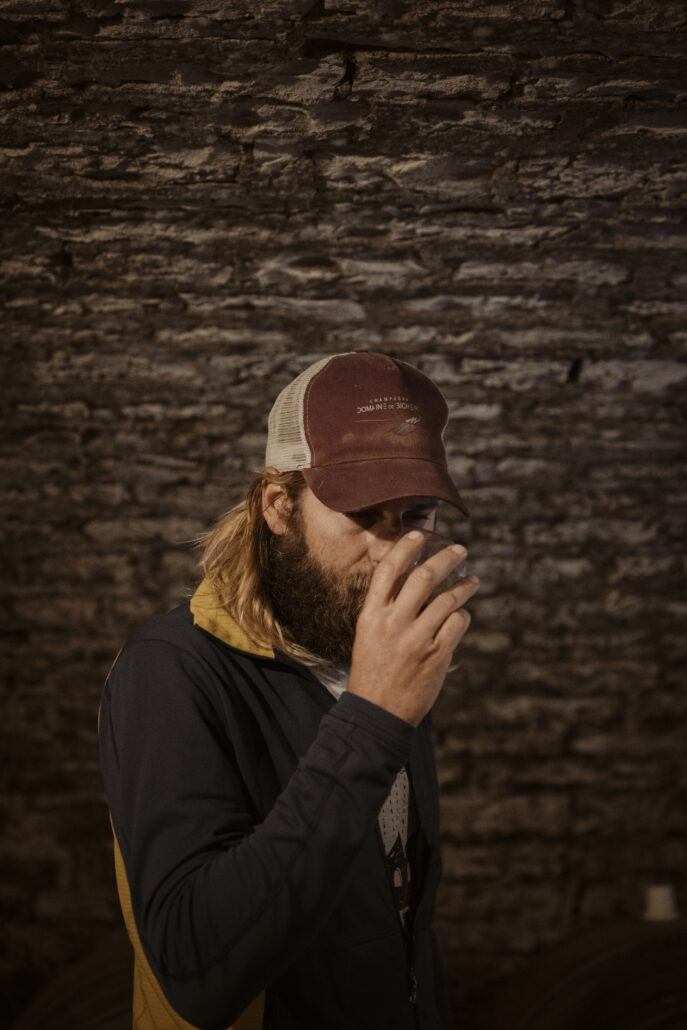
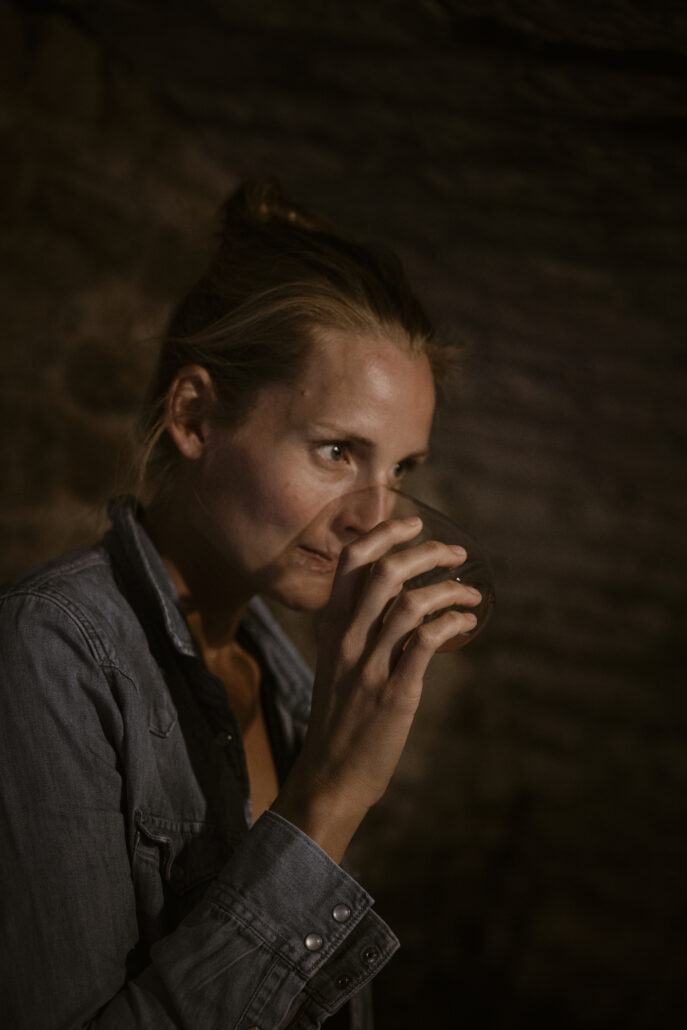
As we sip their Champagne, we discover that their journey into endurance sports was almost inevitable. Raphaël has been cycling since childhood, but it was in 2020 that he and Hannah officially embraced running. “It’s simple,” he says with a laugh. “You just put on your shoes and go, exactly like I did this morning before the fair. After a day in the vineyard you’re exhausted, but going for a run somehow resets everything. And I love eating and drinking, so running is the perfect counterbalance. The funny thing is that the more you train, the more you want to train. When I’m running for two, three, or four hours, I have time to think about so many things, and all of those thoughts are incredibly positive.” A perfect virtuous cycle.
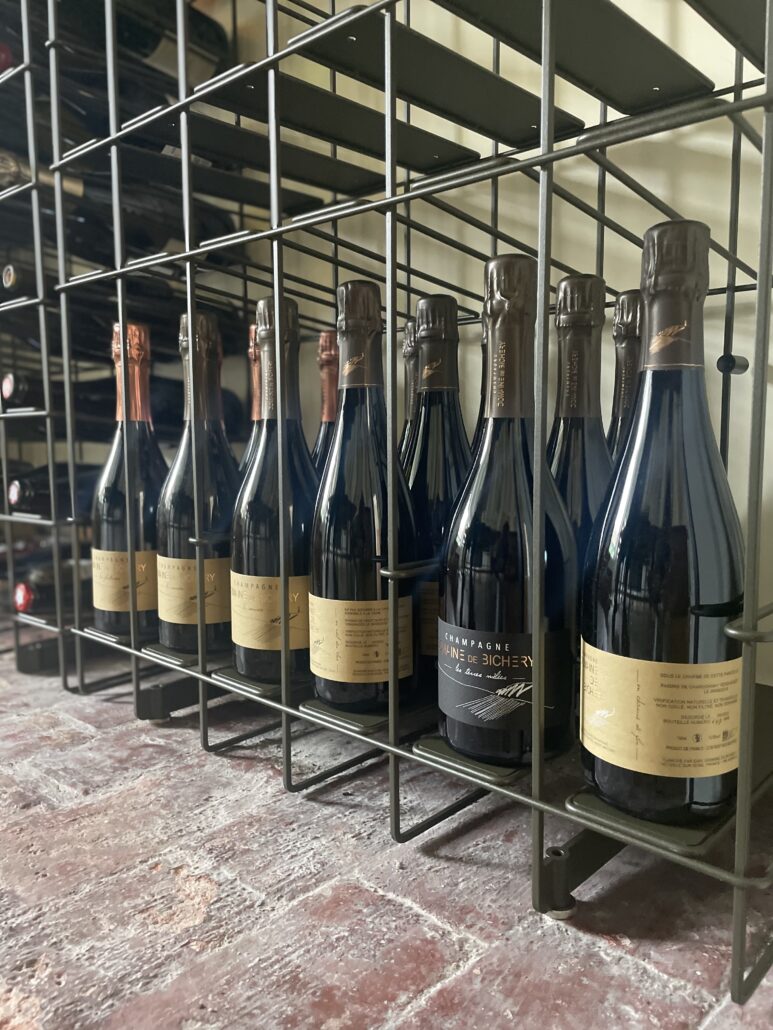
That same unfiltered approach carries directly into the glass. To ensure that every bottle expresses the terroir as purely as possible, Domaine de Bichery chooses not to use reserve wines. Each cuvée is made exclusively from the fruit of a single vintage. There are three principal cuvées, each moving with the same sense of momentum and purpose that defines endurance sport.
First comes La Source, the wine that started everything. It is a blend that reflects the Domaine itself (roughly 60% Pinot Noir, 35% percent Chardonnay, and 5% Meunier, a variety that is surprisingly rare in this corner of Champagne). The blend changes from vintage to vintage, capturing a precise snapshot of a particular year. Then there is La Fontaine du Noyer, a Pinot Noir rosé that showcases the earthy depth and character of the Côte des Bar. Finally, Les Terres Mêlées, a Blanc de Noirs that offers a more vertical, focused, and linear expression of the grape. Further reinforcing the connection between wine and place is their complete rejection of dosage. By leaving the wines entirely unadorned, they amplify transparency, tension, and precision, delivering a faithful expression of their artisanal vision. In the right vintages, the picture is completed by their Coteaux Champenois – still red and white wines that spend extended periods aging in wood and reveal the Domaine’s most distinctly Burgundian side.
The more closely you look at Domaine de Bichery, the more it resembles a perfectly balanced endurance team. Their respective approaches to running mirror both their personalities and their roles within the estate. Raphaël prefers trail running and cycling, activities defined by nature, elevation, and unpredictability. Hannah gravitates toward road running, where rhythm, precision, and consistency are everything.
Do these preferences reflect your personalities and your roles within the Domaine?
Hannah: “That’s a very interesting question. For me, the real challenge of long-distance road running is managing effort and maintaining pace. I enjoy focusing on the long term rather than constantly reacting to sudden obstacles – a root, a rock, a technical descent– which are all part of trail running. Perhaps that’s also how I work. I’m less impulsive and more comfortable concentrating on one objective at a time.”
Raphaël: “I love being alone, preferably surrounded by nature. I enjoy tackling obstacles independently. The technical challenges of trails fascinate me, as does the fact that you can run the same route twenty times and it never feels exactly the same. Quick, instinctive decisions make me feel alive. My role at the Domaine is much the same: always moving, constantly adapting to situations that are rarely planned or expected.”
When asked the inevitable question – whether a 20km run through the woods can solve a technical problem in the vineyard – the answer is both humorous and revealing. “More often than not, a long run gives us new problems rather than solutions,” they laugh. “But occasionally it provides solutions too. More importantly, it allows us to create distance from whatever we’re dealing with, see it from a different perspective, and return to it with a clearer and fresher mind.”
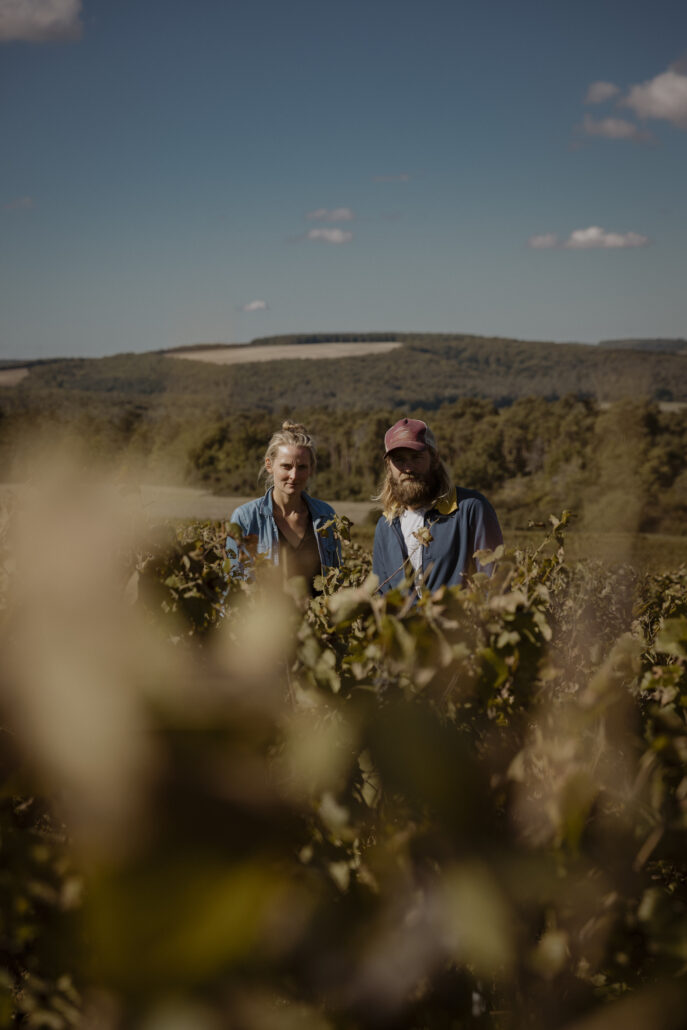
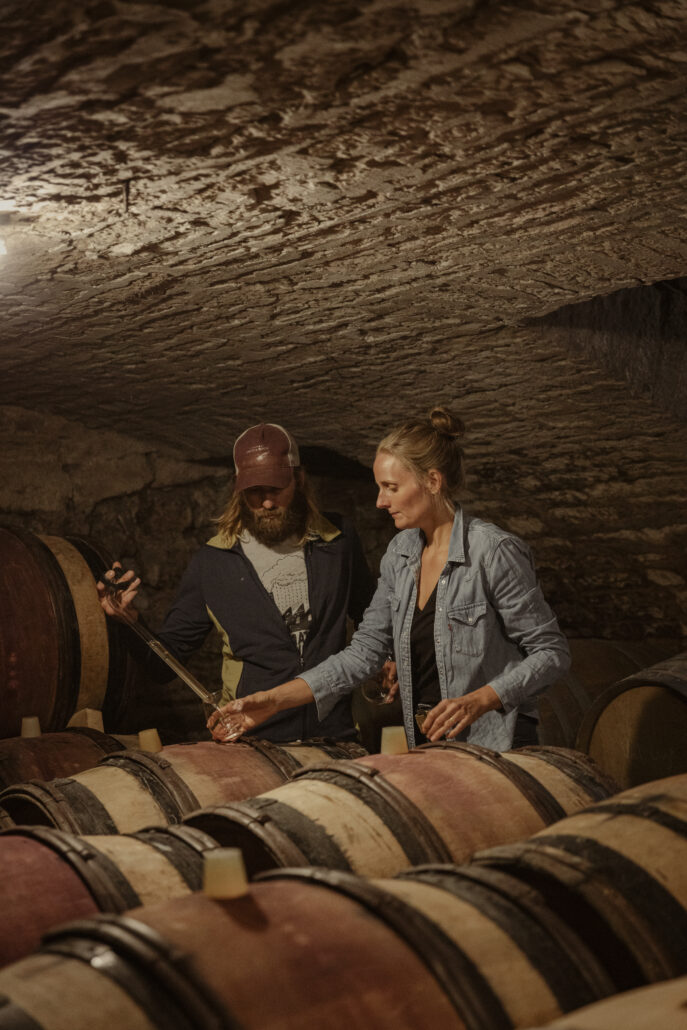
Distance, after all, is one of the most underestimated cognitive tools. Whether you are running an ultramarathon or deciding to make your own wines in southern Champagne, perspective is never measured by a single step or a single fermentation tank. It comes from the ability to look back and make sense of every stride, every setback, and every wrong turn along the way.
“Always start again. Improve every time.” That, perhaps, is what great athletes and great winegrowers share.
At their core, artisanal viticulture and endurance sport are built on the same secret: beauty lies not in absolute control, but in the ability to engage with uncertainty. Domaine de Bichery embodies that philosophy, translating it into Champagnes of remarkable energy and vitality.
After all, those who know what effort truly feels like understand that milestones are not celebrated only with medals or congratulations. Sometimes they are celebrated by popping a cork. And when I ask Hannah and Raphaël which cuvée they would choose to mark the most important achievement of their lives – whether athletic or professional – their answer inevitably circles back to where the journey began.
“Probably La Source R15, our very first vintage. To remind ourselves of how far we’ve come, of all the roads and trails we’ve traveled, and of everything that brought us here.”