For those outside the industry or unfamiliar with the niche, it’s not easy to place Tartuflanghe into a single category: an internationally recognised and structured company that, despite its growth and evolution, continues to rest on a deeply familial foundation – the very same from which it all began. The story starts with Giuseppe (Beppe) Montanaro, who in 1950 began his career as a chef in Alba at the Hotel Savona, before setting sail for new experiences on cruise ships. Upon his return, he opened a restaurant with his wife, Domenica Bertolusso, where he developed a passion for local products: mushrooms and truffles.
In 1975, as their historic sign tells, Tartuflanghe was born with the visionary idea of working with truffle beyond its traditional consumption. Since then, the company has gone far beyond buying and selling, continuously experimenting with techniques and transformations to create innovative products. Today, the company is led by Stefania and Paolo, the children of Beppe and Domenica, who strive to keep a forward-looking perspective while remaining firmly rooted in their origins.
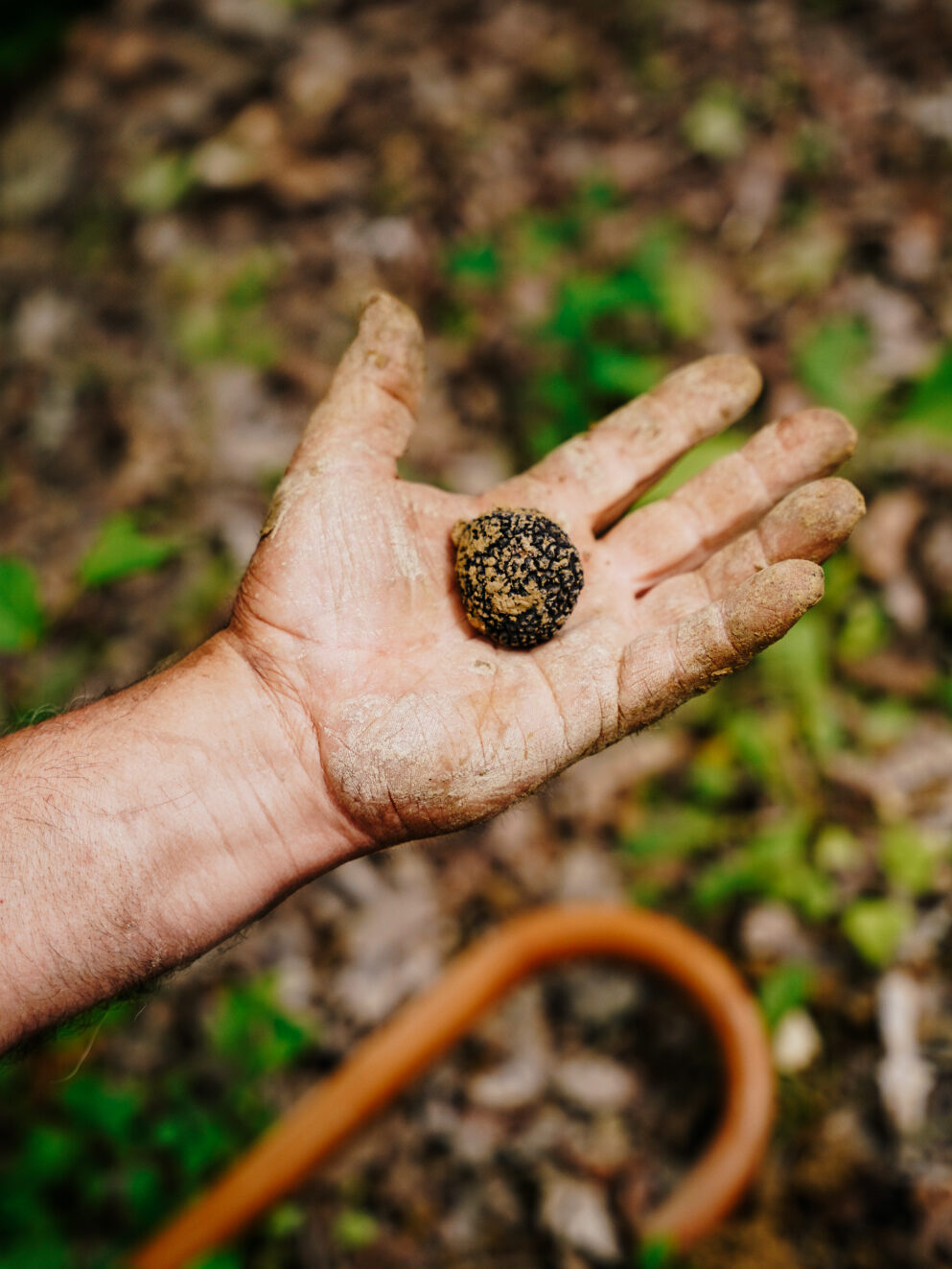
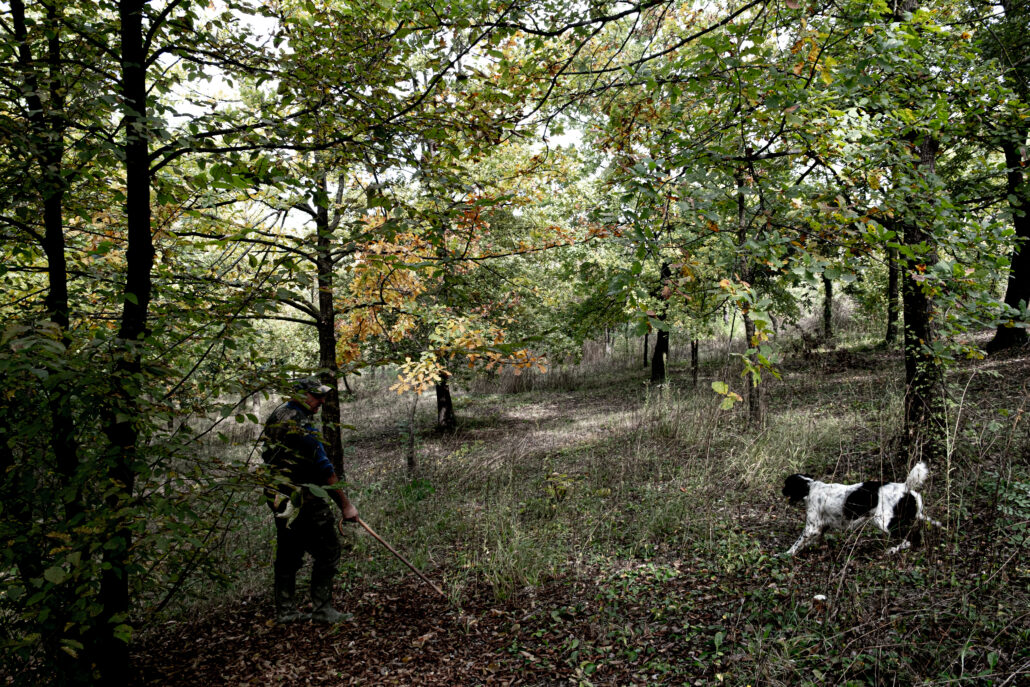
To truly understand all the nuances of this company, you need to start with the land. So, in front of their headquarters in Piobesi d’Alba, a Jeep awaits us. At the wheel is our trifulau (the “truffle hunter”, ed. note), who, together with two splendid truffle dogs, Macchia and Perla, takes us to one of the company’s own truffle groves, specifically the one dedicated to Roberto Ponzio, the king of Alba white truffle, a professional who, in his city shop, has promoted both the product and the territory where it is born.
Tartuflanghe owns over twenty-six hectares of land across the Roero, Monferrato, and the Langhe, all designated to create optimal conditions for spore development and truffle growth. The plantations and land management are carried out in collaboration with the University of Padua, with the goal of creating a natural environment and building a truffle cultivation system that ensures traceability for customers. The forests of the truffle groves are enriched with mycorrhized plants, specifically chosen to support the development of truffle spores.
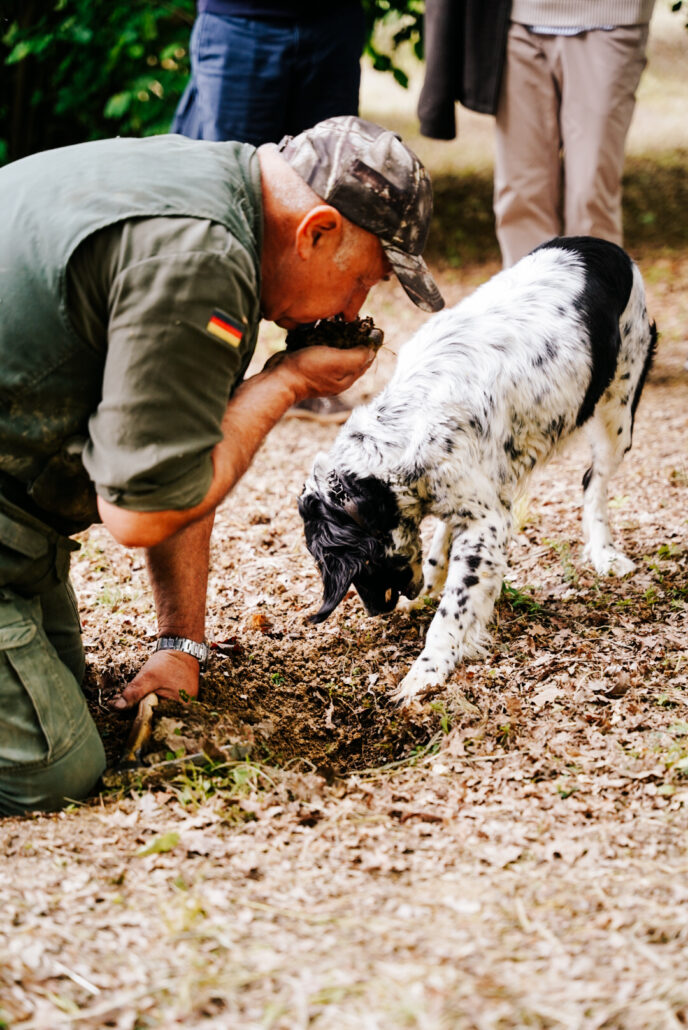
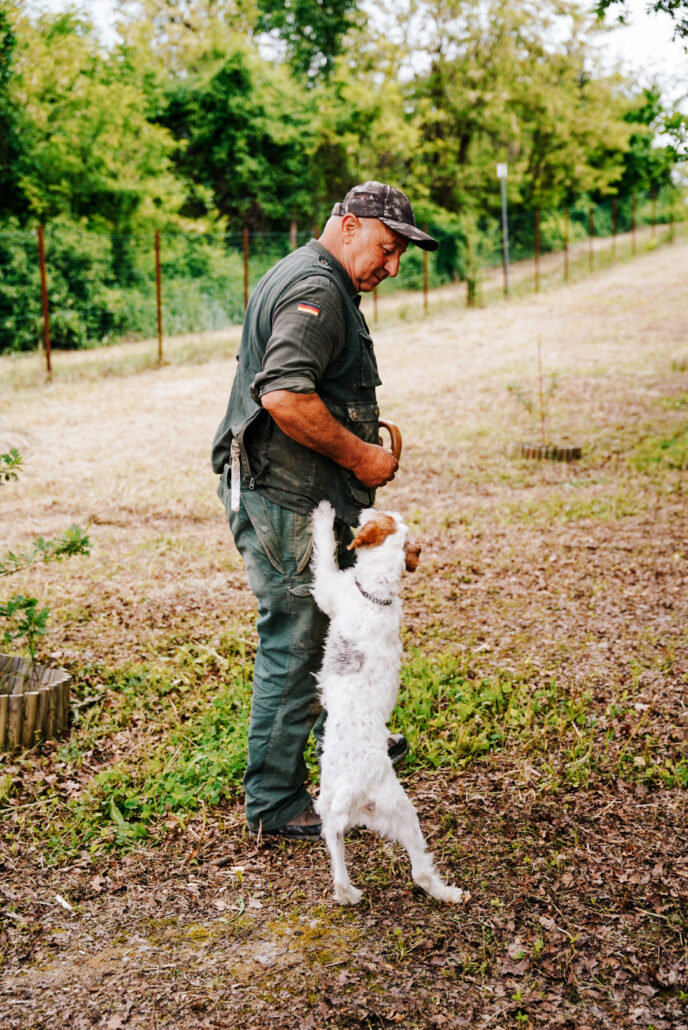
During the journey, in a strong Piedmontese accent, our trifulau tells us how he trains the puppies: from a young age they are accustomed to the smell of truffle, which is not immediately appealing, so it is necessary at first to associate it with something positive, rewarding them every time they recognise it. The training process is long; it is also important to teach the different commands and to hide the object so that the puppies can find it, sometimes even placing it deep underground. Once we arrive at the truffle grove, we see Macchia and Perla in action. They are perfectly in sync and almost seem to communicate with each other. They are not only working, but also enjoying themselves, achieving the main goal: finding the truffles.
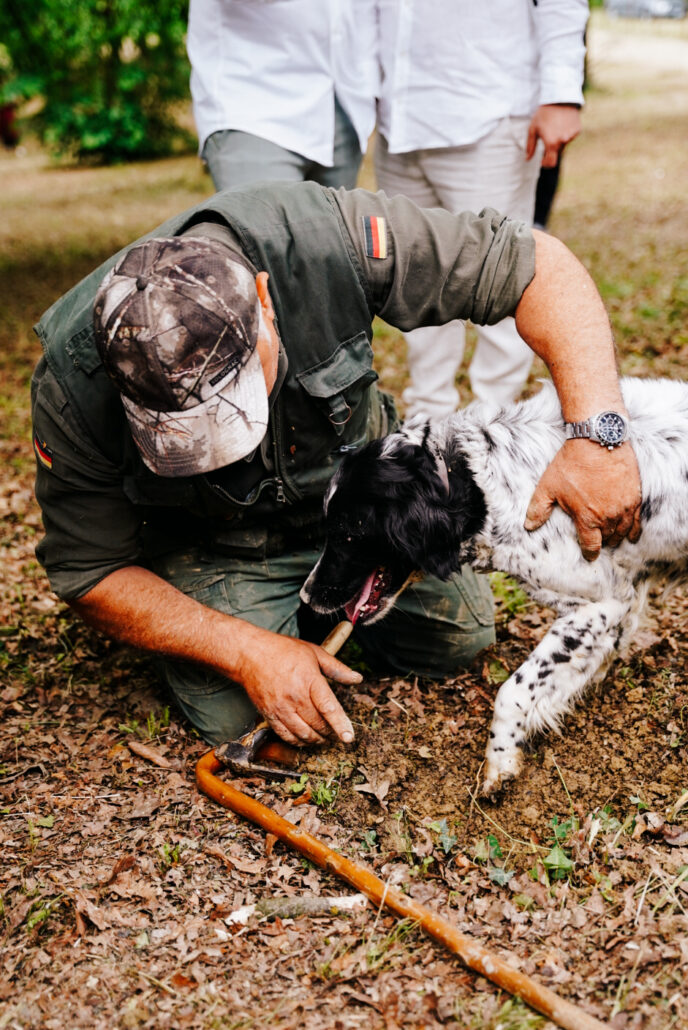
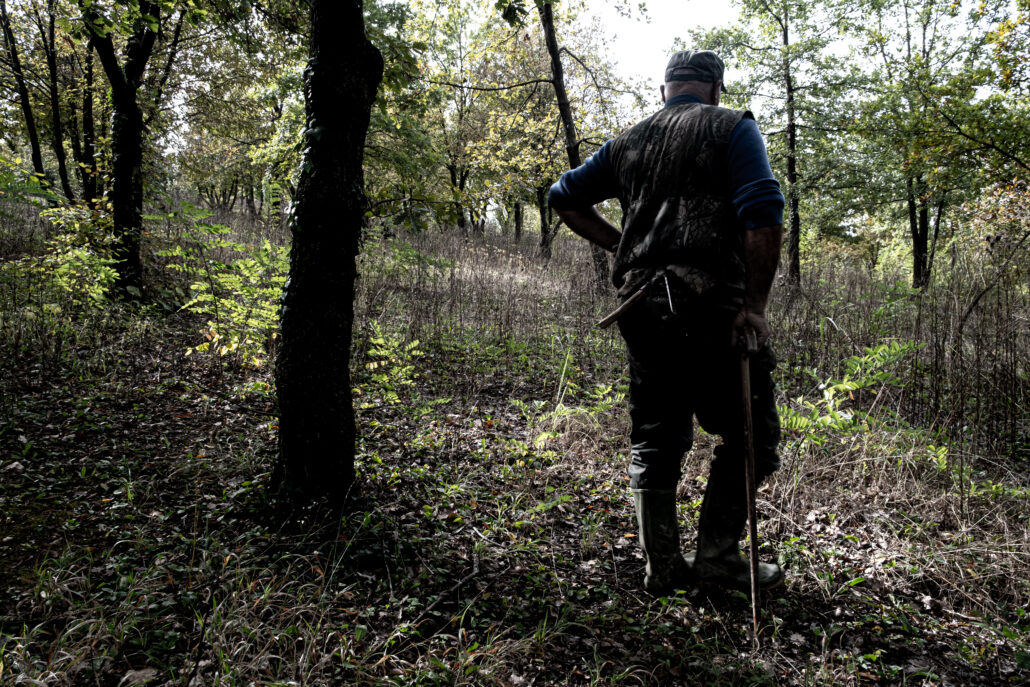
They don’t go straight to the point; first, they patrol the area, trying to sense where the truffles might be hiding, and then one of them starts digging in a very precise spot. The trifulau stops, picks up a handful of soil, and lets us smell it: the aroma of truffle is unmistakable. The two puppies take turns, digging a hole that can reach up to thirty centimetres deep, and finally, with the help of the trifulau’s tools, they uncover a medium-sized black truffle. Delighted, they are rewarded. Every well-trained dog knows that if it finds small truffles, it can eat them, while the larger ones must remain untouched.
We are in a magical place: this truffle grove, with its autumnal light, feels like one of those forests from children’s fairy tales; the timid sun peeks out from behind the trees, the leaves crunch under our feet, and acorns, as if drawn with precise strokes, hang precariously from the branches.
The truffle grove we are in is home to several species of oak (Turkey oak, Holm oak, and English oak), as well as hazel, linden, willow, and poplar trees. It is precisely these trees that create the optimal conditions, determining the growth and harvesting periods.
Truffle is, in fact, an extremely seasonal product: for professionals, the search is limited to specific dates. For example, the prized white truffle is at its best each year from September to January, the black truffle from November to March, while in summer the summer black truffle can be found from June to November.
Macchia and Perla have finished their work, having found three truffles between them, and once back in the car, they enjoy the journey home. Watching them work together makes it clear that it’s not just their sense of smell that matters, but also the bond with their owner. The collaboration between the three is unique: they communicate constantly, have fun, and work with astonishing precision, achieving excellent results.
We return to the headquarters, where a tour of the company awaits us. We discover that, thanks to the presence of the truffle groves, Tartuflanghe can label their truffles: after being analysed and cleaned, each truffle is assigned a QR code indicating the exact spot where it was found. The company is divided into several production areas, each dedicated to a different type of preparation. Here, the processed products contain real truffle, not just flavouring, and all pass exclusively through this environment. For this reason, stepping inside feels almost like entering a place filled with truffle-scented air fresheners, but in reality, it is the constant presence of the product itself that creates a pleasantly pervasive aroma.
We have the pleasure of seeing the cryo-drying machine in action, which, since its first use in 2010, represents the most advanced method for preserving truffles without altering their organoleptic properties. Here, Alba white truffles are preserved as dried shavings through this physical process, which uses low temperatures to remove water. Cryo-drying is also used for various experiments, creating innovative products such as powdered seasonings that allow for long-term storage.
Behind every door in this company lies a different production process or an intriguing machine: from the making of dried, hand-wrapped fresh pasta, the first in the world to contain real truffle, to the creation of Trifulòt, chocolate pralines dedicated to the nearby city of Turin.
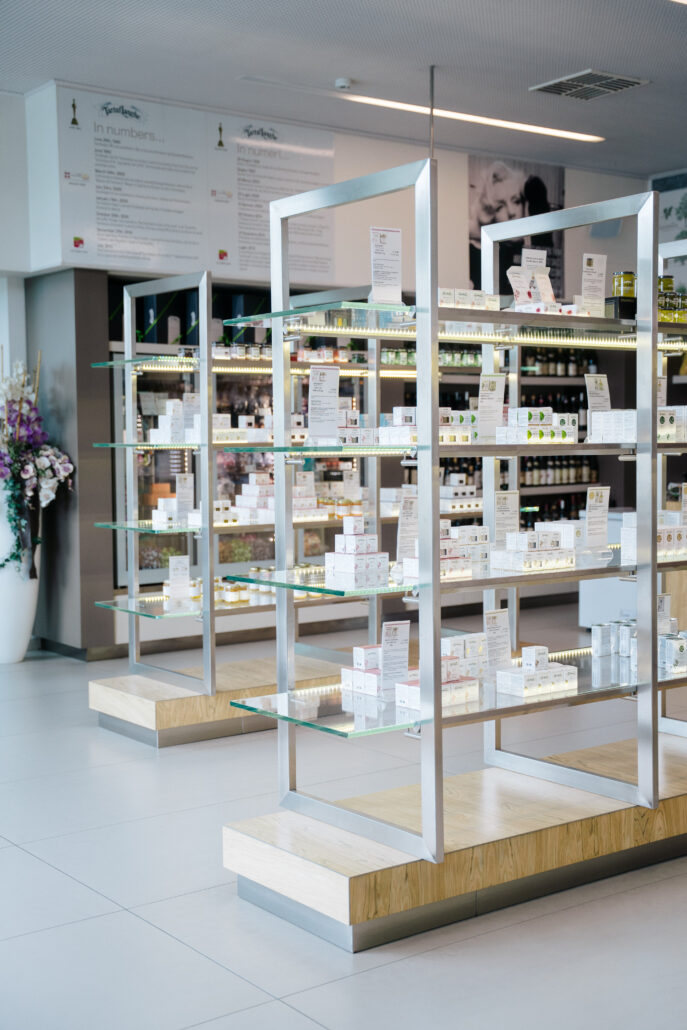
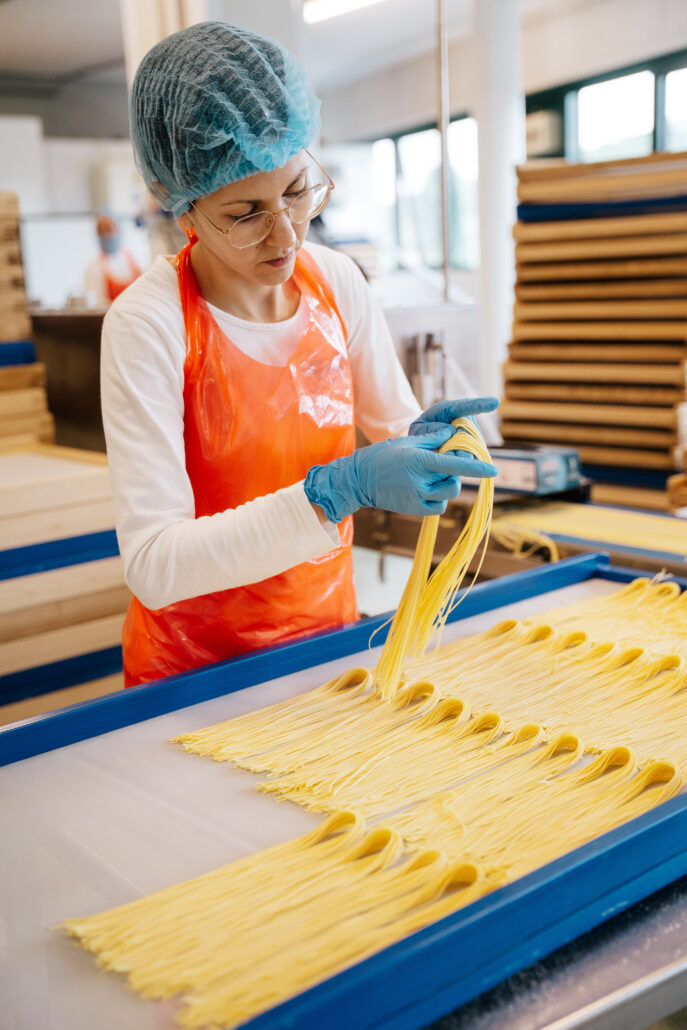
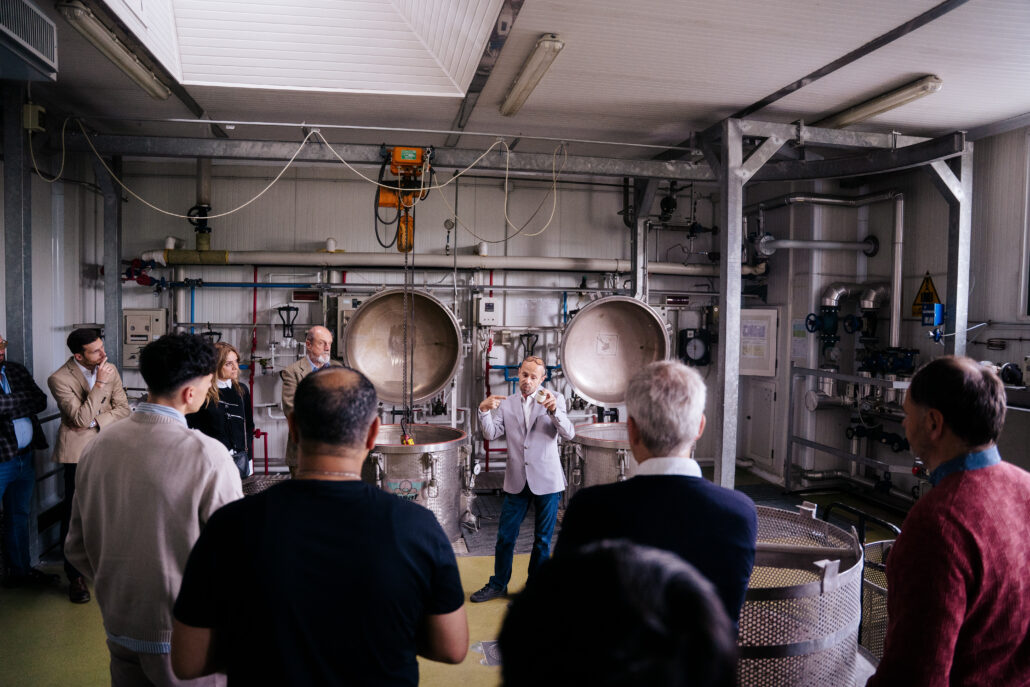
It’s fascinating how, within such a short distance, the product is found, tasted, packaged, and processed.
At Tartuflanghe, it’s not just about buying and selling , there is discovery, innovation, and experimentation, every day, more and more.
And you can see it in the eyes of those who guide us through this world, but also in Beppe, who appears briefly yet doesn’t linger, because there is always much work to be done, and he still takes care of it himself, personally.