“My portion
just a tiny slice
summer’s first bonito “Issa Kobayashi
“The Floating World” is a popular term used to describe nineteenth-century Tokyo, known as Edo at the time. It represented a similar cultural consciousness to La Belle Époque in Europe: teeming with energy and art, excessively indulgent that never seemed sustainable (to which a true Edokko might say, “Let’s not care about that today.”) Since the early 1600s, when the first Tokugawa shogun assumed power, what was barely a township had been transformed by the samurais, skilled craftsmen and construction workers summoned from all over Japan, becoming a mighty metropolis of well over a million residents. Extensive roads and waterways were built during this time to facilitate the flow of goods and people to the city.
Growing ever so quickly, Edo demanded that its immigrants earn their place. Those diligent bodies spent most of the day working away from home, and their hungry mouths needed to be fed. What went in their favour was the fact that food ingredients and culinary wisdoms from across the nations were now concentrated in one place. A booming culture of eating out quickly emerged to cater to individuals of every social class.
Commoners frequented yatai, mobile food stands selling tempura, soba noodles and hand-pressed nigiri – the most popular method of sushi making now was invented at that point to serve busy workers, in place of the longer fermentation processes before. Towards the end of the shogunate period, the city’s increasing fortunes supercharged the refinement of its cuisine. Those with financial means were eager adopters of a consumerist lifestyle, splurging on fancy dresses, unique foods and high-end restaurants (ryotei). The haiku in the beginning by master poet Issa Kobayashi captures the craze for rare early-season skipjack tuna among social elites and lead theatre actors alike.
Few creatives, however, came close to Kunichika Toyohara in conveying the depth of the fine dining scene of his time. His Ukiyo-e print series Thirty-six Modern Restaurants (1870) looks beyond what is on the plate, prioritising the various moments around restaurant-going that every Edo socialite must have had a taste of.
“Kunichika was really focused on the interior and the exterior of the restaurant, and the people who were famous for attending it, the hostesses, the entertainers, and the geishas,” Richard Parr, ukiyo-e expert and owner of Mie Gallery, said. He recently loaned a collection of prints about Edo restaurants to an exhibition at the Hilbert Museum in California.
“Many of these restaurants had beautiful gardens, or they had a view of the river, the mountains or the city. All of those things were capitalised on in order to create the prints.”
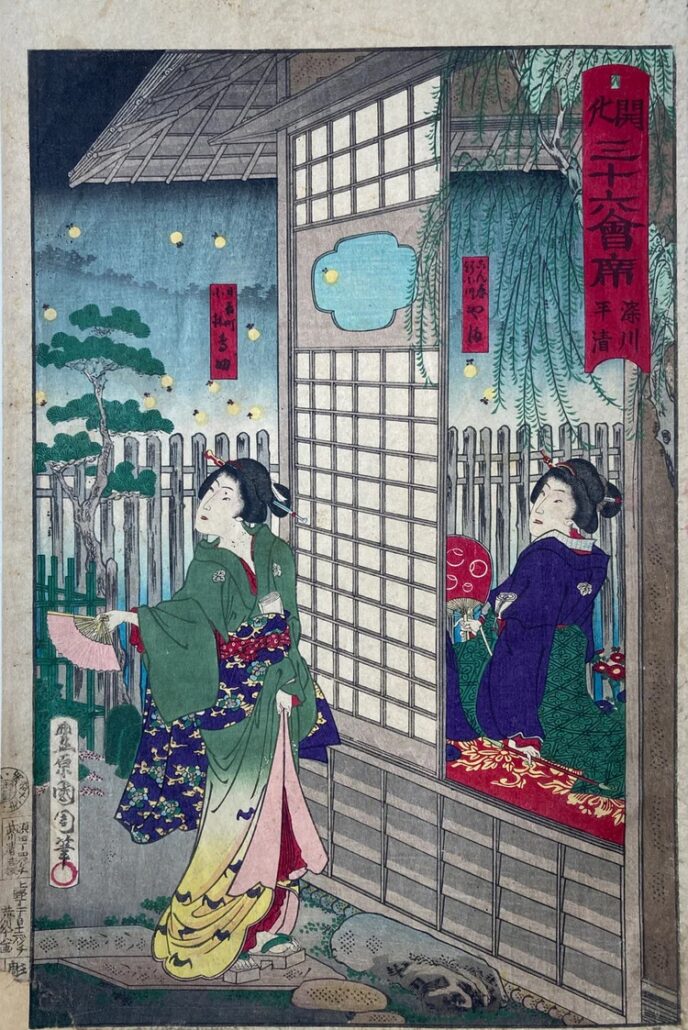
Top Edo ryoteis spared no expense in crafting the perfect ambience because traditional Japanese cuisine (washoku) seeks to not only present exceptional flavours, but also elicit one’s aesthetic sensibility. At the core of that is shun, or seasonality. Every detail, from the choice of ingredients and cooking methods, down to the presentation of the food items and the serving ware, must honour the rhythms of nature. Spatial arrangement is an extension of the philosophy to appeal to diners, as shown in the print about the highly acclaimed restaurant Hirasei.
“I think it is really beautiful, with the women outside looking at the fireflies. It shows you how these restaurant rooms were constructed so that you could slide the screen doors open and enjoy the garden outside. I think that was an important part of the dining experience,” Parr said.
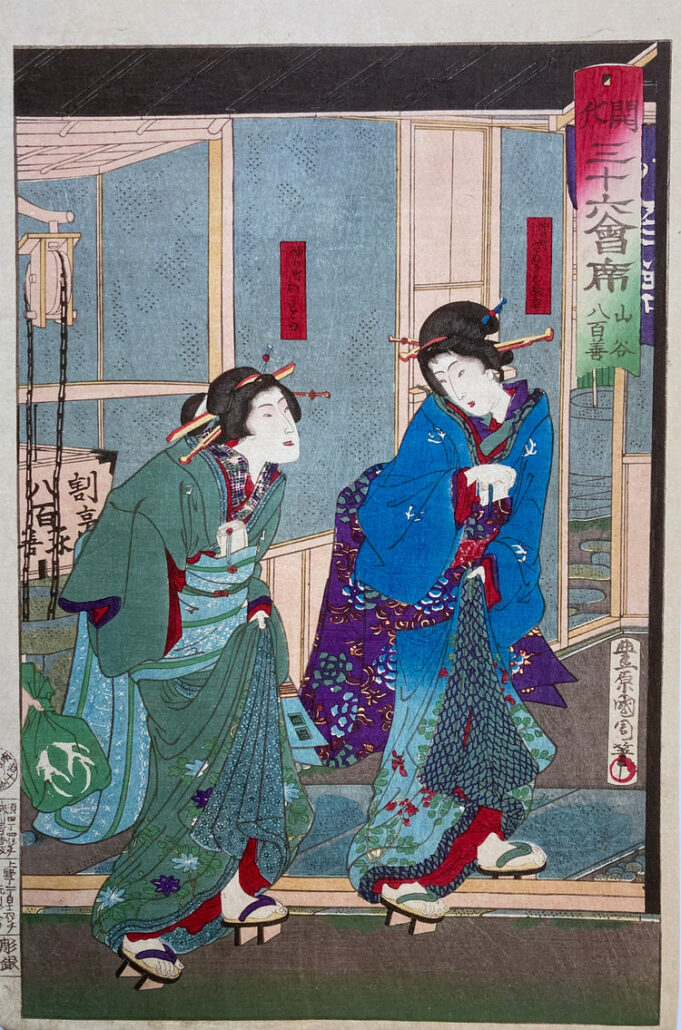
The intense competition among the culinary powerhouses in the late nineteenth century was comparable to that of the warlords in the Sengoku period. If great cooking alone was not enough to stand out, Yaozen, another establishment featured in Thirty-six Modern Restaurants, consolidated its reputation by devising various marketing tactics. From gift vouchers to books with detailed descriptions and illustrations glorying its ultra-expensive chazuke and other seasonal specialities – cue the glossy monographs of Nobu and The French Laundry – the restaurant’s exploits were so successful that it remains active in the gastronomic industry in Japan to this date.
In fact, the very prints by Kunichika were a concerted advertising campaign between the publisher and participating eateries. Parr explained:
“The publisher determined it would be a good idea to do a series of prints on restaurants, and they solicited the restaurants to be part of it. They would say, ‘Hey, we’ve got the most popular artist.’ And Kunichika’s name attached to it would be attractive to the restaurant owner”.
The artist studied all his subjects attentively. In addition, he was a well-documented epicure and partygoer. That innate knowledge was all he needed to recreate the opulent atmosphere of all the dining venues.
To further enhance the artworks’ appeal, many of the figures were local celebrities, their names captioned in red directly above. Through them, we get a glimpse of the gourmands’ perspective, and Kunichika made sure he let his audience in on every moment of it. Many entries in the series convey a sense of intimacy. Most ryoteis were designed with separate dining rooms for individual groups, and that allowed their patrons to lounge around, take in the scenery, eat and mingle without reservation. It is a luxury to be completely at ease in Edo, where strict social codes were enforced in public spaces.
The small door frame of Tomoeya suggests a clear delineation between the two domains. Once the festivity came to an end, one had to keep their body in check and their debauched facial expression hidden again. Firm believers of “living in the present”, the hedonists of Edo would take any amount of pleasure they could get. What made them most anxious was missing out on the fun.
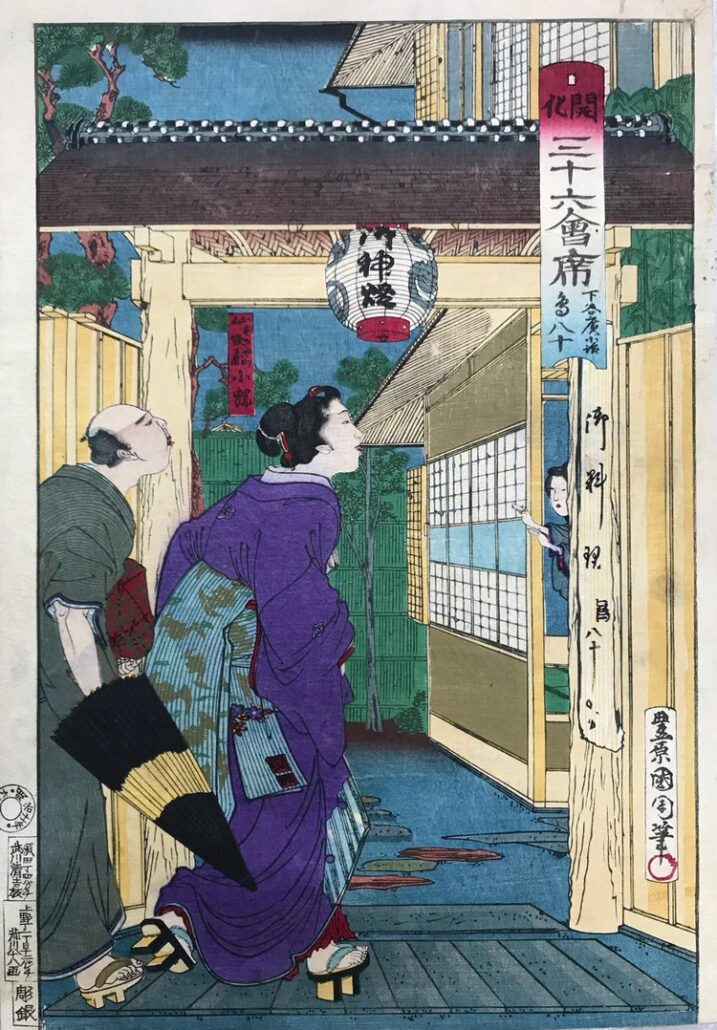
“This couple right here is one of my favourites in this series. You can see the man is carrying the bag and the umbrella and they’re definitely running,” Parr spoke of the pair rushing to the kaiseki eatery Toriyaso. Imagine getting denied at the door after all the effort to secure seats at a Michelin-starred restaurant on your bucket list, just because you are running late.
The word “modern” in the series title is also indicative of the social changes taking place in Japan during the second half of the nineteenth century. The country, under western pressure, lifted its ban on foreign arrivals after two centuries. The influx of European diplomats and businessmen forged relations with local elites and brought their ways of living to cosmopolitan Edo, influencing the discourse of high culture there.
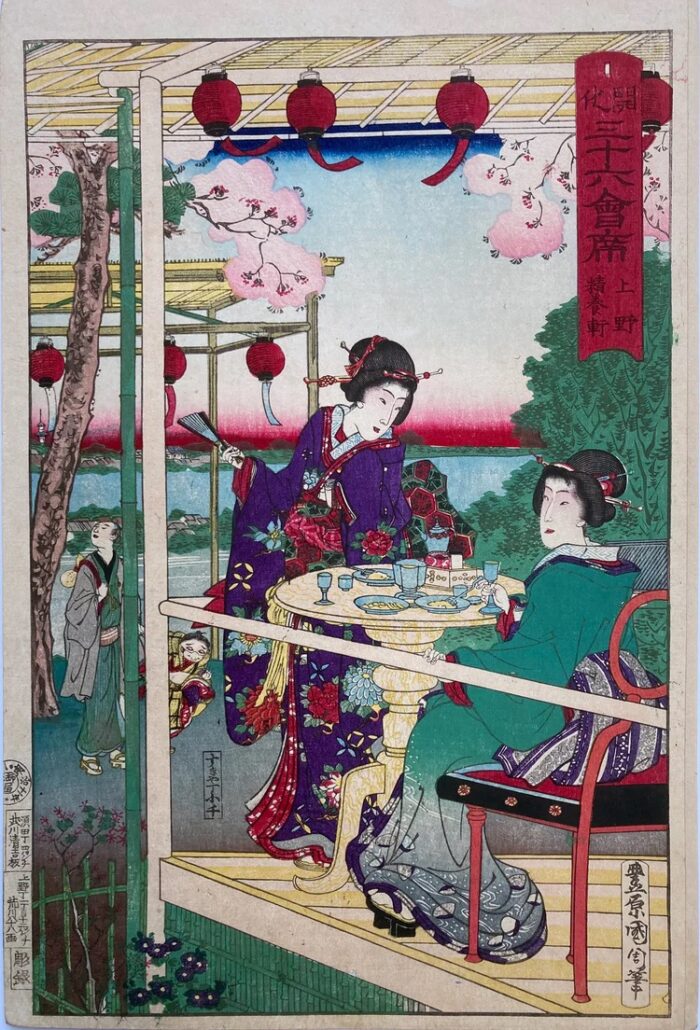
Yoshoku restaurants serving western cuisine were one of the cultural icons supporting this narrative of modernity. Among the most hyped was Seiyoken, known for its beef in demi-glace sauce and still standing at its original site by the idyllic Shinobazu Pond a century and a half later. Kunichika made a point of highlighting its novelty. Food aside (Japanese cuisine had been largely pescatarian for over a thousand years), it introduced a distinct dining etiquette that contested the supremacy of traditional ryoteis.
“There’s a lot going on in this centre image. You’ve got the western style table and western plates. In the distance, you can see this man and this little child walking. The child has a mask and is enjoying the gardens. It’s just a very interesting snapshot,” Parr noted.
He added that the series was never reprinted, meaning the theme did not reach the popularity of those of landscape or beautiful women. Still, from ryotei patrons seeking a memento of their outings, to workers aspiring for a better life, to 21st-century foodies born some generations too late, we all have Kunichika to thank for the chance to step imaginarily into that floating world where visual, gustatory and emotional pleasures overlapped.