August in Athens is murder. I want to kill somebody.
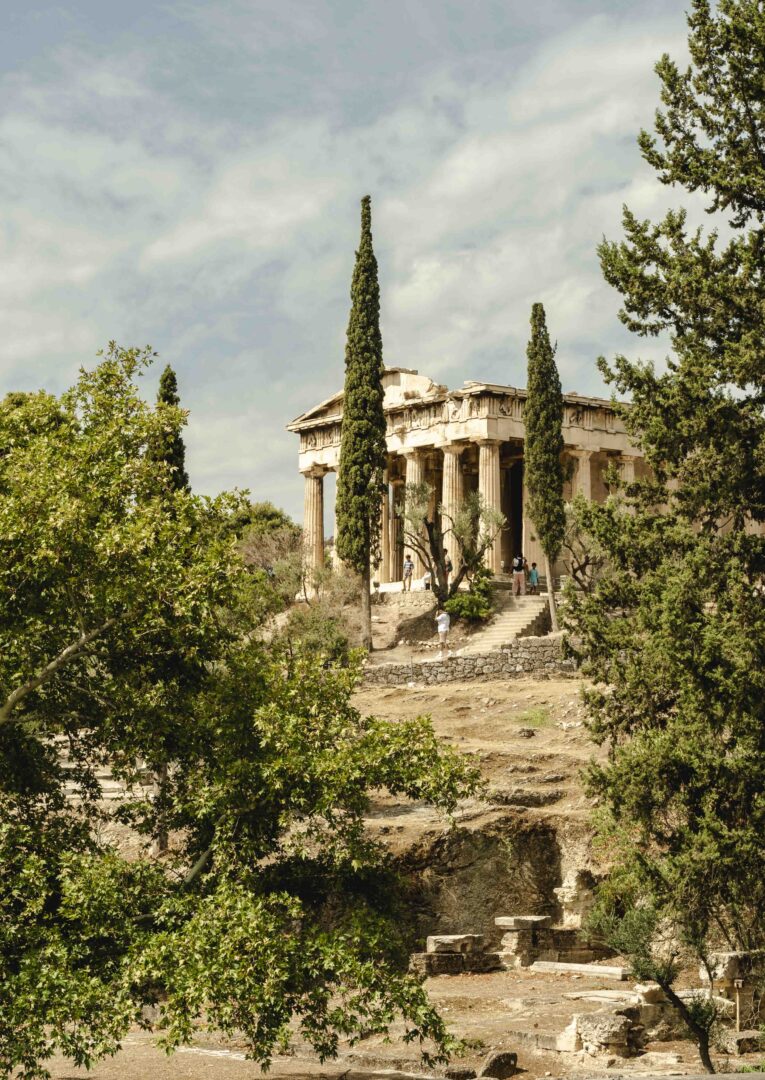
Even at the ungodly hour of 8:30 AM, the sun god Helios is burning down mercilessly upon the tourist hordes already swarming the Acropolis. The new normal of killer heat waves in southern Europe is yet another price we are paying for the crimes we commit against our planet.
The focus of this Cook_inc. issue is culinary crime, and I seem to have come to the right place. Greece is, after all, the home of retsina. Retsina nearly caused a diplomatic crisis when it was served to an envoy to Constantinople in 968. Even the Romans stopped slathering wine amphorae with pine resin once they discovered how to make wooden wine barrels somewhere around the third century AD. It’s incredible that after 2,000 years of oenological innovation, some Greeks still like their wine with a whiff of turpentine.
The world’s first known cookbook author, Mithaecus, was run out of Sparta for being a bad moral influence and eventually made his way to Athens. He had the temerity to introduce the excesses of Sicilian gastronomy to the Greeks. Judging from the only recipe that survives from his cookbook, he deserves his reputation as a culinary criminal:
“Take a taina (cepola bandfish), chop off the head, gut and rinse it; slice, add cheese and olive oil.” Only a miscreant would add cheese to fish, let alone raw fish. If the fish was meant to be cooked, that minor detail was left out of the recipe. Either way, Mithaecus was a punk.
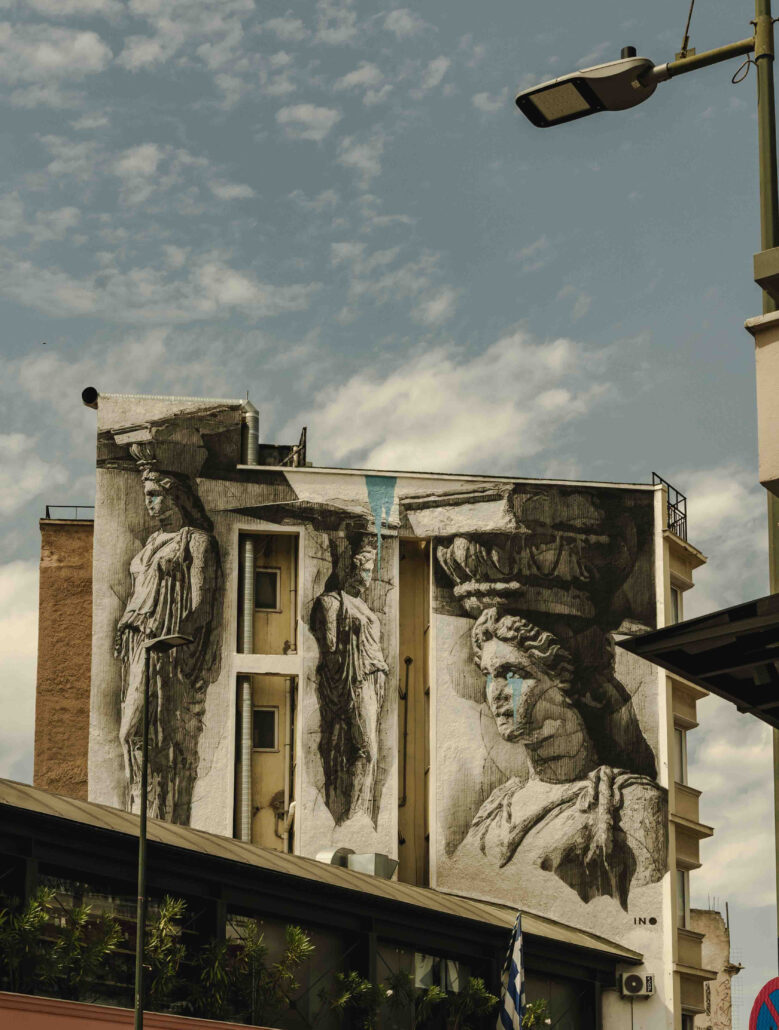
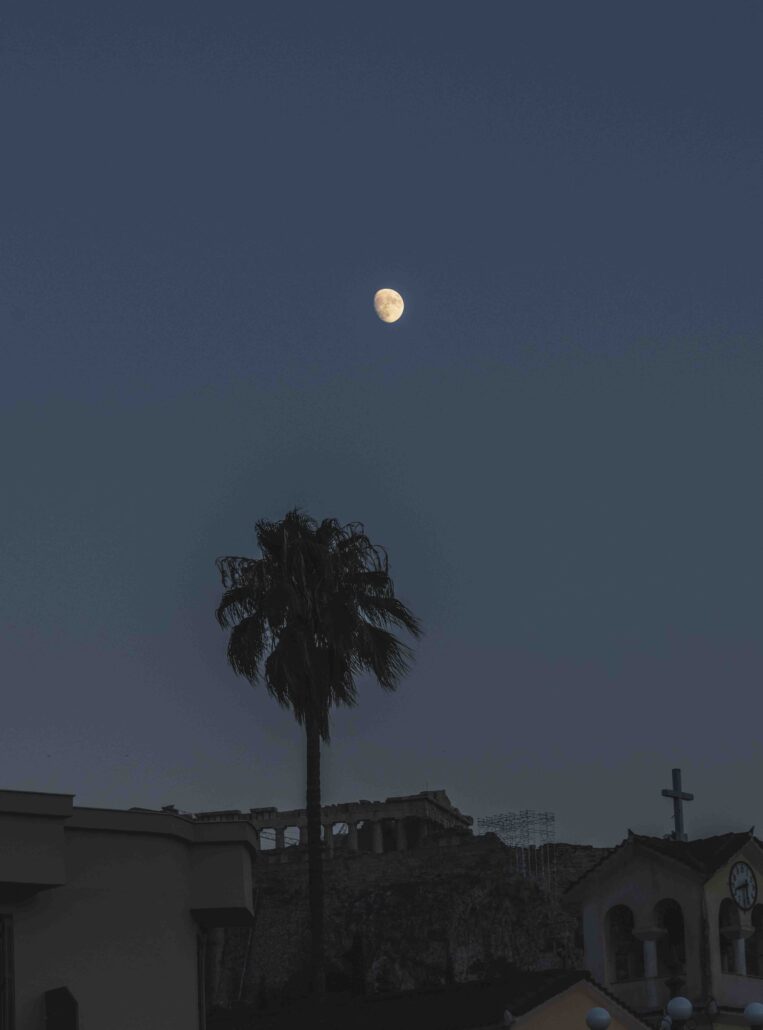
Athens in August is empty except for tourists and those who feed on them.
The current situation is a depressing inversion of August in Athens in antiquity: In the 5th century BCE, while Mithaecus was busy corrupting the populace with culinary decadence, the great Panathenaea festival was held in summer. The Acropolis would have been swarming with Athenian citizens partying at the newly built Parthenon, sumptuously decorated with sculptures depicting those very same festival celebrations.
Two thousand four hundred and fifty years later, there is nary an Athenian citizen in sight. Everybody has gone on holiday, abandoning the Acropolis to be overrun by tourists. Neither are there any sculptures left on the once-ornate marble facades. A few are on display in the nearby Acropolis Museum, but the majority have been destroyed or carried off to foreign shores. The scandal of how the Parthenon lost its marbles to British diplomat Lord Elgin is still considered by many to be a cultural crime of epic proportions, inspiring the poet Lord Byron to write:
Dull is the eye that will not weep to see
Thy walls defaced, thy mouldering shrines removed
By British hands-Childe Harold’s Pilgrimage (1812)
The ruins of the Parthenon have been further violated by the indignities of mass tourism, reducing the epitome of classical Greek architecture to a travel meme. Like the Mona Lisa or the Sistine Chapel, whatever cultural value the Parthenon might intrinsically have is impossible to appreciate while jammed among thousands of tourists in 39°C heat. The selfie is the only artifact people care about these days.
Mass tourism is the death of beauty.
Even renowned American author Henry Miller recounts in his Greek travel memoir, The Colossus of Maroussi, that he gave up touring the Acropolis in 1939: “You feel stripped and plundered, almost annihilated….When we got to the Acropolis–it was an insane idea to go there immediately–there were already several hundred people storming the gates.” He went to look for ice cream and shade instead. Henry Miller would be appalled to hear that there is now a daily visitor limit of 20,000 to the Acropolis.
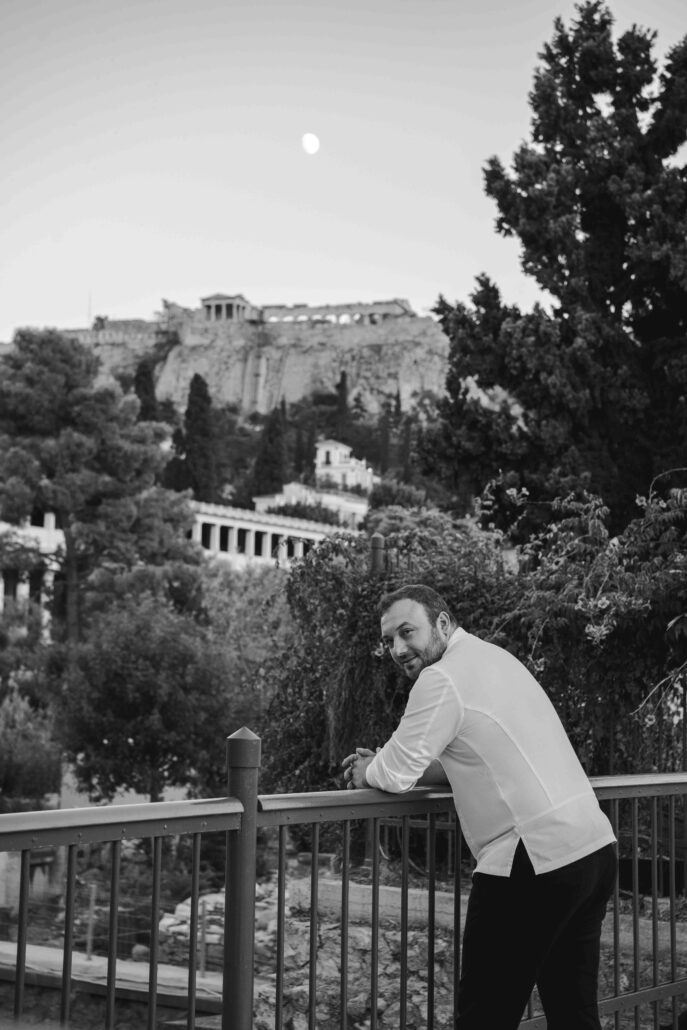
But today I am not a tourist, only indistinguishable from one. We are here on assignment to get the lowdown on Petros Dimas, the 37-year-old chef of Restaurant Makris, located right at the foot of the Acropolis. Makris is the newest restaurant in Athens to have won a Michelin star.
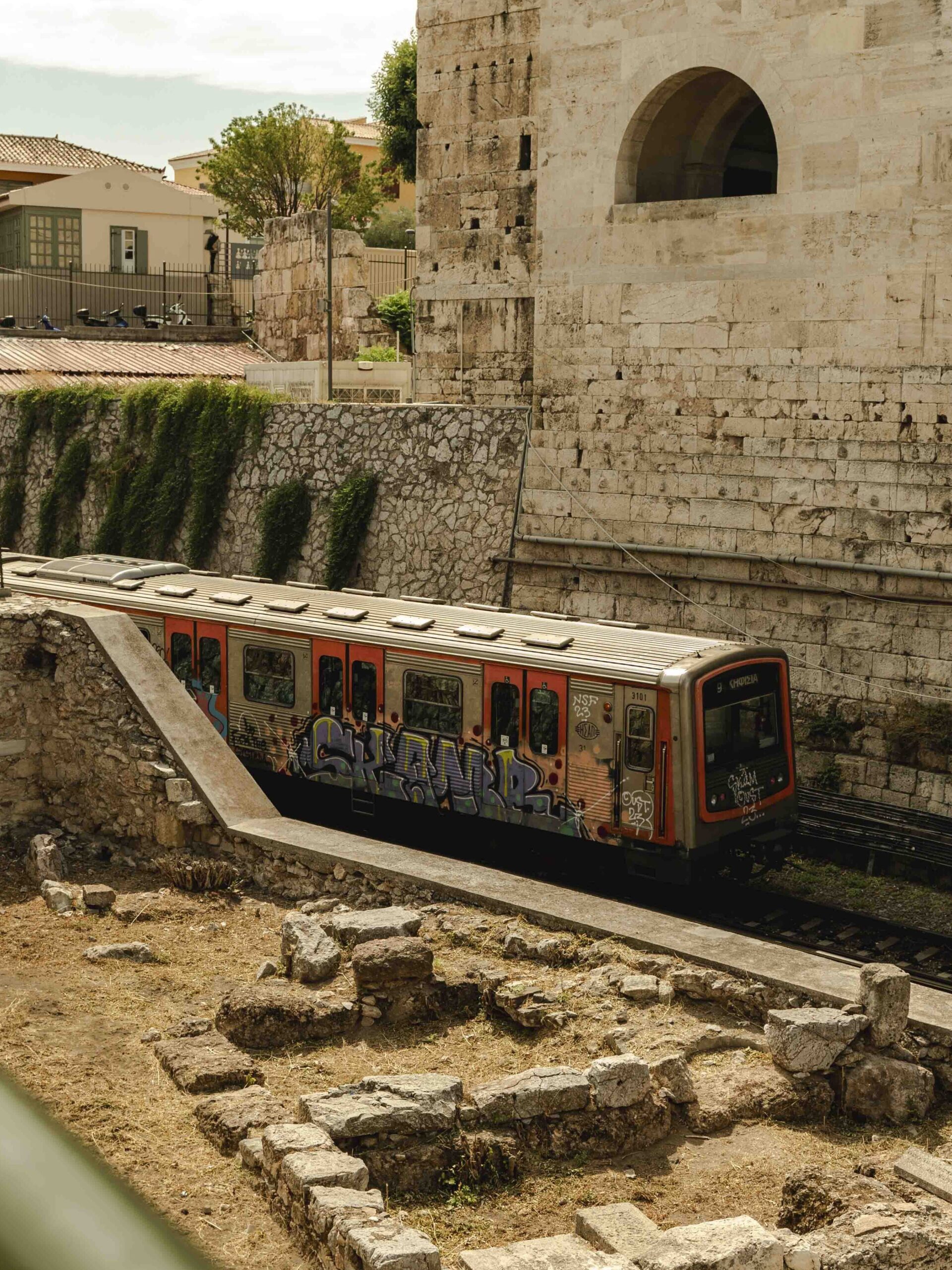
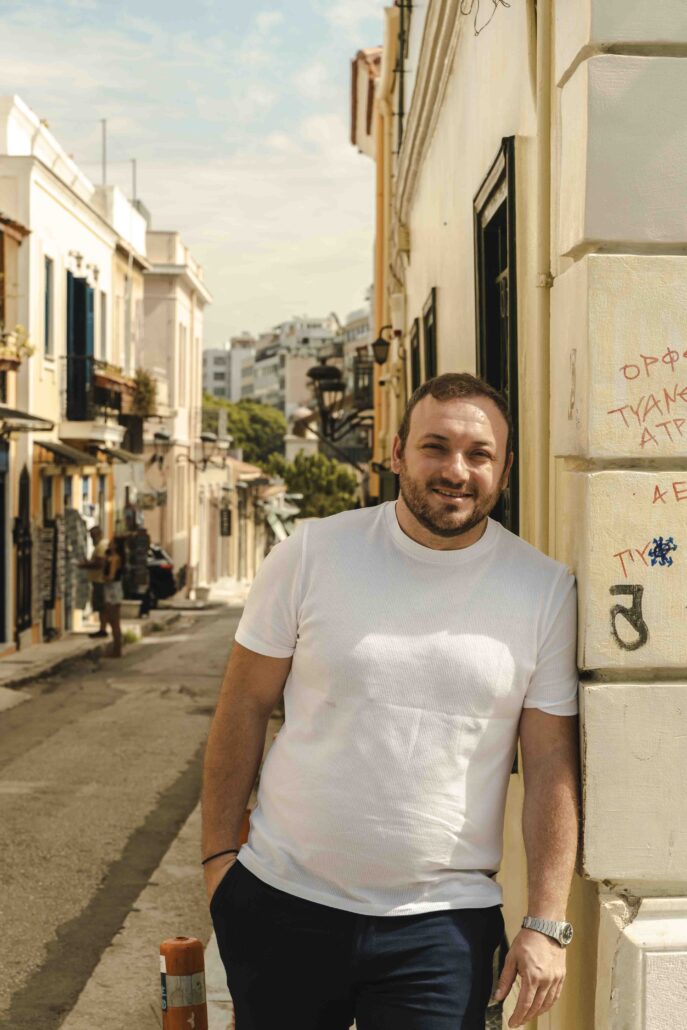
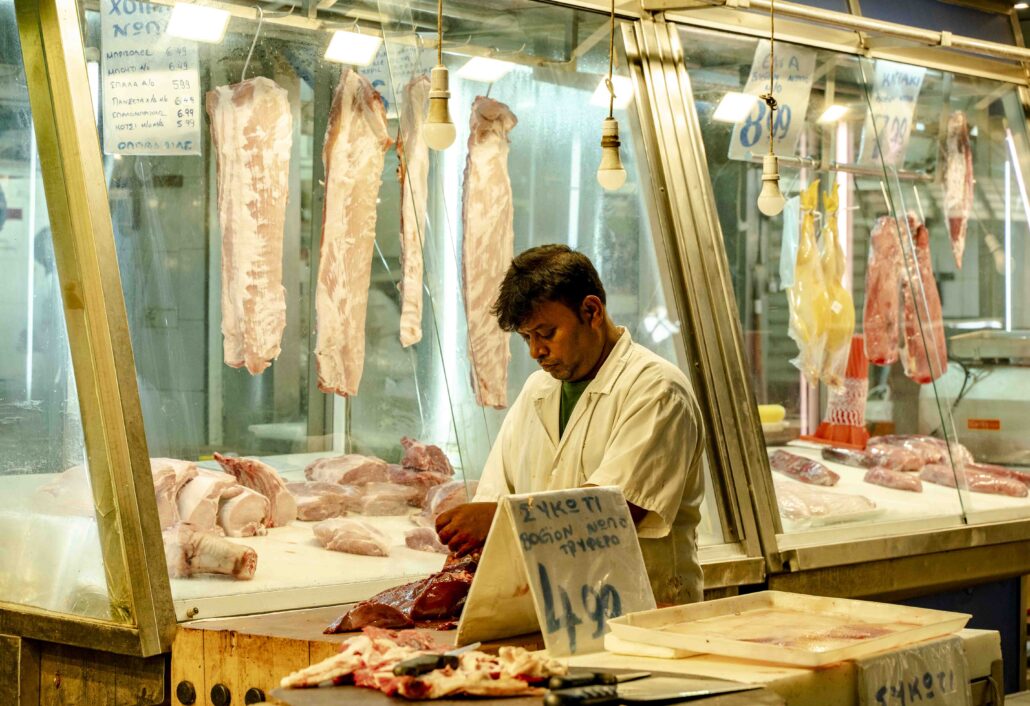
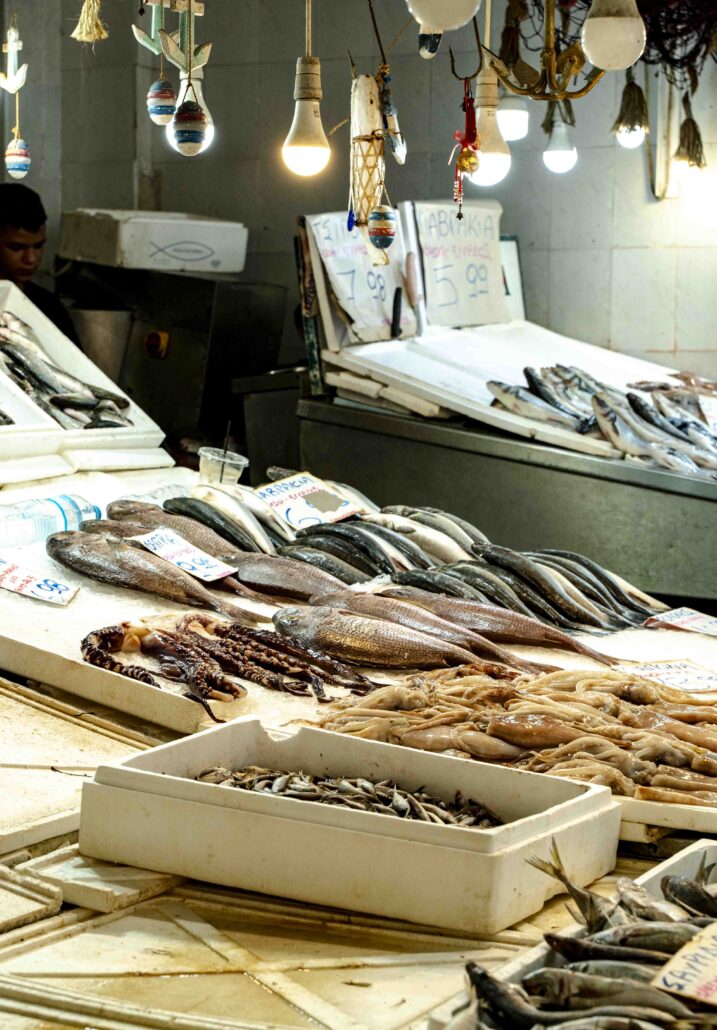
Chef Dimas is in fact an actual local, which sounds about as real as a modern-day Hydra or a centaur. He grew up in a modest house literally 450 meters from Makris, and he is showing us his favorite spots in the ´hood. It’s like meeting someone who grew up in Times Square or Venice’s Grand Canal. He points out where he played football in the Ancient Agora as a kid, the Varvakios food market (picturesque but rather forlorn in August, and I suspect he never goes there except with visitors), and his favorite spot to contemplate the Parthenon, watching the graffiti-covered trains rumbling through the ruins. It was always touristy, he says, but it is home.
In fact, we look so much like tourists than an enterprising young man comes up to my photographer colleague Eleonora while she is shooting street portraits of Chef Dimas in the ruins and propositions her to take glamor shots of him instead. “Hey, how much do you charge? I thought it might be dope to hire a photographer to go around Athens taking pictures of me…” Can’t blame the guy for trying to glow up his socials or his social life, but sorry, dude. Not happening.
In fact, I myself am even worse than a tourist. As a food and travel journalist, I am acutely aware of my own complicity in contributing to the problems created by gastro tourism. Guilty as charged.
Guidebooks, magazines, best restaurant lists, Netflix chef shows, Instagram virality: it’s a slick PR ecosystem that incites mass pilgrimages in pursuit of unattainable temples of gastronomy. And very few mortal chefs can live up to hyped expectations.
Prestige dining is the death of taste.
My mood continues to sink as we finally locate Restaurant Makris in a strip of tourist shops and restaurants crammed on the pedestrian path between the Museum of Illusions and the ruins of Hadrian’s Library. The only feature distinguishing it from the cheap tourist traps is that instead of a laminated photo menu in multiple languages displayed out front, Makris has a newly minted Michelin star pinned up beside the door. Thank God for Michelin.
Inside the restaurant, it becomes immediately obvious why Chef Petros Dimas and Domes Resorts CEO Dr. George Spanos decided to open their flagship Makris restaurant in this location despite being a 30-minute drive from the spectacular Domes glamping beach/tennis resort 91 Athens Riviera on the coast. The rooftop terrace offers VIP views of the Acropolis, while the tables in the lower ground floor float over even more ruins, as ancient as any in the Agora. Makris offers its clients the opportunity to dine on contemporary Greek cuisine with the ancient gods or ghosts in luxury.
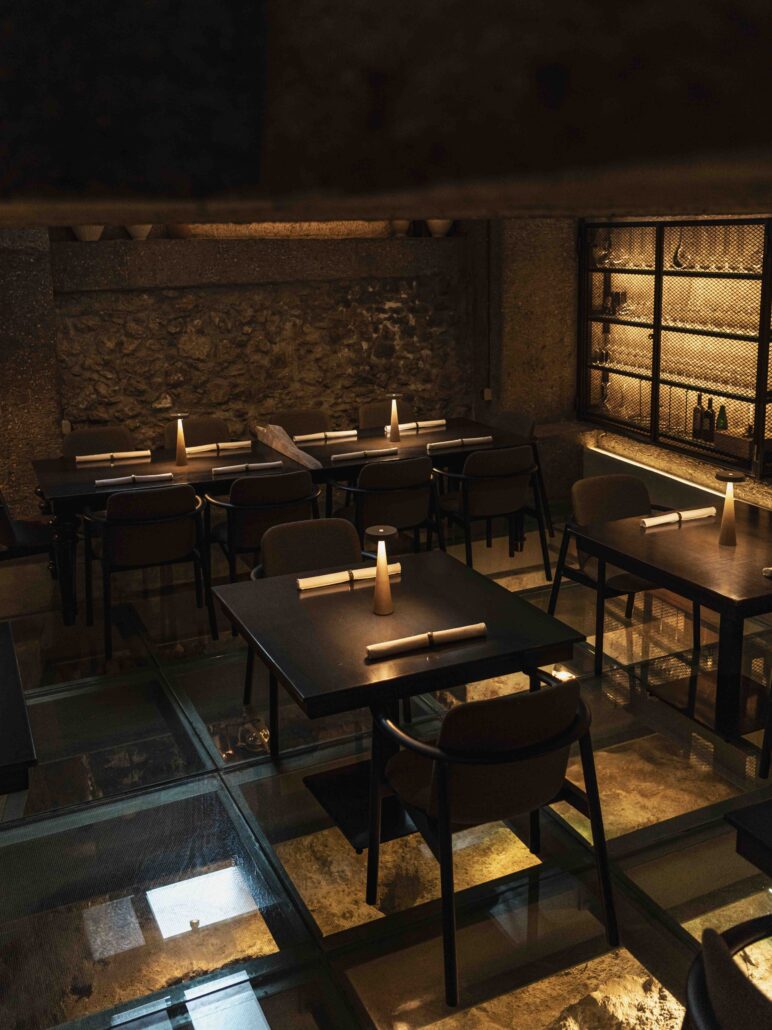
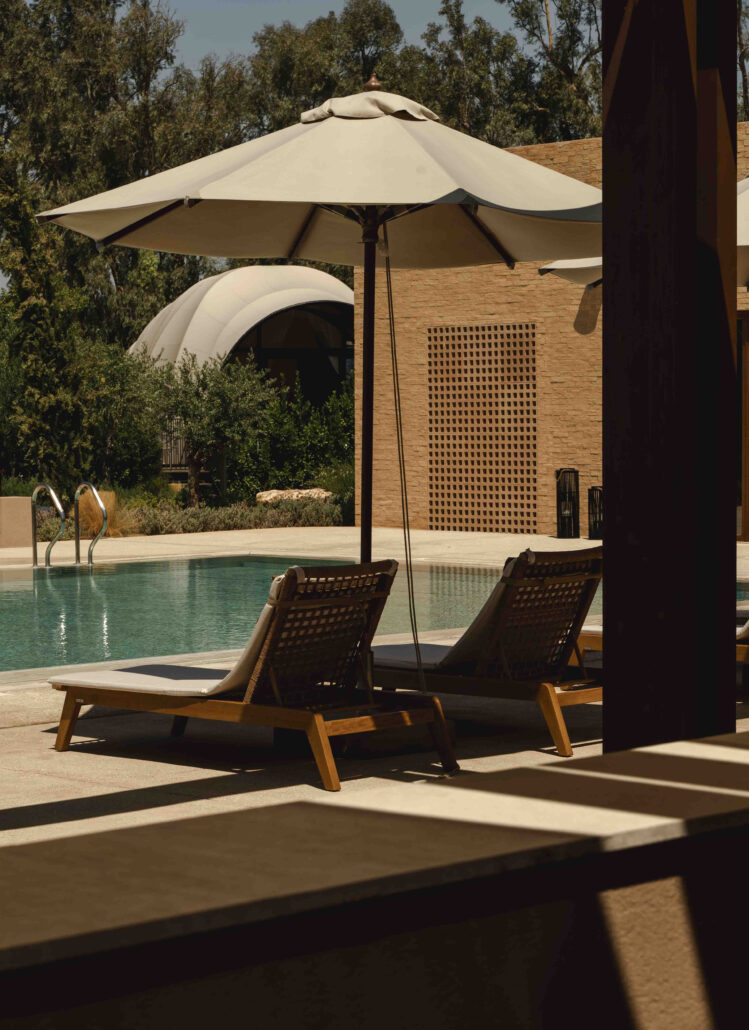
We are seated in splendid solitude in the entry level, which provides an excellent view of the other diners making their way upstairs. Most look fresh from the airport lounge, as the Domes Resorts group prides itself on providing “memorable, inspiring experiences to cosmopolitan explorers.” Funny that when tourists have high disposable income, they become by default more sophisticated. The Domes universe is created for the 1%, what it calls the “LuxLeisure Nomads, the GlamVenturers.”
Scanning the menu, printed on recycled ocean blooms and presented in eco-conscious recycled leather folders, I read the Makris philosophy: sustainability, local producers, seasonal farm-to-table produce, creative Greek dishes that combine tradition with modern technique, yadda yadda.
At first, my cynical and heat-exhausted eye sees nothing but fine dining clichés for cosmopolitan explorers. Many tasting menus offer a luxurious supplement of a course or two, but the Makris menu is literally scored with red as just about every course can, at extra cost, be “upgraded” with lobster, duck, wagyu, and caviar add-ons.
Despite the declarations of showcasing proud Greek culinary identity, I see the telltale fingerprints of safe international dishes (what used to be called “Continental Cuisine” by tourist boards) with corporate scalability. “Look, this is a business, and we have to survive,” says the defense.
Also, after hearing Chef Dimas literally ranting about the capital crime of serving brioche in Greek restaurants, I am shocked to see that one of his signature dishes is a mushroom soup cappucino served with a flaky mini brioche topped with truffle slices. It is excellent, but IT IS A BRIOCHE IN A GREEK RESTAURANT.
Chef Dimas, you hereby stand accused of culinary hypocrisy. How do you plead?
When I confront the waiter with high crimes and misdemeanors, he stammers that “it isn’t a real brioche, it is a brioche feuilletée, kind of like a mix of a brioche and a croissant.” It’s as if noma’s breaking the hegemony of French cuisine in fine dining never happened.
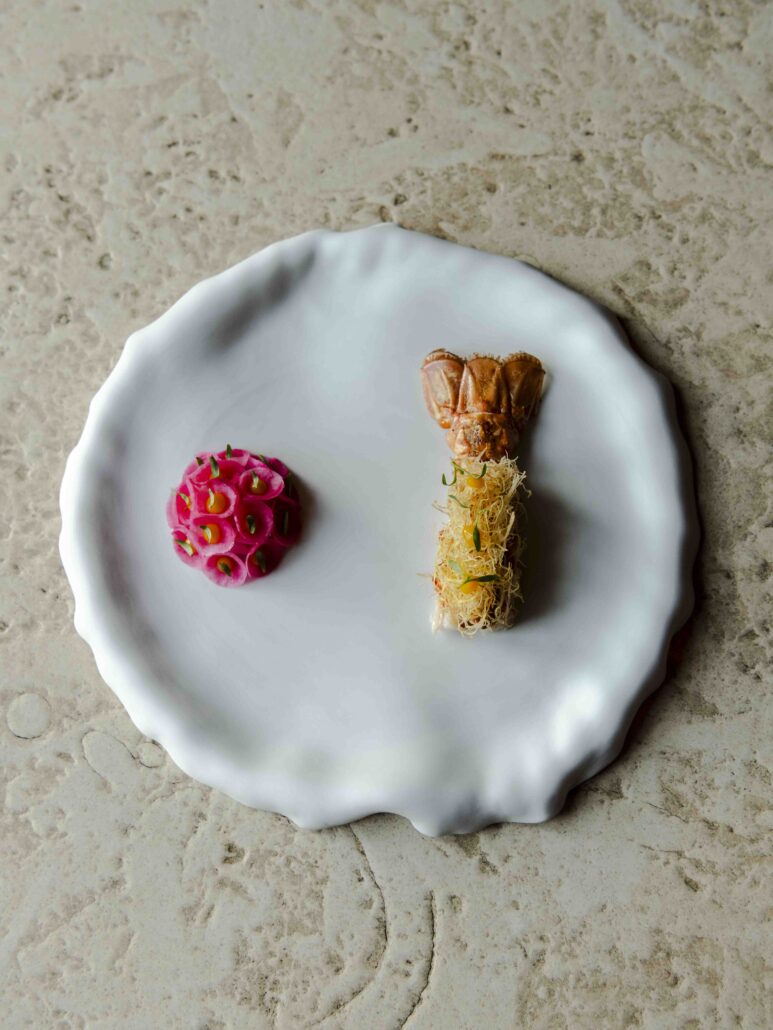
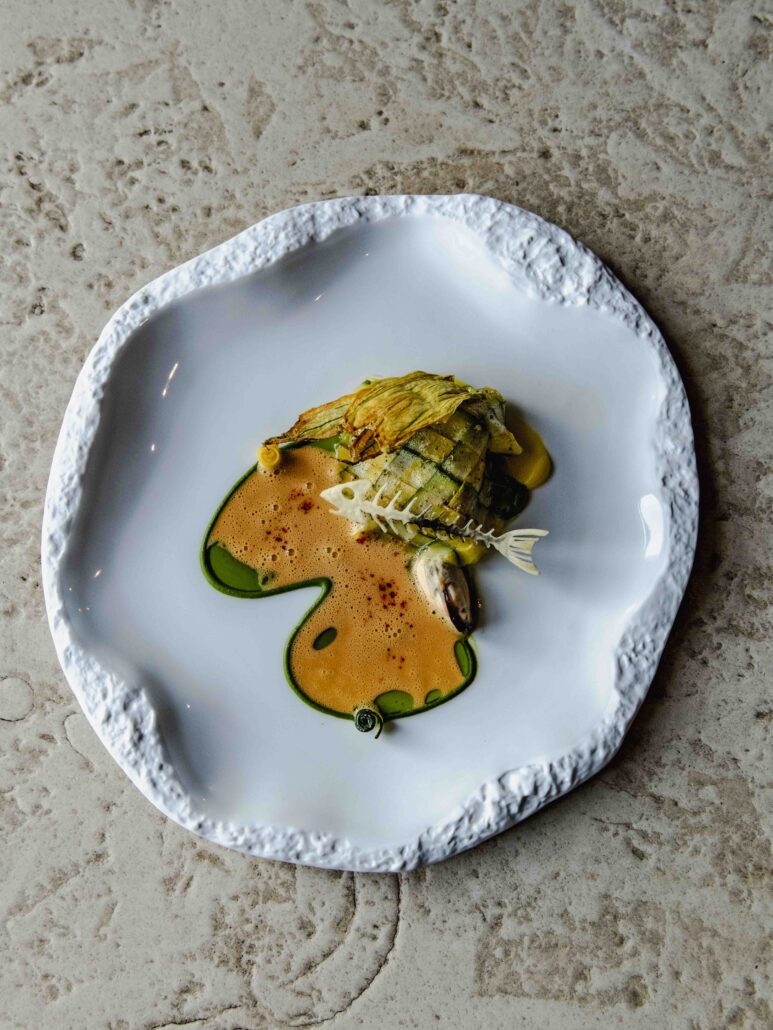
But, oddly, I started to have a change of heart when two baroque and overly elaborate seafood courses came. The first was a ceramic coral reef populated by octopus, crab, and smoked eel tartlets stuffed with tiny cutouts of crabs and octopi, then a dry-aged red snapper fillet draped under a tapestry of woven zucchini ribbons on painterly puddles of multicolored sauces and topped with a fishbone tuile fashioned out of zucchini blossoms. They looked like a throwback to the architectural decadence of dishes served at Sirio Maccioni’s Le Cirque in 1990s Manhattan or Vegas. Mithaecus would have approved.
But maybe there were mitigating circumstances, and I should not be so quick to judge. I realized that Chef Dimas was doing his best to achieve a Platonic ideal of a fine dining restaurant that he had heard about but nobody has ever actually experienced, and an ideal that might be different for each of us.
And, as his Michelin star recognition in Makris’ first year and high ratings on Google and TripAdvisor reflect, he is doing a good job of making sure the majority of his clients leave happy. He knows most of his clients are out-of-town visitors, and it is no crime to try to meet their expectations of experiencing Greek flavors in a familiar vernacular.
Just as it is not the Parthenon’s fault that it is filled with tourists, neither is Makris to blame for the fact that its enviable Acropolis views and Michelin prestige might be as important a draw to some people as the food. In fact, given the enormous handicap for a restaurant to not have demanding regulars to keep it on its toes, it’s laudable that Makris is as good as it is.
Neither is it surprising that Makris is more of a trend follower than a trend setter. Even though the ancient Greeks used garum (γάρον gáron) in everything, Chef Dimas had never heard of it until noma started using it. Greeks are reencountering their own heritage by way of Copenhagen.
Chef Dimas comes from a humble home. He did not grow up going out to fancy restaurants, and even his own mother is too timid to come dine in her son’s posh temple to Greek cuisine. His father has come to eat once, right after the Michelin star came.
In fact, Chef Dimas himself only landed in the world of fine dining by mere chance. As a boy, he taught himself to cook by feeding his baby sister. He read cookbook recipes and made dishes if ingredients – and electricity – were available. At nineteen, in the depths of the 2008 financial crisis, he was about to accept a 3 euro-per-hour job making pizzas when the phone rang at 9:00 one morning to offer him a tryout that afternoon as a line cook in a fine dining establishment called Hytris. As it happens, Hytris was located about 50m from the current Makris.
The first few hours of the trial did not go well, as the young Petros Dimas had never seen this kind of food before and was confused by all the talk of foams, gels, and Michelin stars. One can only imagine the culinary crimes then being committed in kitchens all around the world in the attempt to emulate the cuisine of El Bulli.
After a talking-to from the chef, Petros Dimas saw that he needed to make a better impression if he was going to land this 700-euro-per-month job (which isn’t too different from 3 euros an hour, actually). He buckled down for the last half of service, and he impressed the chef with his speed and ability to learn. He was hired, and the rest is history.
Finally, as a boy who vividly remembers the taste of home – of a freshly sliced tomato and his grandmother’s pancakes with his grandfather’s homemade goat cheese and honey – Chef Dimas has a deep respect for Greek ingredients. As I took a closer look at Makris, every detail told a story.
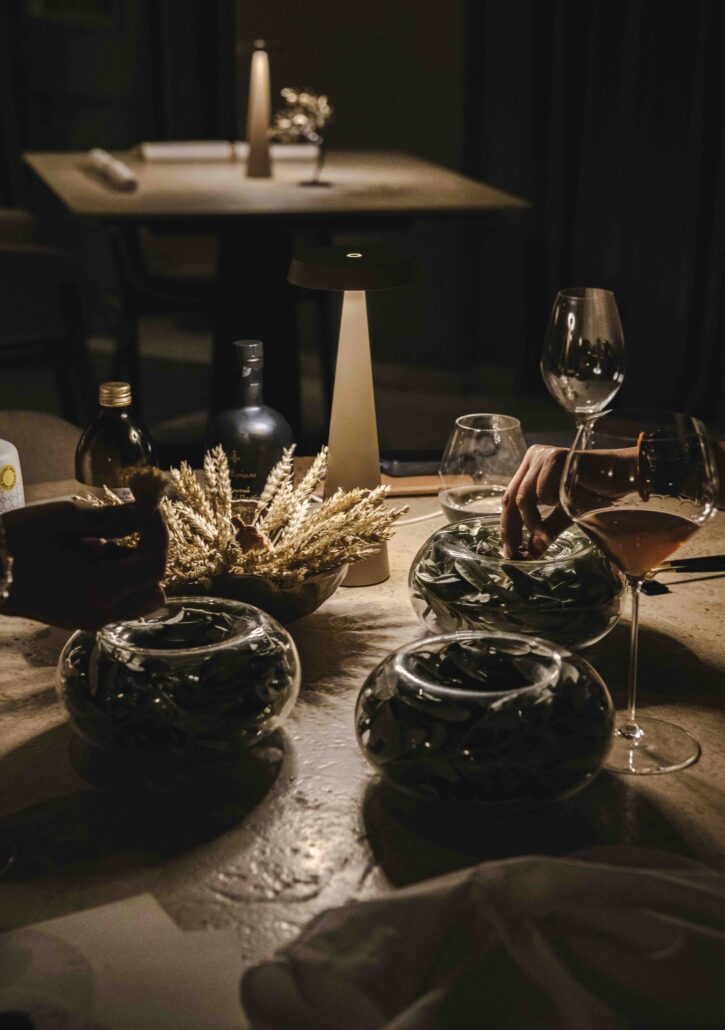
The heart of the Makris menu is not the brioche, but the real bread course: a sturdy loaf of hearty brown bread made from his mother’s 14-year-old sourdough starter and Zἑa (emmer or dicoccum wheat) an ancient grain similar to spelt, consumed by Alexander the Great, and one of the oldest cereals in the world. With the bread, we are offered cultured cow’s milk butter and a choice of artisanal olive oils. Cow’s milk butter, it turns out, is another Frenchy rarity in Greece, which is sheep and goat country. Chef Dimas has to get it from Corfu.
But the real treasure is the olive oil menu, presented on a board made by the Liofyllo women’s cooperative in Patra from upcycled olive tree trimmings. By showcasing their work, Makris supports their message of sustainability and female empowerment.
The olive oil poured into a glass bowl filled with fresh olive leaves is a fragrant, somewhat bitter elixir called Mikra Agia Anna “Of the Desert.” It is made by monks living in an impossibly remote 400-year-old monastery perched on the craggy heights of the holy mountain Athos. The monks fetch water from a spring and tend to the olive trees, picking the fruit by hand and hauling it in sacks on their backs until they can load it onto mules to carry it the rest of the way to the olive press.
The olive tree was Athena’s gift to Athens, and dipping this bread in this olive oil at the foot of the Acropolis feels like an ancient ritual.
The other standout dish of the menu is also one of the simplest: an herbal bouquet of fresh leaves and flowers from the restaurant’s farm, Greenhouse Corinth. The greens have an intense vitality that stands up to the 5 spoonfuls of vinaigrettes and sauces the over-eager server douses over it.
Up until the moment I tasted that salad, I had dismissed Makris’ farm as yet another must-have fashionable restaurant accessory, like an R&D lab or fermentation room or dry-aging chamber. I figured it was probably a meager herb garden in a back lot somewhere. After hearing so much about the farm, I start to feel that I must go there to truly understand Chef Dimas’ cuisine.
A farm visit is listed on Makris’ website as an exclusive add-on experience available to guests, but there is a catch: would-be visitors have to dine at the restaurant first, and Chef Dimas will personally determine whether to grant them a golden entry ticket.
The farm is run by his parents, the ones too shy to come to the restaurant. They are willing to host Makris guests because they love their son and will do anything to support him. It’s a big ask, especially as it is an hour’s drive away, near Corinth.
Chef Dimas gives me a calculating look. Finally, he agrees, and we all pile into a car for the long, hot drive. On the way, he points out a hill from which the invading Persian king Xerxes watched in frustration to see if the allied Greek armies would surrender – and threw a servant to his death when they didn’t. Ancient times were rough.
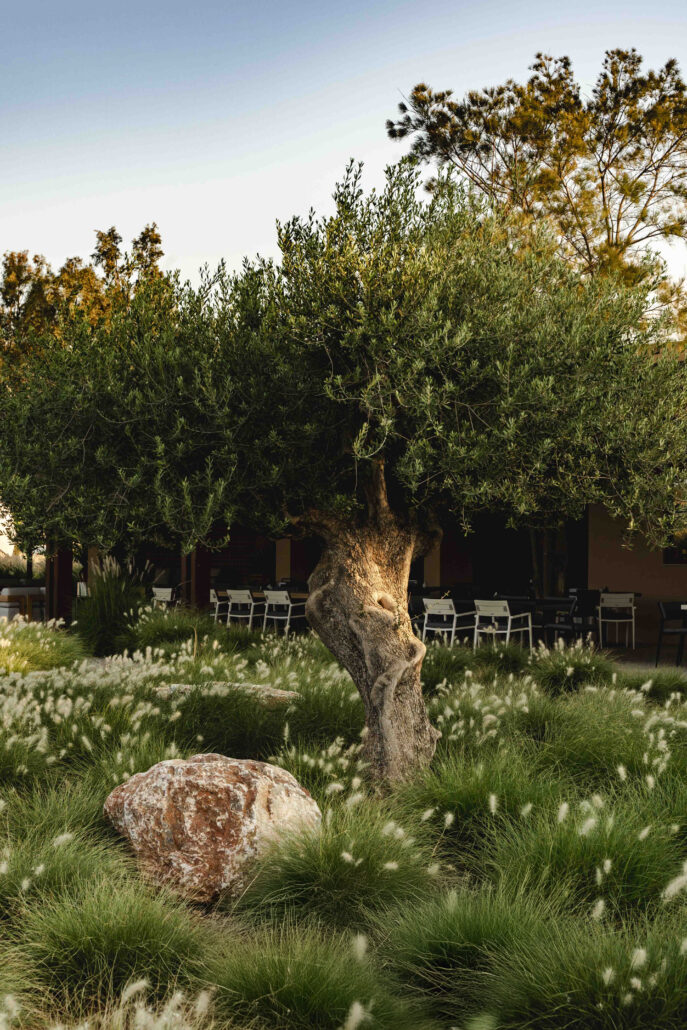
As we approach the 11-hectacre farm, Chef Dimas explains that they found the property for sale at a good price 8 years ago, and it was nothing but a rocky cliff overlooking the bay. Now they have planted nearly 500 olive trees, figs, pears, quinces, citruses, almonds, grapes, and plums. There are chickens, wild boars, and bees – an entire ecosystem.
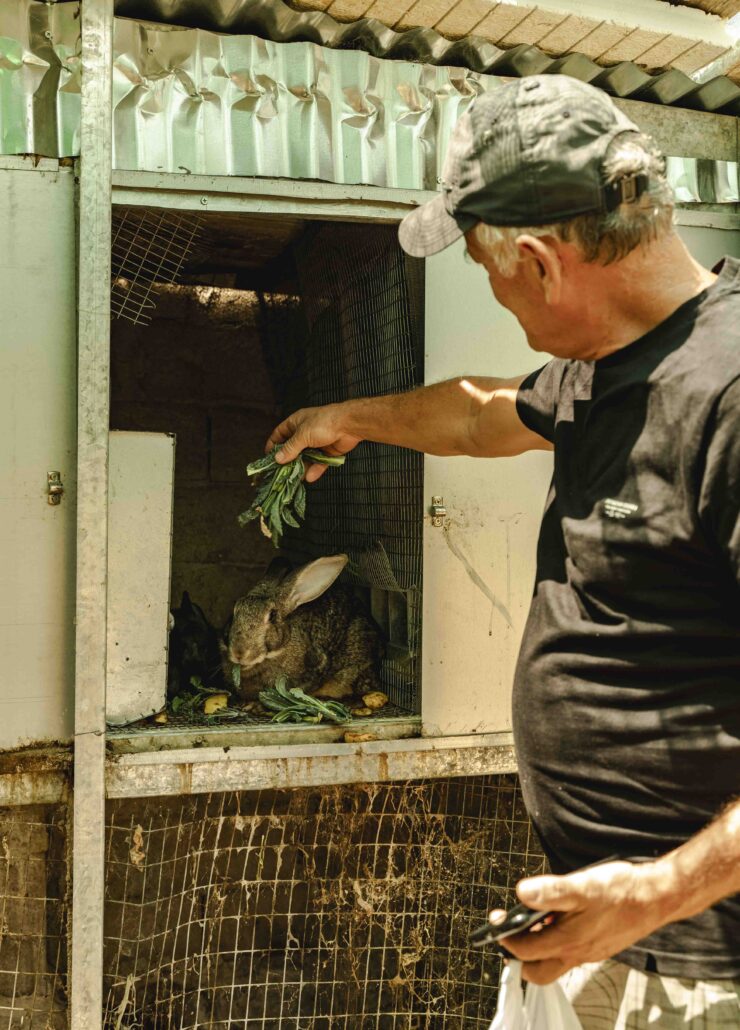
He is interrupted by the welcoming shouts of his small son and smaller daughter as they fling themselves joyfully upon their papa. Chef Dimas picks up three-year-old Amelia as his father, Napoleon, takes us immediately to feed the rabbits. Those lucky bunnies eat better kale than I can get at my local market. The makeshift greenhouse next to the rabbits is a riot of shiso, oregano, peppers and edible flowers.
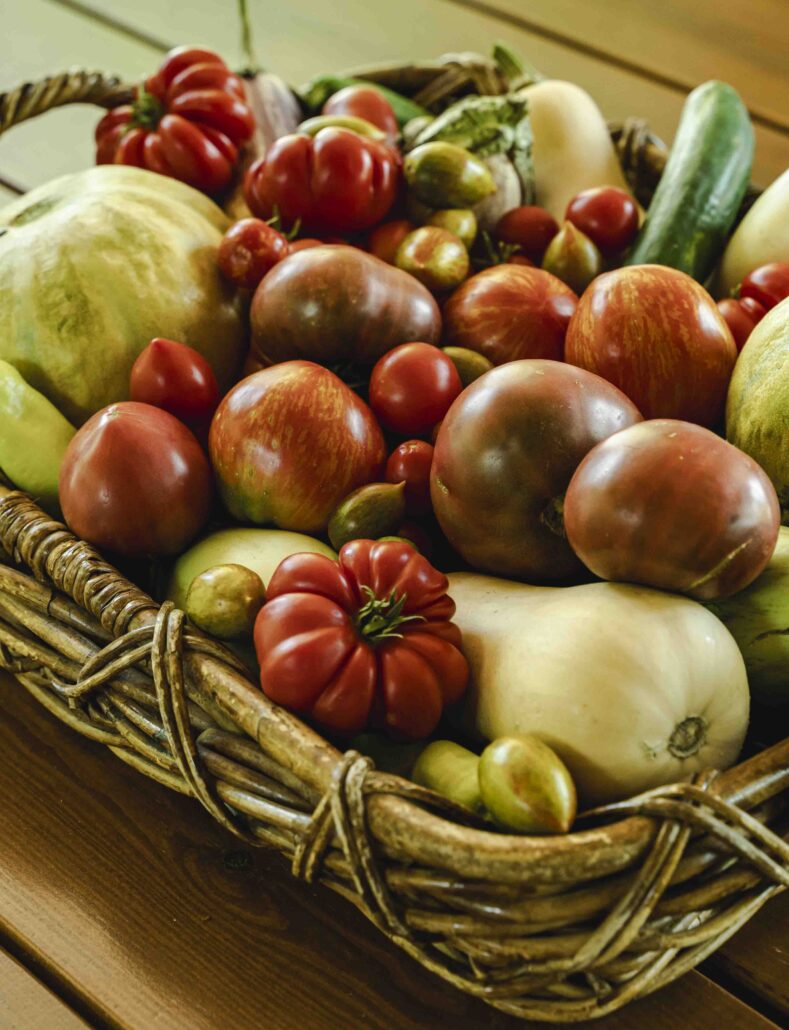
There is a long wooden table near an open fireplace that Chef’s mother, Ermioni, has set with a tall vase of garden flowers and a wide basket overflowing with more bounty from the farm: melons, several varieties of tomatoes, cucumbers, zucchini and snow-white Santorini eggplants. A prop designer could not have done a better job setting a movie scene.
Her grandson, eight-year-old Noel, carefully carries a large glass bowl of purple grapes over to the table. He has his father’s almond eyes and big-brotherly protectiveness toward his little tow-headed sister, who trots after him everywhere like a puppy. Watching them, I can picture Petros playing with his sister in that park by the Ancient Agora.
An enormous platter of succulent figs also appears. More figs, two different varieties, are drying on trays in the sun. One type, explains Napoleon, can be dried whole, while the other must be opened to prevent mold.
As we eat grapes, figs and crisp slices of cucumber sprinkled with salt, we admire the Mediterranean-blue tree house that Napoleon built for Noel’s birthday. It is guarded by a phalanx of toy dinosaurs, and the sea sparkles behind it over another sea of treetops.
We don’t speak a word in common, but this entire family is fluent in hospitality and in love and support for each other. I ask Napoleon what he thought of Makris, and he smiles. He doesn’t really understand that way of eating, he says, but he was so proud of his son. He says the visit motivated him to work harder to grow exceptional produce for the restaurant.
I also suddenly recall another gastro crime Chef Dimas listed earlier, along with serving brioche in Greek restaurants: that of the diner who comes to Makris and wants nothing but a plate of sliced tomatoes as a starter. Sitting here, sharing tomatoes warmed in the sun and sliced by the hands that grew them, I would argue that there is no greater luxury, no more glorious dish. Forget lobster, forget caviar.
Next time I go to Makris, I’m going to ask for a menu supplement of tomatoes and insist that the whole Dimas family, including Mama Ermioni, come share them with me. I hope they will do me the honor of joining me, as it won’t be as delicious otherwise. Oh, and I will also make sure next time to try the white Santorini eggplant. I’m really curious what it tastes like.
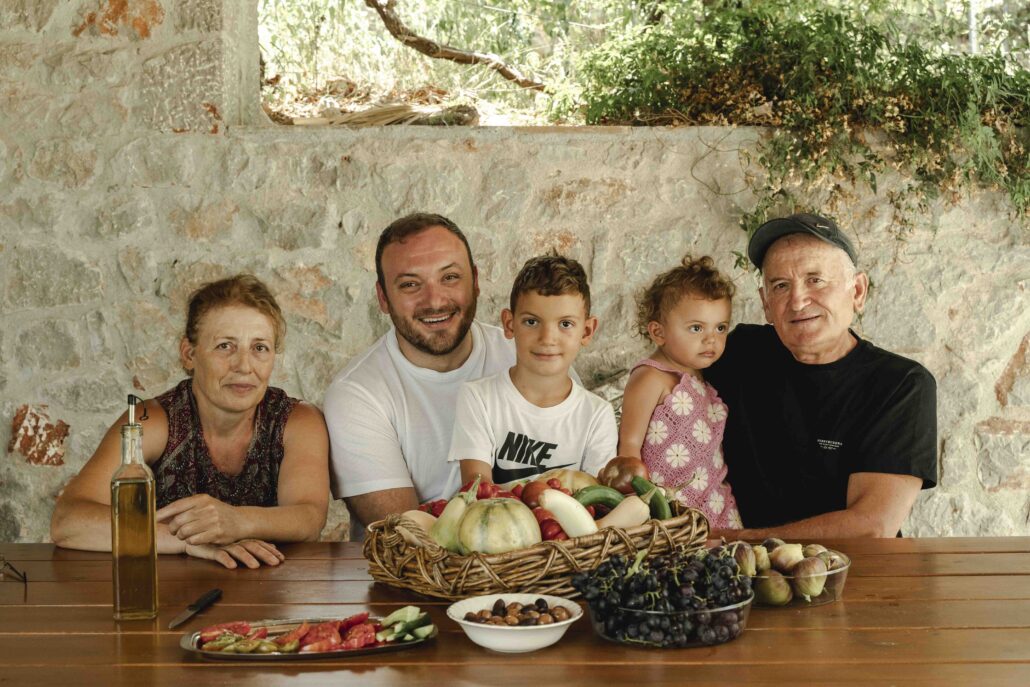
Of the seven million tourists who have come to Athens this August, I feel the most privileged. This is the finest dining there could ever be. This is what authentic connection tastes like, and this is the reason we travel.
When we arrive back in Athens, it is nearly dusk. I take one last look at the Parthenon, glowing like a guardian over Athena’s city.
Despite the ravages of time, war, and Lord Elgin, the Parthenon somehow still rises above the cultural clichés and mounds of tourist tat of Monastiraki Square as a transcendent vision of eternal beauty, and it is impossible not to recall the equally immortal lines of John Keats:
When old age shall this generation waste,
Thou shalt remain, in midst of other woe
Than ours, a friend to man, to whom thou say’st,
“Beauty is truth, truth beauty,—that is all
Ye know on earth, and all ye need to know.”
–Ode to a Grecian Urn (1819)