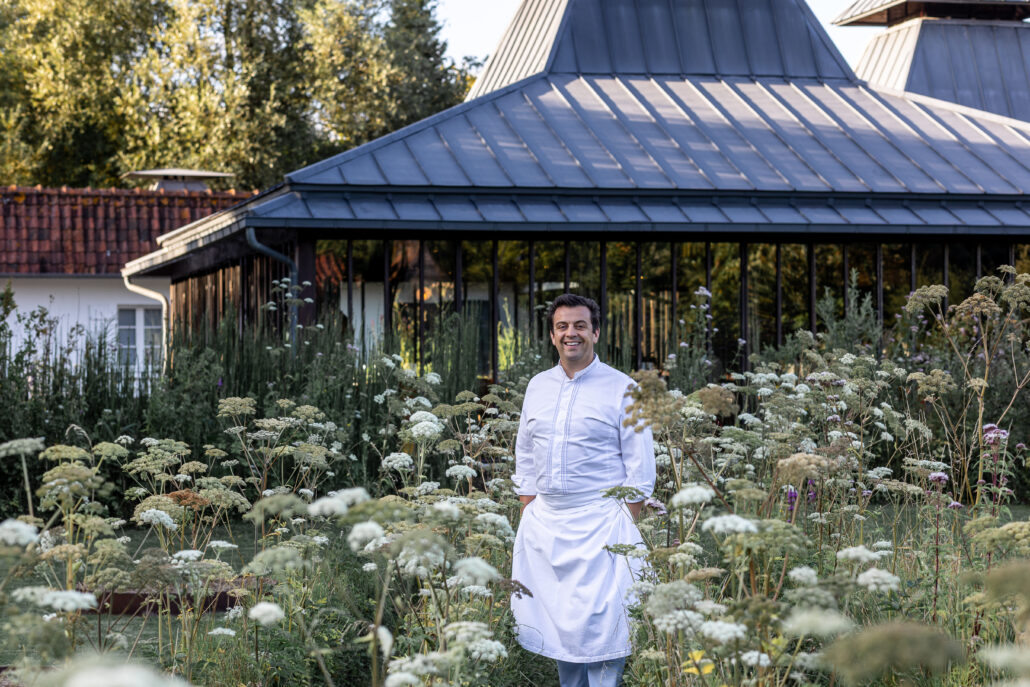
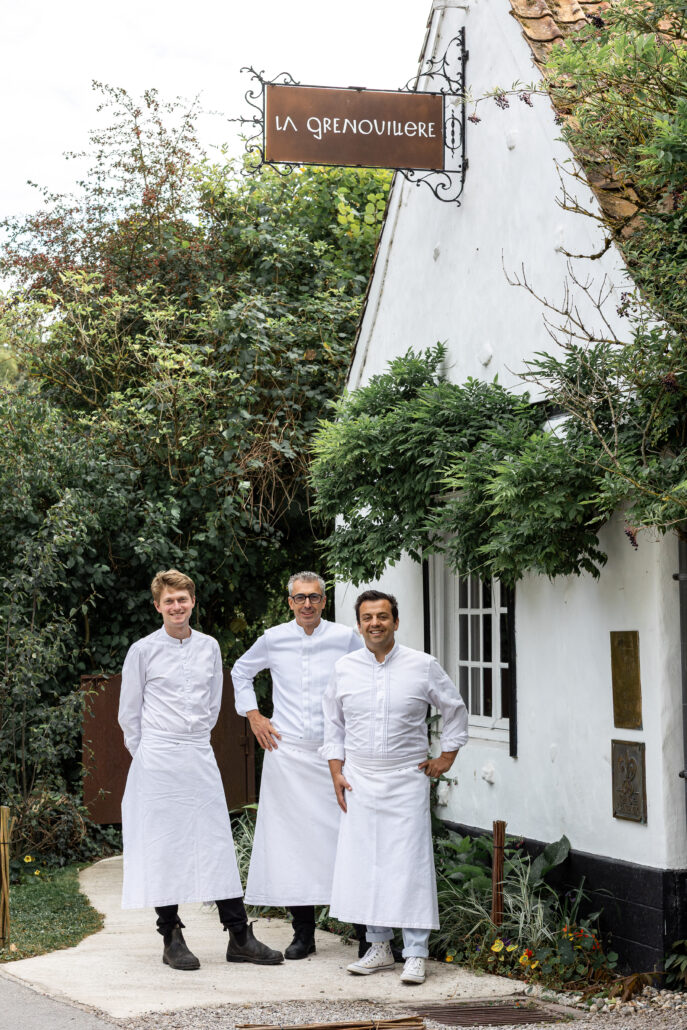
In the title of his book, Alexandre Gauthier chose a precise word to introduce himself: cuisinier. Cook, not chef. A simple, almost essential definition that says a great deal about how he sees his craft. And yet Alexandre is more than a cook: he is a cultured, knowledgeable individual with a vision of gastronomy that extends far beyond the kitchen to encompass design, architecture and hospitality, alongside a deep understanding of ingredients and how best to work with them.
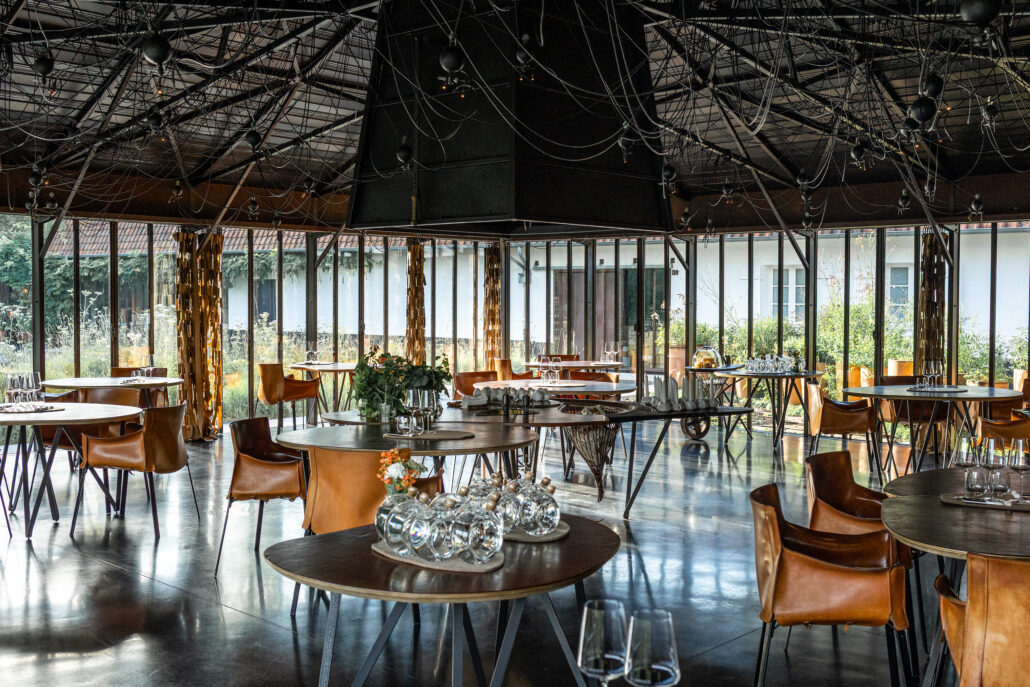
We first met him at the very beginning of our journey, and one of his dishes graced the first cover of Cook_inc. back in 2011. This summer, we went back to see him and had the chance to spend a few days immersed in his world: La Grenouillère, Sur Mer, Froggy’s and Le Grand Café.
Gauthier has deep roots in the Côte d’Opale and its landscapes: the banks of the Canche, the ramparts of Montreuil-sur-Mer, that distinctive northern French light that he continues to observe with fresh wonder. He grew up here, and now his son is growing up in the same place. La Grenouillère, bought by his parents forty years ago and taken over by Gauthier in 2003, is an integral part of his personal and family history.
The land is one of the foundations of Gauthier’s cooking. But he draws a distinction between territoire and terroir, a concept he considers more limiting. Terroir risks being reduced to a repertoire of products and traditions; territoire, by contrast, is something broader and more alive. It encompasses the land, the sky and the sea, fishing, foraging, farming and animal husbandry, but also the people, their gestures, their knowledge and their savoir-faire. This is why he describes his cooking as the physical, moral and mental portrait of a season, a landscape, a climate and a particular light, all belonging to the Côte d’Opale. He is not trying to recreate a regional repertoire or a codified tradition; rather, through everything around him, he seeks to express who he is.
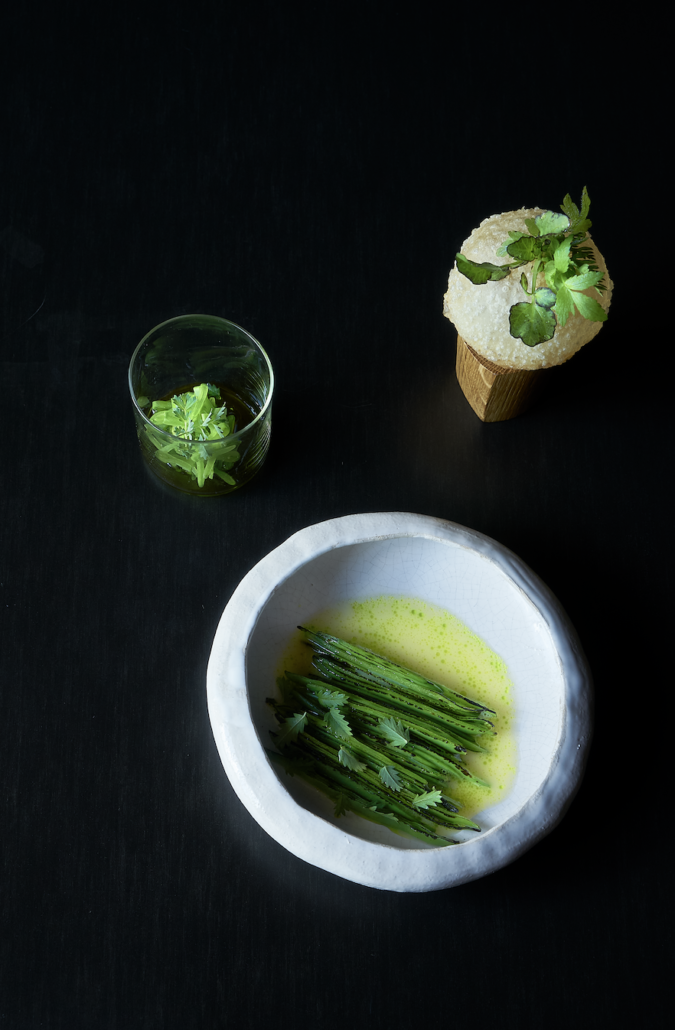
Nearly 85 per cent of the produce served at La Grenouillère comes from within a forty-kilometre radius of the restaurant. Yet this connection to place never becomes a constraint. Gauthier rejects any form of extremism: his is a personal cuisine rooted in French tradition but “free from its certainties”, open to ingredients from elsewhere whenever their use makes sense.
Territory thus becomes an alphabet, a range of notes, a palette of colours through which to express himself. Not a boundary, but a creative constraint: a starting point deeply rooted in place, solid enough to allow him to look beyond it, too. It is precisely this freedom, and his way of bringing identity and ingredients into dialogue, that led us to ask him a few questions about the use of Parmigiano Reggiano in his cooking.
France has an extraordinary cheesemaking tradition. Where do you think Parmigiano Reggiano fits into this world?
If there’s one cheese that has truly crossed borders, it’s Parmigiano Reggiano. Much like Italian cuisine itself, it has won over other countries, finding its way into professional kitchens as well as home cooking.
France has an extraordinary cheesemaking tradition, with almost infinite variety and richness. And yet Parmigiano Reggiano holds a very important place within it: a truly distinctive, privileged position, I would say almost that of a leading player.
For me, it’s not simply a great Italian cheese added to a dish. It has become part of our everyday lives, our kitchens and our culinary rituals. We grate it, cut it, let it melt, sometimes even use the rind: it belongs as much in home cooking as it does in a chef’s kitchen.
It has managed to do something rather rare: preserve a strong identity, deeply rooted in its territory and savoir-faire, while becoming universal at the same time. It brings depth and intensity to a dish and has the power to transform it with very little. That, to me, is what makes it such a unique and indispensable cheese.
Do you remember the first time you tasted a particularly well-aged Parmigiano Reggiano, or the moment you truly began to appreciate its complexity?
I believe it was in Italy, in fact, I’m certain of it. Perhaps during my first trip to Rome, when I was a student, or a few years later in Venice. That’s when I realised there isn’t just one Parmigiano Reggiano, but a whole world of different Parmigiano Reggianos. It’s everywhere, because production is substantial, but truly exceptional examples are much rarer. And generally, they’re not the ones you find already cut and packaged.
You have to seek out those that have been given time to mature, developing an almost crunchy savouriness alongside notes of hazelnut, butter and sometimes even toasted bread. They’re not so easy to find, but coming across a cheese of this calibre is an extraordinary discovery.
Too often, Parmigiano Reggiano is reduced to something to grate over pasta, a sauce or a risotto. But all it takes is tasting it on its own, in a proper piece, letting it melt in your mouth, perhaps alongside a glass of wine, to appreciate its full complexity. At that point, it’s no longer just an ingredient: it’s a great cheese in its own right.

When you choose to use Parmigiano Reggiano in a dish, what exactly are you looking for: savouriness, aromatic depth, umami, or something else?
When I use Parmigiano Reggiano in a dish, what I’m looking for above all is its elegance and subtlety. It brings a particular finesse, a touch of savouriness and a little depth, but above all, it has the ability to elevate a dish, almost as if it were an additional ingredient.
That applies to finishing a dish, but I also use it a great deal to bind ingredients together: to finish a sauce, give it body or sometimes thicken it slightly. In the pistou we make, for example, Parmigiano Reggiano is what brings the savouriness. It’s never a sharp, direct saltiness, but something softer and more enveloping, almost milky, that comes from the cheese itself.
Are there any dishes or techniques from French cuisine in which you find it particularly interesting to bring Parmigiano Reggiano into dialogue with your own culinary world?
Yes, absolutely. Parmigiano Reggiano is such a refined and complex product that it can work beautifully in a wide range of French preparations, sometimes in rather unexpected ways.
For instance, I might use it in paper-thin shavings, almost as you would katsuobushi, scattering them over a dish at the last moment before pouring a broth over them. The heat would make them melt slightly, releasing their full aromatic depth. I also like the idea of grating it into potato gnocchi, not simply to add a cheesy flavour, but almost as a seasoning in its own right: replacing some of the salt while bringing greater depth to the dish.
I also find it interesting to pair it with a French cheese in a soufflé, or to add it to so-called gnocchi à la parisienne, which are actually small choux pastry dumplings cooked in stock or water. I don’t use it as an Italian signature or a decorative touch, but for its ability to season, provide structure and transform a dish.

What’s the most surprising or unexpected pairing or use of Parmigiano Reggiano you’ve ever experimented with?
One of the most unexpected ways I’ve used it is in a Parmigiano Reggiano ice cream, served not as a dessert, but as a summer starter.
The cold slightly tempers its intensity, while revealing its depth, savouriness and almost sweetness in a different way. The first taste is surprising, but then it feels entirely natural: you recognise Parmigiano Reggiano immediately, simply expressed in a form you wouldn’t expect.
Iconic ingredients can sometimes become clichés. How can we avoid using Parmigiano Reggiano in predictable ways or simply as a garnish?
We need to bring it back into the heart of the action. To avoid clichés, we first need to stop thinking of Parmigiano Reggiano as a finishing touch, something to grate over a dish for seasoning or decoration. Instead, we should make the most of it, exploring its full range of qualities and nuances.
You can also look beyond its strictly culinary uses and enjoy it on its own, paired with a glass of red wine, Port or an oxidative wine. You can build an entire meal around Parmigiano Reggiano, serve it as an aperitif, eat it in the afternoon or late at night and, above all, learn to compare different ageing periods and stages of maturation. By taking another look at it and giving yourself time to really taste it, you can avoid using it purely out of habit.
The fact that it belongs to everyday, home-style and popular cooking doesn’t mean it should be confined to a stereotype. On the contrary, it’s precisely this familiarity that makes it so powerful. Parmigiano Reggiano is both an everyday staple and a noble, complex product that has long since crossed Italy’s borders.
We need to recognise it for what it is and use it wherever it truly makes sense: not as an accessory, but as an ingredient in its own right.
If you had to introduce Parmigiano Reggiano to a young cook who had never tasted it before, how would you describe it?
I would tell them that Parmigiano Reggiano is one of the great benchmarks of cheesemaking worldwide. It is undoubtedly an essential product, but above all, an extraordinary culinary ingredient that you need to learn to reinterpret and transform, as well as appreciate and taste for what it is.
You have to look beyond that first impression, the crumbly, almost dry texture in the mouth, to discover how it gradually melts and releases its fat. Its savouriness stimulates salivation, followed by depth of flavour and complexity. That is what gives it such a rare character.
It’s also important to understand that no two wheels of Parmigiano Reggiano are ever quite the same. You have to taste it attentively, comparing different ageing periods and tasting it again and again. That’s how a young cook can truly discover it, open up new possibilities in the kitchen and perhaps even dream up a magical recipe.
Some ingredients emerge from a particular culture and go on to travel far beyond its borders. Why do you think Parmigiano Reggiano has become one of them?
I think Parmigiano Reggiano has been able to travel the world because it rests on exceptionally solid foundations: a rigorous production method, consistent output and rare quality. Scale matters, too. Without significant production capacity, a cheese tends to remain tied to a village, a region or a specific territory. In this case, however, that capacity has allowed Parmigiano Reggiano to reach far beyond its place of origin and build a truly international reputation.
Parmigiano Reggiano carries a powerful sense of Italian identity. Italian cuisine has spread all over the world, alongside Italians themselves, and I think this cheese has become a way of carrying a little piece of home with you. Even on the other side of the world, a single taste is enough to immediately evoke something of Italy: something familiar and reassuring. And even for those who aren’t Italian, tasting Parmigiano Reggiano means experiencing a little piece of Italy.
It’s a product deeply rooted in its territory and, at the same time, capable of crossing every border. It spans generations and speaks to everyone, yet never loses its complexity or the richness of its aromas. That is probably its greatest strength: being instantly recognisable and accessible while remaining utterly distinctive.