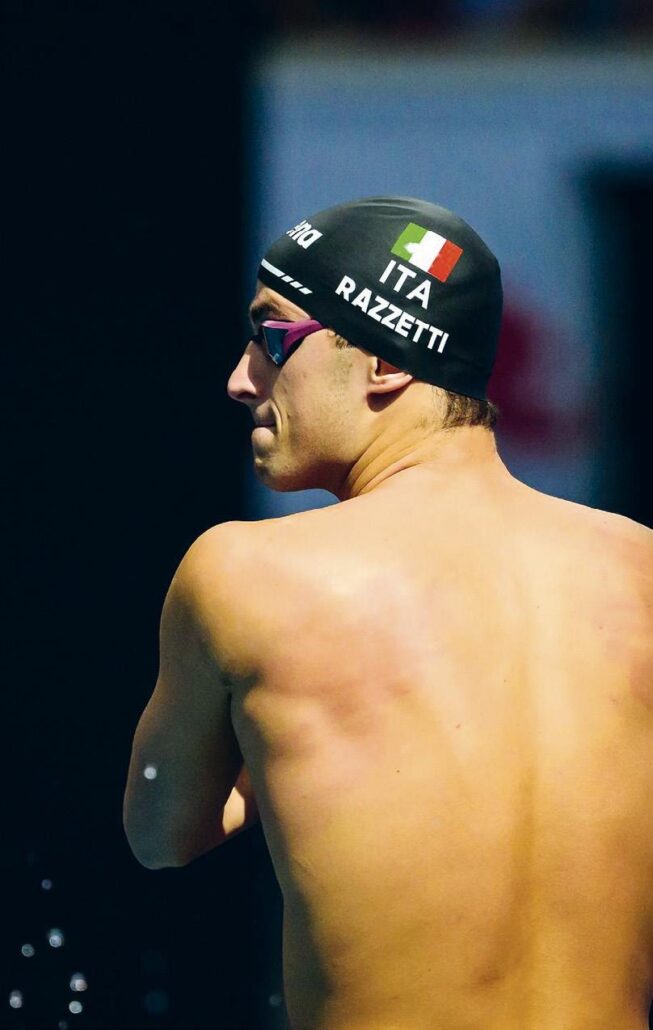
Two hundred and fifty grams of pasta is the absolute minimum Alberto Razzetti (nicknamed Razzo which means “rocket”) devours for lunch and dinner every single day. “It’s just easier, exactly half a box, though I could easily eat more,” he shares over pre-dinner drinks as the sun sets over the outdoor tables of a cocktail bar along Livorno’s historic canals. This is where Alberto, an athlete originally from Sestri Levante (Genoa province), moved in 2020 to train at the Italian Swimming Federation’s regional center. One of the most striking things about him is the sheer casualness with which he describes a life that is anything but ordinary. Watching him sit there, cocktail in hand, it’s hard to connect this smiling guy to the athlete who, just hours earlier, was in the pool churning through a grueling fourteen-kilometer workout. And yet, swimming is etched into his very being: in his broad shoulders, his posture, and his calm, measured way of speaking. He carries the quiet energy of someone intimately familiar with relentless hard work.
Behind his apparent calm lies one of the brightest figures in Italian swimming today. Born in 1999, Alberto Razzetti belongs to a generation that has quietly reshaped the country’s presence in the sport, turning Italy from a promising contender into a steady force at the highest international level.
A medley specialist, he focuses on the 200 and 400 individual medley, while also excelling in the 200 butterfly. He has built an impressive collection of Italian records and a medal haul at both World and European level that marks him as a true standout – gold medals included, of course. He competed at the Olympic Games in Tokyo in 2021 and again in Paris in 2024, reaching the final on both occasions. Behind his success lies a life structured around training, recovery, and discipline. Alberto has grown up in the water:
AR: “My mother likes to remind me that she first took me to the pool when I was only a few months old. I guess I never really found my way out of it.”
The sea of Sestri Levante, the pool in Lavagna, then back to Sestri Levante, again Lavagna, and eventually La Sciorba in Genoa. His high school years at the Nautical Institute in Camogli turned the balance between school and swimming into a constant game of Tetris – but Alberto never gave an inch. Long before the idea of becoming a professional athlete even felt tangible, his life was already being shaped, almost inevitably, around the water.
AR: “I started to realise I could achieve something meaningful when the first results came at the Italian youth championships. But the real turning point was in 2018–2019, when I won my first medal at the national championships. That’s when I joined the Fiamme Gialle, and it became clear that swimming was going to be my job.”
“Razzo”, however, seems to have been destined to be just that from the very beginning. A fate embedded in a nickname that is not merely a shortened version of his surname – already a moniker once carried by his father – but something closer to a prophecy. Those who watch him up close during races know that the moment the nickname truly comes alive is at the swimming turns: that’s where Alberto turns into a hydrodynamic projectile. It’s a quality that makes him especially lethal in short course pools (25 metres), where the tighter walls create a more frantic rhythm and races are often decided underwater. In fact, swimmers can travel up to 15 metres submerged off each swimming turn, turning the underwater phase into a decisive weapon. The story shifts in long course, the 50-metre “king’s pool,” where the number of swimming turns is halved. There, Razzetti has learned to endure pure suffering, especially in the 400 individual medley. It is the most unforgiving of events: not only do you need complete mastery of all four strokes – butterfly, backstroke, breaststroke, freestyle – you also need resilience and psychological strength to withstand its demands.
AR: “They are extremely tough races, both physically and mentally. In the individual medleys, you have to manage everything: pace, transitions between strokes, race strategy, and your mindset. You might go out fast and then see others catch up during a different stroke, but you have to stay clear-headed, because you know you can make it back later in the race.”
Backstroke is generally considered his least comfortable stroke, but judging from his latest international short-course performance (gold medal at the European Championships in Poland, where he finished almost a full length ahead of his rivals) it’s hard to see it as a real weakness. He doesn’t talk about talent as something magical; there is no romanticism in the way he approaches sport. For him, it’s about work, an enormous amount of work. And then there is the element of enjoyment, because swimming, for him, still means finding joy in it, despite the weight of professionalism. To keep challenging himself, whenever he can he takes on events that don’t belong to him, drawing out a different kind of grit, the kind that only appears when you know you’re not among the strongest in the pool, but you want to prove you could be. This search for balance is also one of the reasons Alberto now lives in Livorno. He often points out that while swimming is an individual sport, it is not an individualistic one, and the training group you share your daily routine with becomes essential—more than almost anything else.
AR: “Here there’s a great group of guys like me, and many of them come from elsewhere too. Finding that kind of connection is essential – you push each other in the pool during training, but also in everyday life. In Livorno we train ten times a week: four double sessions, two single ones, plus the gym.”
There are no shortcuts in swimming, which is why nutrition plays a central role. Alberto is not obsessive about food. He knows how important it is for performance, but he also enjoys eating, and plenty of it. He has learned to treat his body like a Formula 1 engine: it needs the right fuel to run at that level, and he adjusts accordingly, without turning food into a mental constraint or giving up pleasure. His approach is straightforward – no extremes, no unnecessary restrictions, just awareness of his body and the right supplements to support recovery.
AR: “I eat a lot. With the training loads we do, we burn an enormous amount of energy. I don’t follow a very strict diet, but I try to eat well.”
Razzo’s day starts early, but not too early. He’s in the pool by 8.30 a.m. As for breakfast, he keeps it simple: crispbreads with jam, or a few biscuits—whatever lets him squeeze in a few extra minutes of sleep. Then come two hours of training, followed by a mid-morning snack: a piadina, a toasted sandwich, or something along those lines. Lunch is built around his trademark 250 grams of pasta (“Anything less and I barely notice it,” he says) followed by a source of protein, usually bresaola or chicken. Nothing elaborate, just what his body needs. After lunch, it’s time for a short nap before heading back to the pool for another two-hour session. Another snack follows, much like the first, then some downtime before dinner. And yes, another 250 grams of pasta, this time with whatever sauce he feels like, alongside a protein dish and vegetables.
Any swimmer will tell you the same thing: without carbohydrates, you simply can’t keep going. Pasta, rice and bread are the fuel that keeps your muscles working when the training load is at its peak. But nutrition in swimming is more nuanced than simply eating a lot. You have to train your stomach to handle large amounts of food, while paying close attention to recovery. It’s all about balance, especially during the shift from heavy training blocks to the pre-competition taper, when mileage and training intensity are gradually reduced. The number of sessions, however, stays exactly the same:
AR: “Three days out of the pool are enough to lose your feel for the water, that unique sensation you carry in your hands. It’s almost impossible to put into words.”
During the pre-race taper, when training volume is reduced, in theory, your energy expenditure drops and so should your appetite. In Alberto’s case, though, the maths never quite seems to add up. A life planned down to the smallest detail doesn’t have to be a monastic one. Quite the opposite. “If something makes you feel good mentally, it can give you more than it takes away physically,” he says. Coming from an elite athlete, those words carry weight. Razzetti never gives the impression of being consumed by performance. He is fiercely competitive, meticulous in his work, and just obsessive enough to excel. But he also seems to have understood something many athletes only realise too late: if discipline becomes the only thing in your life, sooner or later it starts to consume you. He speaks about swimming for what it really is, an endless exercise in repetition.
AR: “There are mornings when, rather than jumping into the water, I’d rather shoot myself. Because in the end, swimming is always the same lane, the same black line on the bottom of the pool, the same movement repeated thousands of times. Mentally, it’s exhausting.”
Being a champion means enduring monotony without losing hunger, the real hunger to improve, and to race. That’s what he loves most, alongside everything that comes with it: the travel, the people, the experiences.
AR: “Swimming has taken me to incredible places: Australia, Japan, Egypt. The best experience was spending three months training in Australia alongside Léon Marchand (the dominant figure of the French national team, the swimmer who broke Michael Phelps’ world record in the 400 individual medley in 2023 and went on to win four gold medals at the Paris 2024 Olympics). It felt almost like a holiday disguised as work.”
Rivalry in the pool often leads to international friendships, as in this case. During that stay Down Under, where training is highly hybrid and includes running and cycling sessions alongside pool work and the gym, there was no shortage of lighter moments:
AR: “I only did one running session, and my feet hurt so much I switched straight to the bike. It really is true that swimmers are like fish out of water the moment they try anything outside the pool.”
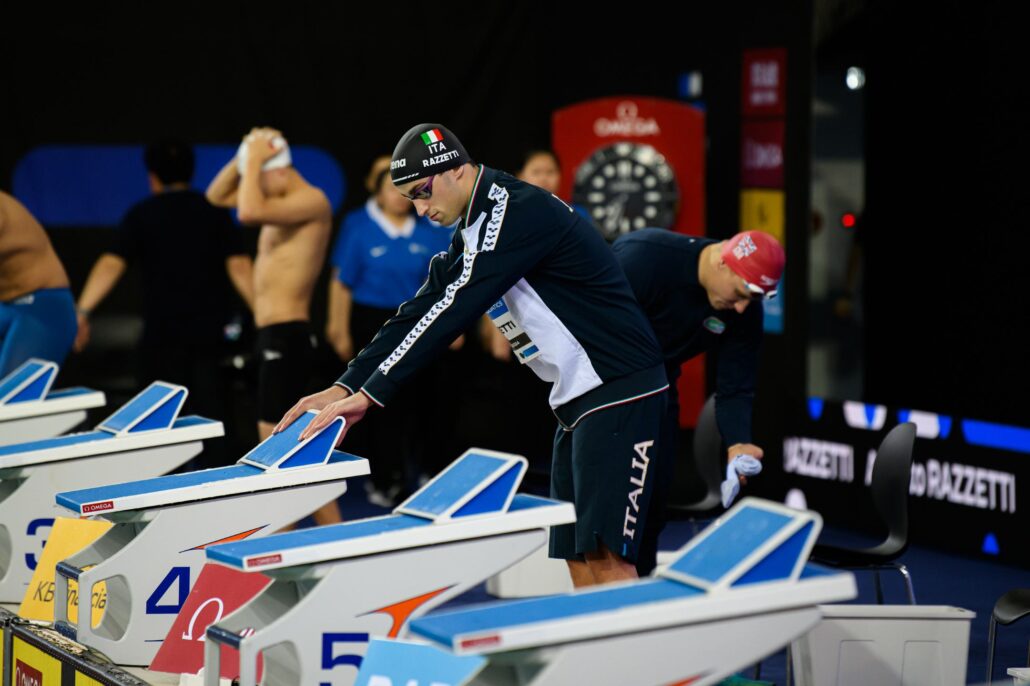
It goes without saying that, in his time away from the pool, he also developed a passion for surfing. And what about the Olympic chapter?
AR: “Reaching an Olympic final is something almost impossible to describe. Just qualifying already felt surreal; then actually experiencing that atmosphere was something else entirely. Tokyo, though, was a very particular edition because of COVID-19: daily testing, masks everywhere, and the constant fear of testing positive and losing everything. Paris, on the other hand, was completely different—crowds, cheering, an incredible energy in the stands.”
Beyond the races and the results, it’s the Olympic Village that stays with you the most.
AR: “You sit at the table with athletes from all over the world, mixing cultures, making friends.”
Inevitably, food becomes part of the conversation too. In Olympic Villages, you can’t expect perfect execution: the dining hall feeds over ten thousand people a day, but the variety of cuisines ensures everyone can meet their energy needs. What matters most is simplicity: easy-to-digest food with minimal risk of any digestive surprises, which is why it’s usually best to avoid heavily spiced dishes if you’re not used to them.
In Tokyo there was always an inviting fish soup on offer, but I preferred not to risk it.
In the days leading up to a race – any race – you can’t afford to take chances at the table. So it’s pasta, preferably plain, or rice, with grilled chicken breast. As an Italian, it’s not easy to get used to that overcooked, sticky pasta, but:
AR: “You know that for a few days you just have to grit your teeth, knowing you’ll make up for it once the last race is over. Like with fried chicken and burgers in the United States, or boats of sushi in Japan. I stayed there for ten days after the races, tried everything, and didn’t touch a single plate of pasta.”
Today, between training sessions in Livorno and international competitions, the focus is already set on what comes next: the long-course European Championships in Paris (August 2026), for which he has already qualified. And, of course, the next Olympic Games in 2028. The Olympic cycle leaves no room for breaks, and the hunger for victory – just like his appetite for pasta – doesn’t fade easily.
The nickname “Razzo” suits him perfectly, because once he hits the water he takes off. Yet outside the pool, what stands out is the disarming simplicity with which he talks about immense sacrifices without ever losing sight of life’s small pleasures. He is a grounded champion, who flies through the water with a shy smile and a rocket engine ready to ignite at the next start.
The conversation inevitably ends up on pesto pasta. Because you can become one of the strongest swimmers in Italy, but if you’re from Liguria, some things are simply in your DNA. And when pesto is mentioned, Razzo lights up. The fuel for racing may be plain pasta, but the real reward is something else entirely.
AR: “When I go back home, the first thing I crave is pesto. Lasagna or trofie, it doesn’t matter, my grandmother knows it well by now. You can find it outside Liguria too, but it’s never quite the same.”
After all, people from Liguria aren’t just fans of pesto, they’re fundamentalists.