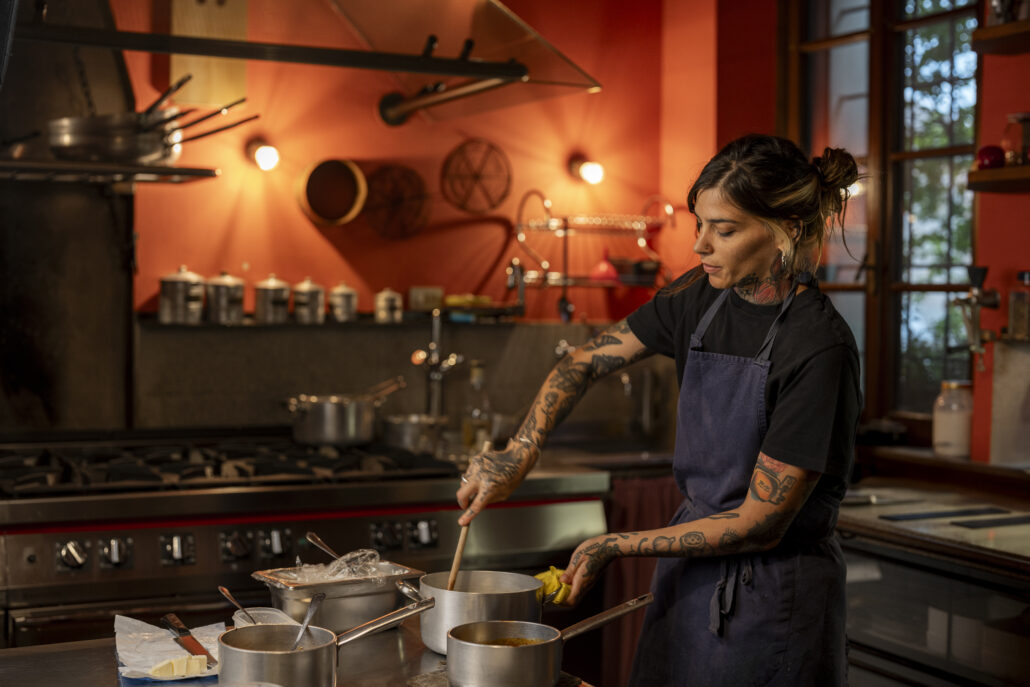
Cooking, the very act of preparing food for oneself or for others, is something that unites all human beings. Sooner or later in life, each of us has found ourselves standing before a flame or a pot, driven by either passion or necessity. Those who have learned to see beyond the monotonous rhythm of repeated gestures have managed to turn this routine into creativity, transforming it into a craft.
What for many is merely a vacuum of time – waiting for water to boil, butter to melt before frying, or the oven huffing and puffing as it heats – for others is a daily ritual with a purpose: to be a cook.
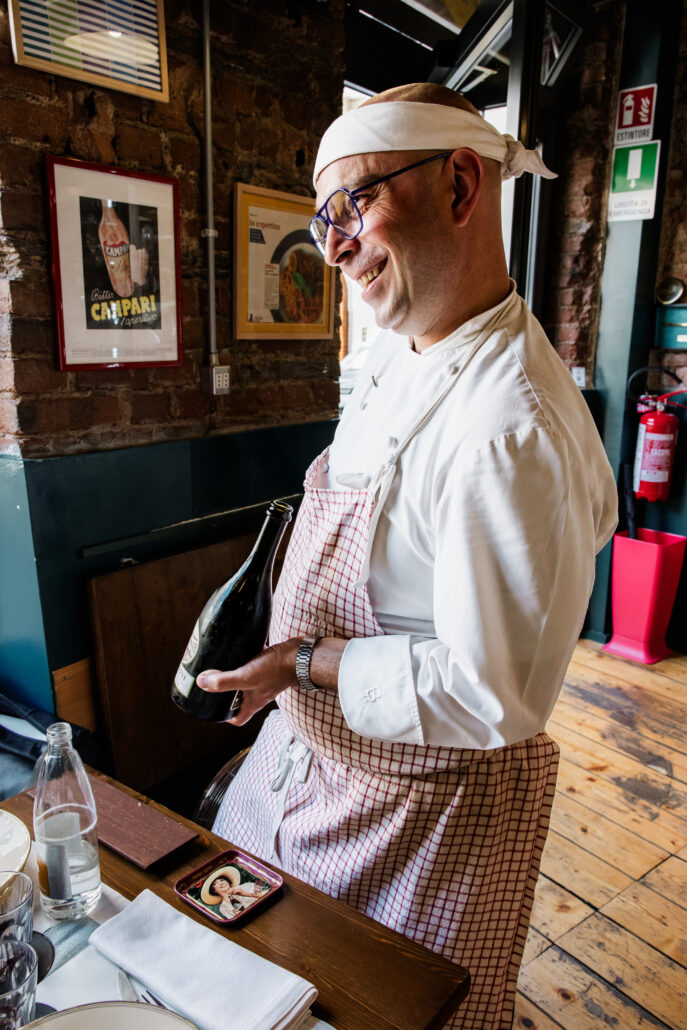
Some find satisfaction in kneading dough, others in hearing their sauce sizzle, and others still delight in the taste of a forkful of pasta with ragù. Yet no one perceives cooking as something salvific, therapeutic, alchemical, sensual, or artistic quite like a cook does. And we’re talking about cooks, not chefs, because here, the dimension of work, of direct and constant contact with the matter at hand, remains essential and concrete. In a cook’s life there is truth, humanity, disappointment, and sacrifice, but also a vast freedom of expression. “One thing’s certain: with only four tables, if you come here to eat, you are truly in my home. You behave accordingly and adapt to our way of doing things, or, let’s just say it, this isn’t the place for you.” These are the words of Matteo Monti, a Piacenza-born cook who brims with personality, at times almost caricatural, and a tireless sense of duty. He is the custodian, owner, and soul of Razdora, one of Milan’s smallest, yet most prolific, restaurants. Unlike his colleagues with more linear paths, Matteo’s career has been punctuated, for better or worse, by moments of great significance and equally great turmoil.
Log in or subscribe.