In 2014, the first episode of Hell’s Kitchen aired on Italian television, a show that had already had tremendous success in the United States over the previous nine years. The format was fairly simple: a kitchen, two teams, red and blue, competing to cook a full dinner service as if they were the staff of a high-end restaurant.
At the helm of the brigade, sometimes calmly but more often harshly, stood a chef embodying the figure of the uncompromising leader, obsessed with perfection, unflinching and largely indifferent to the emotional breakdowns or struggles of those working under him. In the United States, that chef was Gordon Ramsay. In Italy, it was Carlo Cracco.
When I read the New York Times article about René Redzepi, Noma, and the atmosphere that prevailed in his kitchens, I couldn’t help but think that while the accusations against the Danish chef were entirely justified, the sense of surprise surrounding them was in itself surprising.
Redzepi has clearly done wrong. He crossed a line that no one should ever cross: he used his position of power to humiliate, insult, and inflict psychological and physical abuse on someone in a position of vulnerability. But Redzepi is not a rotten apple in an otherwise perfect orchard. He is, rather, the product of decades shaped by a particular mindset – one in which those in positions of power, especially white men, are permitted to do whatever it takes to achieve their goals.
This way of thinking and acting has never been exclusive to kitchens, and unfortunately it still isn’t. But in kitchens it has taken root, evolved, and spread in a deeply structural way. To be clear, describing Redzepi as one of many does not absolve him. However, it matters, because only by acknowledging it can this moment become an opportunity for the industry to change direction.
If, instead, as seems to be happening in recent days, we start promoting the idea that most kitchens have been, and still are, places defined by harmony, kindness, cohesion, and mutual respect, and that Noma is some kind of isolated exception, then I don’t believe we will get very far at all.
And so, I go back to Hell’s Kitchen. Because when the New York Times story broke, I couldn’t help but think: those of you who are rightly outraged now by what Redzepi did in his restaurant, where were you when Carlo Cracco was shouting on national television: “Don’t answer like that, otherwise I’ll grab this pan and throw it at you”?
Yes, of course, that was fiction. Entertainment, some will say. True. But it was fiction and entertainment that closely mirrored reality. You only have to read that extraordinary book, Kitchen Confidential, to know it. In telling his own story, Anthony Bourdain exposed a world that outsiders may have ignored, but one that insiders, cooks, journalists, enthusiasts, knew perfectly well, and that, at the time, failed to provoke much of a reaction.
Because, and it is worth saying clearly, for decades violence – both physical and psychological – in professional kitchens was not something external to the system, but an integral part of it, almost a necessary one, meant to forge the character of future chefs through a kind of Darwinian selection, where only those able to withstand pressure, exhaustion, and pain were deemed fit to move forward.
And it did not surprise anyone. It was simply accepted. From the early twentieth century onward, kitchens have been run more like military regiments than orchestras. Before that, they were probably places we would not wish even on our worst enemy. And even orchestras, as their biographies often reveal, are far from the healthy workplaces we might imagine. Of course, there were exceptions. But most kitchens worked this way. The structure conceived by Escoffier mirrored the army even in its roles, with superiors and subordinates, and the former, in order to make themselves understood by the latter, used whatever methods they deemed necessary. During service, the cook was expected to move like a soldier at war, protected by an organization designed to minimize mistakes and entirely at the disposal of the head chef, the only one who truly knew what needed to be done.
If for so long that structure did not outrage us, it was not because we were unaware of it, but because it seemed normal to us, and we accepted it. More than that, we reinforced it. We built television shows that promoted that very model, quietly sending a message: this may look awful, but as you can see, without shouting and without this kind of behaviour, nothing good can be achieved.
In reality, some voices had already begun to question that widespread mindset. Redzepi himself, for example, in 2015, in his essay Culture of the Kitchen, published on the MAD website, openly described his own abusive behaviour and acknowledged that change was necessary.
The public expects more from us now. Questions arise: Is there still room for guys like me, who started before this new era? What about the French armies we trained in, the regiment we still follow? How can we rectify the screaming and shouting and physical abuse we’ve visited on our young cooks? How do we unmake the cultures of machismo and misogyny in our kitchens? Can we be better?
Perhaps, the real question is this: Do we want to be better?
I’ve been a bully for a large part of my career. I’ve yelled and pushed people. I’ve been a terrible boss at times. For some reason, I’m particularly bothered when I remember a girl from Colombia who was working for us, whom I really liked. One night, we had some big-time guests in the restaurant—journalists from somewhere I can’t recall. I had given her directions, and she had said, “Yes, Chef,” and then when it was time to do her task, she didn’t do what she was told. This happens. People say “yes,” but they have a thousand things on their mind and aren’t paying attention. I went completely crazy. I pulled her out of service, and I screamed at her: “What the fuck are you doing? Go home”. (Redzepi)
Then came Covid-19 and #MeToo, and thanks to a growing number of courageous people willing to put themselves on the line, a broader collective reflection began to take shape around the meaning of work, in kitchens as elsewhere. In less than two years, what had long seemed normal suddenly became unacceptable. As Redzepi’s own text suggests, this reflection had been smouldering beneath the surface for some time. It needed a spark, and that spark was the pandemic. The global shutdown accelerated everything, making what had defined the work of cooks throughout the previous century no longer sustainable: not only physical and psychological abuse, but also endless working hours, which for a long time were framed as a predominantly female issue but in reality affected everyone, the lack of rest, the absence of proper pay for interns, another issue that, judging by the surprise expressed in recent days by some colleagues, seems to have only just been discovered, despite the existence of an entire army of unpaid workers in kitchens across much of the world, and much more. This sudden and collective awakening has had visible consequences for the system, starting with the economic ones.
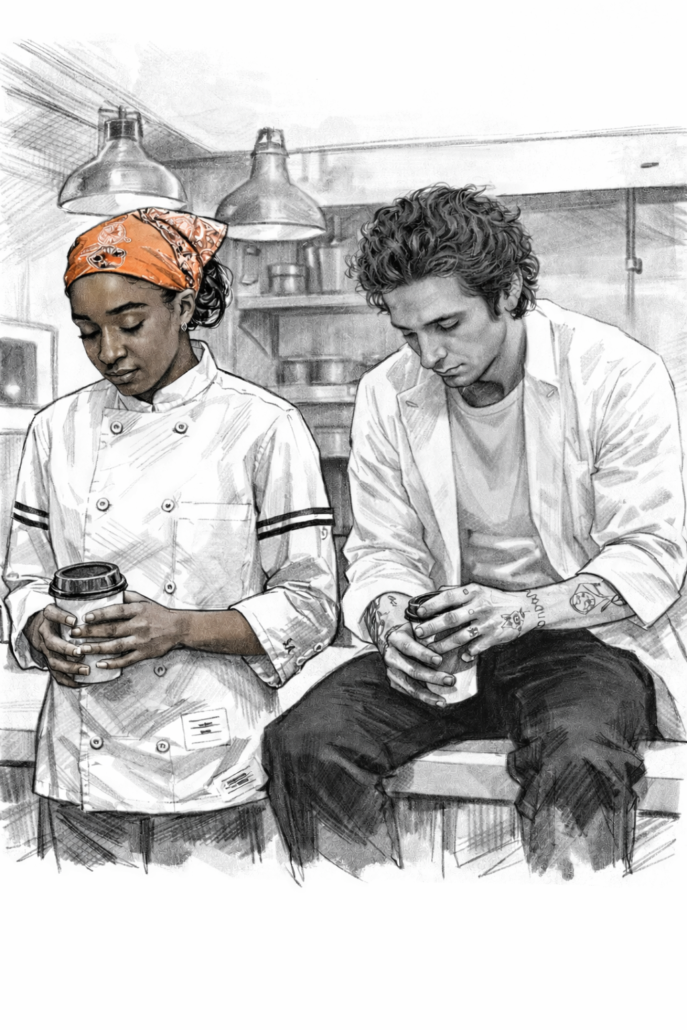
With the pandemic, the context in which we are immersed changed, and with it our way of looking at the world. What had once been considered normal, even necessary, became unsustainable, even unacceptable. And as the context shifted, so did the way we tell these stories. We moved from Hell’s Kitchen to The Bear. That “Every second counts” sign hanging on the wall of Carmy Berzatto’s kitchen, which just a few years earlier sounded like a motto, a mantra, a call to constant vigilance, has become something else entirely: a source of pressure, a problem to overcome, an attitude to be questioned. And I believe this shift concerns not only those who work in kitchens, but also us, the customers.
At its core, The Bear captures, and does so remarkably well, the transitional moment we are living through. It shows how suffocating the kitchen can be, a place that can be faced either with hardness and distrust of others, as Carmy does, or with empathy and trust, as Sydney does.The handover in the final episode between Carmy and Sydney is not simply a transition between two chefs. It is the old model stepping aside and allowing the new one to take responsibility for the future. More a hope than a true reflection of reality.
And so we return to Redzepi, who seems to embody perfectly that Carmy stepping aside to make way for Sydney’s future. The problem is that if Sydney is truly to take his place, if that hope is not to be disappointed, it is not enough for Redzepi to step aside. It requires everyone to take on a share of responsibility.
Not to step aside. In fact, I don’t believe that even Redzepi should have stepped aside. To think that by removing one individual we have solved the problem of violence in kitchens is simply hypocritical. Watching him fall may satisfy those who never liked him, but it does nothing to address the issue.
As we said at the beginning, Redzepi was a rotten apple in a world of apples that, if not rotten, were at least bruised, not a rotten apple in Eden. This, of course, does not absolve him. And when the time came, he did not absolve himself either.
As I said, Redzepi is not paying for being the worst, but for being the most famous among them. The most successful of the guilty. The one who hosts dinners at 1,500 dollars a head. It is right that his actions have consequences, that should be clear. But those consequences, I believe, should extend, at least in part, to all the others who embraced that same way of working, who tolerated it, or even actively promoted it.
Because it could just as easily have happened to many others, the very ones who today act surprised or claim that “in my kitchens everything is perfect.” And my greatest fear now is that, given the way things are unfolding, we will be satisfied with having Redzepi’s head served on a plate.
From tomorrow, in fact it is already happening, many of those who are saying nothing, or worse, pretending this has nothing to do with them, after letting out a sigh of relief for not having been called to the scaffold, will continue stepping onto stages to tell us how important sustainability is, how important teamwork is, how important a healthy work environment and quality ingredients are.
Ultimately, they bear no real blame, aside from sustaining the same old hypocritical collective farce.