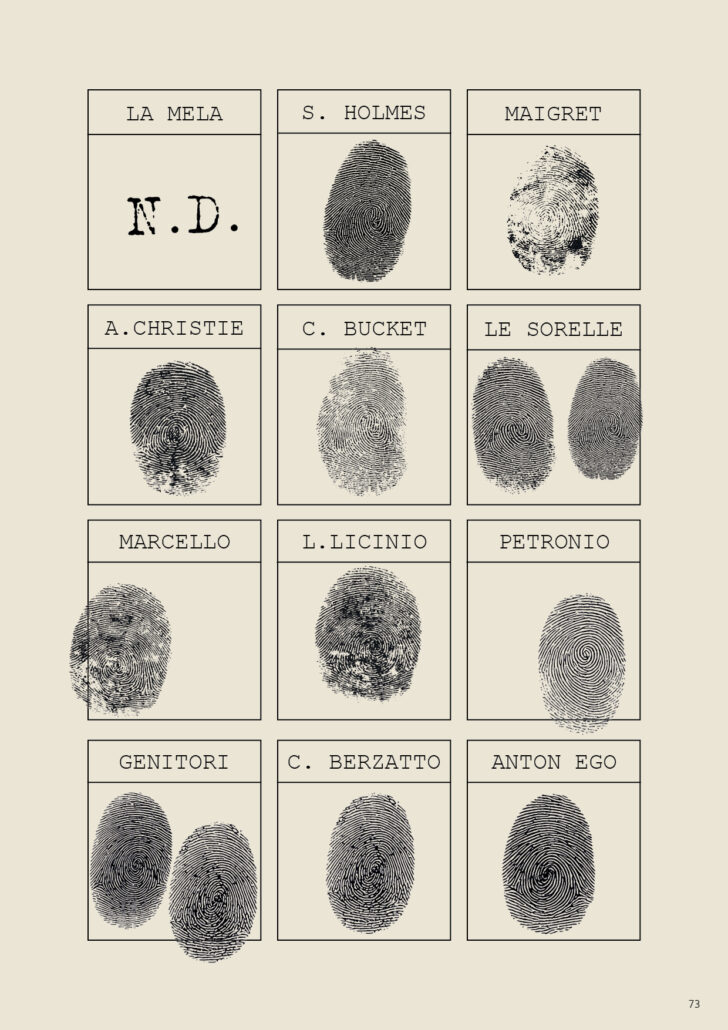
It all begins with the apple. Juicy, slightly tart, voluptuous on the skin (at least that’s how I picture it). That’s how the story goes: the first gastrocrime in history occurred in the Garden of Eden, which, in no time, would turn into the London living room of an investigator at 221B Baker Street. There, Mrs. Hudson, the landlady of Mr. Holmes (Sherlock, that’s elementary, Watson), lays out meals that are nothing short of literary legend. The two share three meals a day, even beyond the walls of their study: biscuits, capon pudding, oysters, cheese, French wines, all recounted in Paola Alberti’s Breakfast with Sherlock Holmes. So it was at the table, then, that the crime was committed! Or at least, well, the sin of gluttony. If the Bible is the first bestseller in history, affectionately known as “the book of books,” one could say that the pleasure of food and wine has always existed in literature, often accompanied by a thirst (sometimes quite literal) for knowledge. Let’s put moralizing aside: was it not the tree of knowledge – and then, of course, of good and evil – from which that ill-fated apple was picked?
Nothing could be more natural than detectives, men and women of letters, and bon vivants helping themselves to this or that delight.
It doesn’t happen only in England, over cups of tea. Across the Channel, in the land of French grandeur, Inspector Maigret (and his creator, Georges Simenon) prefers the comme il faut kind of establishments. Simple, hearty recipes can be found collected in Robert J. Courtine’s Dinner with Simenon and Inspector Maigret: tomato soup, andouillettes, quiche lorraine, omelets, often prepared by Madame Maigret, “Simenon’s ideal woman and, in a way, the mother he wished he had.” With another pirouette northward, Agatha Christie – who was quite fond of the kitchen and its pleasures – turns food into a murder weapon. As in A Murder Is Announced, where a swoon-worthy chocolate cake, well, quite literally becomes to die for… Or in Sad Cypress, where, as her compatriots would say, there’s something fishy, something that doesn’t add up, something that, quite literally, smells of fish. And what if the saying referred to the fish paste used as a vehicle for poisoning in that very story?
Log in or subscribe.