
Osip… what on earth is that?
We have long known Oasis, the two dorks from Manchester.
We are also used to Aesop, the Australian brand selling organic skin care products .
But Osip… what the heck kind of name is that for a restaurant?
“It comes from the great Russian poet Osip Ėmil’evič Mandel’štam (also written: Ossip Emilievitch Mandelstam) of whom my father, a poet himself, is a fervent admirer. So when I was born, he baptized me precisely like that, Osip: a tribute to one of the greatest representatives of acmeism, the poetic movement of the early decades of the last century that, fiercely critical of symbolism, appeals to the human heart via the most direct expression of the everyday. However, a couple of weeks later, my mother was plagued by doubt and reconsideration. She managed to convince my father to reluctantly change my name. Exit Osip, here comes Merlin. On my birth record, I officially am Merlin Timothy Osip Labron-Johnson, but Merlin is easier. That said, I was attached to Osip (with one or two s, the debate is open). Because in Hebrew texts, besides being a distant diminutive of Joseph, Osip refers to the concept of plenitude, of multiplication, invoking divine intervention – textually “God will increase” – that will always provide for man. It seems to fit perfectly in designating the benevolent reception of a restaurant. The art of hospitality, in short,” says Merlin.

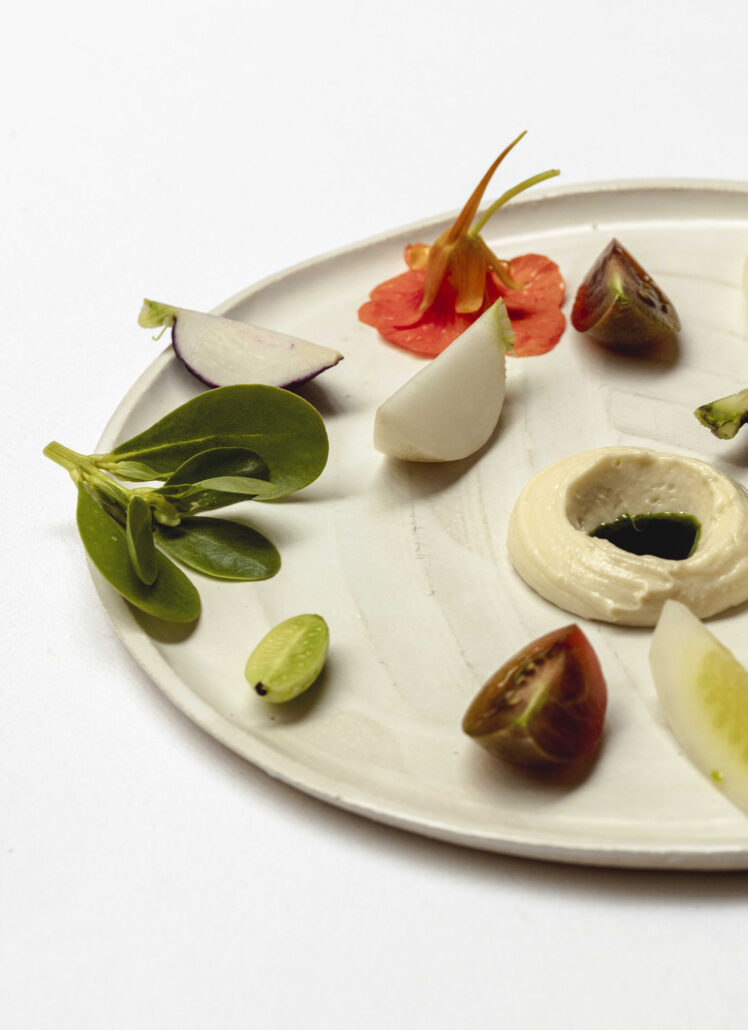
“It sounds better than the barbaric Hospitality Business…”
And so Osip it is. A cottage in the woods, a stone’s throw from the village of Bruton, nestled in the shaded countryside of Somerset. The young chef’s birthplace Devon lies just a bit further south, along that invisible border that, skirting around Oxford and the Old England of the Cotswolds in all their picturesque glory, leaves Bristol behind and descends southward from Bath.
Everyone – ourselves included – would have continued the journey backward in time, rushing toward the Cornish coast, bidding a fleeting farewell to Dorset, so dear to Thomas Hardy, the author of Far from the Madding Crowd and Tess of the d’Urbervilles. Perhaps, long before Merlin, literary spirits had already set their GPS coordinates for Bruton. To seek an audience – near Frome, just ten kilometers away – with another great man: Anthony Powell. A Commander of the Order of the British Empire and the monumental author of A Dance to the Music of Time, a twelve-volume novel-world, an autobiographical summa chronicling the end of a certain idea of England, as it passed through the collective trial of the First World War. A “memorial” spanning thousands of pages that earned him the title of the British Marcel Proust (“Hey, but I’m not homosexual,” he always protested, irritated). And in a way, living memory is also a theme for our Merlin. Not that, on the cusp of thirty, he already feels the urge to revisit the enchanted pages of his own life. He is calm, a composed young man, finally settled in his adopted countryside after years of nomadic training across half of Europe – from Switzerland to France and Belgium – without ever venturing, unlike so many (too many) of his generation, into the Viking lands of the far North.
Log in or subscribe.