Time is measured differently in Bosnia and Herzegovina. There is before the war and there is after. That’s what I learn during my first dinner in Lukavac, in the north east part of the country, which is one country with three presidents and three million people living across two main territories of land. These territories were established by the Dayton Agreement in 1995 and reflect the two sides of the Bosnian War. Bosniaks & Croats make up the Federation of Bosnia and Hercegovina while Bosnian Serbs occupy Republika Srpska. But despite what politicians will have you think, the differences are not always stark. Lukavac is in Federation territory, with a majority Bosniak Muslim population, but this is a mixed household. Tonight we are eating veal liver for dinner, tomorrow we’ll have smoked pork leg with sour cabbage. In short, the country is complicated.
There is surely an article to be written about Bosnian food traditions and the confluence of trade and agriculture under Ottoman, Austro-Hungarian, and Yugoslavia rule, but I am not the person to write it. I am here as an observer and a guest. From my outsider perspective, I can see that grilled meat, whether pork, beef, or lamb, is important. Just as pivotal are the pickled veggies, fermented sour cabbage, and roasted red peppers eaten alongside. Whatever the next pickling trend involves, I am sure a Bosnian woman has already perfected it. Dough, either in bread or pie form, is another ever present part of the meals I eat in Bosnia. In between there is Turkish coffee, sipped with a sugar cube held on my tongue.
My US-centric education has left me woefully ignorant of Bosnian history. In 10th grade we were taught about the assassination of Franz Ferdinand, in relation to WWI, and were shocked to learn one of our favourite bands was named after a person. What really sunk into our heads was that a man got caught lacking 100 years ago and changed the world. In Sarajevo, I will stand on the exact spot Princip murdered the Archduke and think about Mr. Zuckerman’s world history class at Oakland Technical High. Franz Ferdinand’s murder in Sarajevo was the extent of our lessons involving Bosnia, with the Bosnian War omitted entirely. That’s either because it was too recent for our history books, or because there is only so much time in the school year. Whatever the reason, it left a huge hole in my understanding of this part of the world. In a way, my trip to Bosnia is just a past-due field trip for Zuck’s class. In another way it is personal.
I am in Lukavac because of love. This is not a travel guide, this is a guide to my girlfriend’s favourite memories. You will probably never find yourself in this part of the world. It is a small, industrial town, with packs of stray dogs and a smell of burning coal so strong it permeates your clothes. I never would have come without Andrea to introduce me. Life is strange that way. One day you meet a beautiful Bosnian woman working at a bar, and four months later you are talking to her parents about the food they ate during the war. They won’t touch lentils now, because they had too much back then. Corn bread has crept back into their diet, but it was such a wartime staple that it took a long time for that association to disappear. They laugh when I ask about skembici, the Bosnian word for tripe. It’s not very common, but before the war people cooked it more often. There is a restaurant nearby named Čantara, another word for tripe, but they have never been.
Usually, they eat pretty healthy. Fish is common on their table; Andrea’s aunt is a fishmonger. Preserves are a must. Andrea’s mom makes her own ajvar, a roasted red pepper spread, and turšija, what Andrea calls ‘Bosnian kimchi’ – cabbage, carrots, onions, and pepper fermented together in a jar. All of it is delicious and bright. Her parents have a small plot of land to grow the summer things they will preserve for winter. This is not uncommon. Homemade rakija, a liquor usually made from plums, is a constant as well. It’s the first and last part of every meal. A greeting and a goodbye. Andrea’s father used to do it all himself, fermenting the plums and renting a still every year, but now he drops the fruit with a local man who returns the final product.
The northeast of Bosnia is a road the same way the United States is a road. There are gas stations everywhere. On either side of Lucavac there are huge factories billowing smoke into the sky. Cement is manufactured here. Coal is burned, transformed into electricity, and sold to neighboring countries. Sodium bicarbonate is refined. There is a tire factory. The air is polluted. Still, it is beautiful. There are hills here. Beautiful nature. A cemetery overlooks the town, pocked with the white gravestones that Bosniak Muslims use to commemorate their dead. There are numerous mosques, and two churches. The call to prayer rings out every night. Still, the most important sights to me are the bar where Andrea threw up on her sixteenth birthday, and the food stand she visited every day in high school, whose mascot, curiously, offensively, is a Native American Sioux.
Nearby, in Tuzla, there is Europe’s only salt lake. During the winter it is dry, but in summer it acts like a water park for the whole city, slides and all. In Turkish, Tuzla means salt mine, and the salt here has proved lucrative throughout the Ottoman empire up to modern times. Mining that salt is also causing the city to sink. A smaller, architectural attraction is the Tuzla Bank, a concrete behemoth designed in 1977, sometimes called Europe’s ugliest building, that I happen to think is really cute.
What strikes me most about the Bosnian homes I visit, is how they are organized. In the living room there is always a table with three seats around it, with the empty side opening up towards a television. The table is used for hosting, to rest food and rakija, and the TV remains on even if nobody is watching. It’s a familiar, warm setup, but more formally convivial than the living rooms I grew up in. Conversation is at the forefront. Smoking is encouraged.
On our last day in Lukavac, we head to the family’s country house in Brijesnica, a Bosnian Serb village that was destroyed in the war. Andrea’s father has spent the last six years building this house with his bare hands, using timber from the surrounding woods, and powering it with a river turbine of his own construction. It’s a gorgeous feat of craftsmanship. Outside there is a greenhouse and a grill which Andrea’s father uses to make us lunch, a dish I’ve been waiting days to try.
Ćevap, meat fingers, derived from the Turkish word kebap, is the national dish of both Bosnia and Serbia. Minced meat, generally 100% beef in Bosnia but containing pork in Serbia, is rolled into tiny fingers, char-grilled, then served with raw onion and a fluffy flat bread called lepinja. There are numerous regional styles throughout Bosnia, in Sarajevo the old city is dedicated to čevap, in Banja Luka it is an intangible part of their UNESCO world heritage, and in Tuzla the lepinja is dipped in beef jous before landing on the plate. Here at the country house, they arrive piled high on a platter, and taste better than any I’ve had before, handled with the same care that built the house around us.
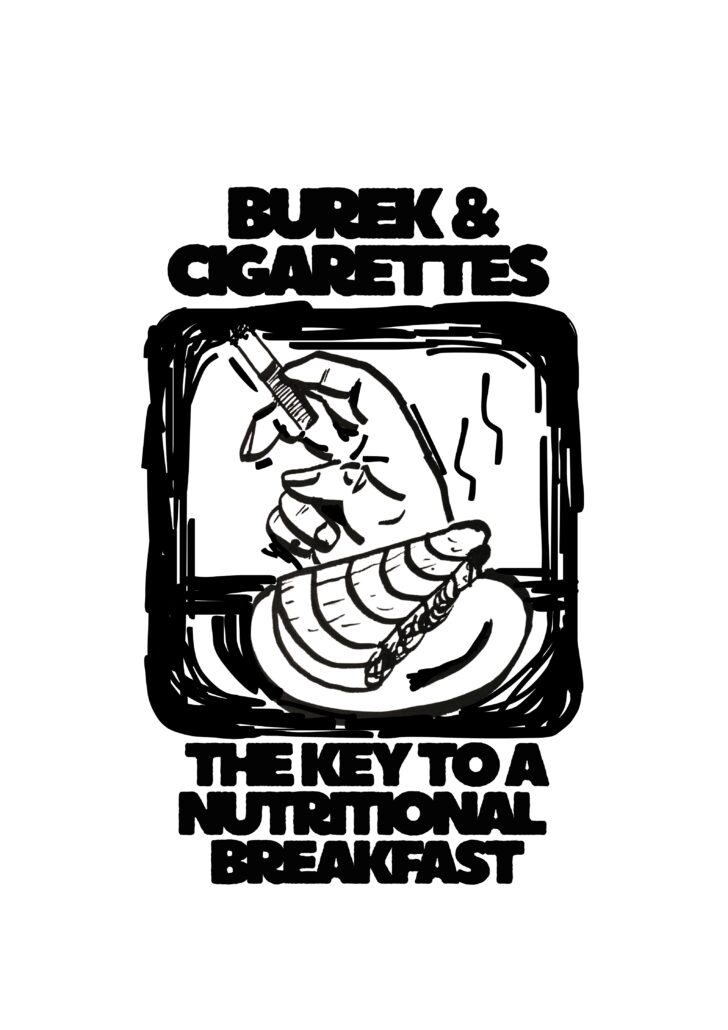
A Turkish coffee, some rakija, and a little more grilled meat later, we head back to Lukavac. There is one last touristic experience to enjoy, the Big Brother Band, who has played every week at the same club for the last twenty years, is on tonight. They are the definition of dad rock, alternating between Balkan classics I don’t understand, and English ones I can sing along to. The crowd of locals puffs away on Marlboro’s and halfway through the bands rendition of Pretty Woman I light a cigarette with them. The second hand smoke is staining my lungs anyway, maybe this is part of the field trip too. Smoking inside was outlawed in Bosnia starting January 1st this year, but looking around you would never be able to tell. There’s not a thing on this planet that could stop Bosnians from smoking inside, Andrea says.
Tomorrow we will wake up early, take showers in an apartment that hasn’t been renovated since before the war, that physically speaking is still in Yugoslavia, and drive two hours south to Sarajevo. On the way we will stop at a roadside bakery that is famous across the country for their miniature sač-baked bureks, a type of meat pie from a coal powered oven covered in ash. They are delicious and the view from the highway is beautiful, with rolling hills, small household farms and grazing sheep. I imagine New Zealand looks like this, it could almost be Hobbiton, until we come across a skull and crossbones, a sign warning of landmines just beyond the ridge. There it is, a physical reminder of the time we’re living in, after the war, always, no matter how good the burek tastes.