Earlier this year marked Anthony Bourdain’s 70th birthday, even if he wasn’t around to celebrate it. I wanted to publish this then, instead of on the anniversary of his death, though the two are intertwined in my head. I can celebrate his life twice a year; it’s a life worth reflecting on. Most are, but this is about him.
Anthony Bourdain was things, hats, titles, words. Among them were cook, writer, journalist, celebrity personality, real life personality, father, husband, brother, addict, spy novelist, Jewish, boy scout, American, and artist. An artist at living the good life, an artist as a writer, an artist at running a commercial kitchen? I don’t think he would cop to that, but I didn’t know the man. It feels like I knew the man but I didn’t. He had that effect on a lot of people. Like the regular at the bar who says hello to everybody but really just wants a quiet pint. That’s speculation because, again, I didn’t know the man. All I have is his art.
Pages and pages of writing; hours and hours of television. No Reservations, The Layover, Cooks Tour, and Parts Unknown are all great shows but it’s his non-fiction that matters most to me. Kitchen Confidential of course, but you know he gave up the royalties for that? Medium Raw, Nasty Bits, A Cooks Tour are great too. I haven’t read much of his fiction. Bone in the Throat, Gone Bamboo, Get Jiro, and what? A hypothetical history of Typhoid Mary? He gave the world a lot. First food, then words, then TV. Always a point of view. On that, he said this:
“I’m writing from a cook’s perspective. I have limited expertise. I am neither an expert or critic or a reliable guide. I approach it with a stated point of view, to be open to the world.”
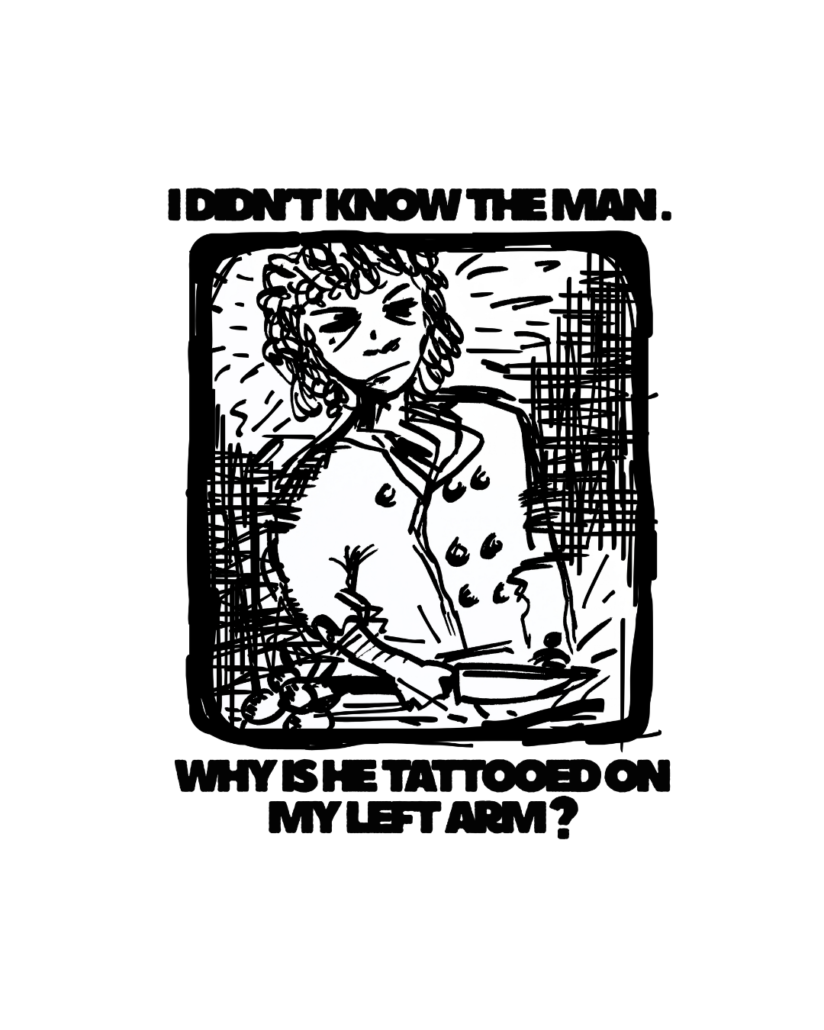
That’s from an interview in 2004, four years after Kitchen Confidential was first published and two years into his television career. I took that point of view to heart. I am what you might call a big fan. I carry him with me wherever I go, almost literally. He’s tattooed on my left arm. Well, a self-portrait he drew in an annotated version of Kitchen Confidential is tattooed on my left arm. It’s a simple ink drawing of him dressed in whites and cutting onions with tears flowing all over the page. It stunned me that even in the middle of a successful TV career, his self-portrait was as a prep cook. So I got it tattooed. Who are we really? The ink begs the question.
I have literally positioned myself at restaurant tables he’s sat at to try and figure that out. Let me see it how Tony saw it. Let me order what he ordered. Maybe it will change me.The first time I sought out a place he featured on No Reservations was in Hong Kong circa 2013. That was right around when I read Kitchen Confidential for the first time. The restaurant was Tung Po in the Java Road Cooked Food Centre. We were there for squid ink noodles and to say that we went. Here I am, telling you I’ve been. I don’t think that’s the kind of travel he was pushing for, but I’ve done it anyway. I couldn’t help it. You know that thing when you idolize an artist no matter how much they tell you not to?
Tony had that effect on people. I’m calling him Tony now.
Despite all the pain he wrote about, the masochism of restaurant labor, people still want to emulate his life. From the outside looking in, it probably seemed perfect. Eat your way through the world and get paid for it? I can only imagine their shock when they found out how he went. It turns out that, yes, you can idolize a man all the way down to their despair, not unlike the way Tony idolized the pirate crew of chefs from his first restaurant job. Where does this cycle of emulating the worst parts of people you admire get you?
Tony was upfront about his demons and the damage he caused but recognizing pain and advocating it are two separate things. He did his best to distance himself from the bad-boy chef thing he helped create. It was a shallow reading of a complicated man anyway. Fame does not insist on nuance. I am guilty of learning all the wrong lessons too. I know he was more than just a hedonist, the best episodes of Parts Unknown are barely about pleasure at all, but that’s what I dialed in on. That’s what I took from his art. That’s my problem.
Like Tony, I worked in restaurants and I considered them my life too. And even if I became a waiter because I had nowhere else to go, Kitchen Confidential foresaw that too. If you can’t be Tony, you can always find yourself in his words. I’ve found him around the world, not always intentionally.
In Toronto, I frequented a bar he visited on The Layover in 2012. It’s called Ronnies Local and it’s still there. In the episode, Bourdain sits on the same patio I liked to spend my Canadian summers drinking at. It’s one of those semi-dives with craft beer and cheap whiskey. They had a Jameson sponsor back then. It’s what I imagine Williamsburg looked like in 2013, except in Ontario.
I can’t remember if I went to Ronnies before or after Bourdain did. Does it matter? Going there knowing he had too felt good. I don’t know how to describe it. Vindication? A recognition of taste? All pretty pointless emotions. Is Bourdain the right barometer for living a life? If you look at any of the social media accounts dedicated to him, his quotes, and his photos, then absolutely. If you read his books and listen to how he talked about his own life? Maybe not.
But I couldn’t help it.
In Rome, I sought out the cacio e pepe he ate in an episode of No Reservations at Ristorante Roma Spirita. It was fine. I remember thinking the pasta was a little cold but the parmesan bowl it was served in was divine. Bourdain was still alive at the time. I still had a vague hope I would meet the man someday. That all this walking in his footsteps would lead me closer to him.
In San Francisco, six years after Bourdain’s death. I went to Swan Oyster Depot for the first time. It’s a legendary place, originally opened in 1912 and largely unchanged since, it has only eighteen seats with a marble countertop. Bourdain had reportedly been eating there for decades before filming the 2012 Layover episode that extols its glory. James Beard was a regular at Swans too. A lot of people were, celebrities and locals alike. I had always wanted to go but there is generally a line and I am generally not one to wait. This occasion was special. A good friend was visiting, a fellow Bourdain acolyte, and it was his first time in the Bay Area. We had to. Swans was on the top of his list. We took a ride-share from Oakland into the City at nine in the morning to get there before the rush. There was still a line but they gave us beer for the wait.
The line between the art and the artist, the pleasure and the hedonist wears very thin inside Swans Oyster Depot. When you’re there, you’re existing inside the history of San Francisco gastronomy, something Bourdain very much enjoyed, but it’s not like he invented eating oysters, crab backs and beer for breakfast. He just became emblematic of the right kind of misbehavior. He lived the type of life many wish they could. For a long time I tried.
“How to Travel Like Anthony Bourdain” was trending somewhere on the internet last year. It annoyed me. The way people deify him often annoys me, because I’ve done it too. Somebody had made a list of tired travel platitudes that included “embrace being uncomfortable” and “eat where the locals eat”. I wonder if this is what impressed me about Bourdain when I first discovered him? I sincerely hope not. Did I want to be him, write like him, eat like him? Sure. But you can’t dive-bar your way into travel nirvana. If you really want to travel like Bourdain you need local fixers, a production team, and occasionally Christopher Doyle to handle the cinematography.
I was the local fixer in San Francisco. After Swans, I took my friend down Lombard Street then guided us to North Beach. We weren’t just on Bourdain’s trail, but the Beats too. We passed by Mario’s Bohemian Cigar Store, perused City Lights, then stopped into Vesuvio for a drink. Bourdain was on our mind and in our conversation. He had never been to Vesuvio on one of his shows but we assumed he had been in life. It was the kind of historic divey place that he would like. You see? We felt like we knew him. We felt like we were getting to know him better with each stop.
Stumbling through Chinatown we stopped at Li Po lounge for their famous Mai Tai, but the power was out. The bartender couldn’t use the blender to make the drink so we had beer instead, lit by sun through the open doorframe. Twenty minutes into sitting there we discovered a photo on the wall. A familiar face was beaming our way from the other side of the bar. Bourdain had visited the Li Po lounge too, the photo told us. A sign we were doing something right.
The day progressed. Things got blurry. When you’re living life like a Bourdain episode things often do. I am sure his real life was not like this. I am sure of it. But I wanted mine to be. I wanted to tap into whatever life he found all over the world and live inside it forever. Overconsumption is part of that. So is curiosity.
I got too curious about all the wrong things. Like Tony, I was a thrillseeker. I just wanted to be a person, man. Now I’m a person with problems. That’s how my therapist ties it in a bow. I would never blame Bourdain or the hospitality culture that relishes indulgence for my own drinking. I wouldn’t even blame my family’s genes or the alcoholism that runs through them. We were just tapped into the same things. The shit is my own but addiction isn’t unique either. Bourdain was honest about his. It doesn’t mean we would have been friends. I like to think we would have been, but I don’t think that’s what would have bound us.
In San Francisco, with the real-life homie, we ended our tour at the Tonga Room & Hurricane Bar. One last stop on the Bourdain trail. Opened in 1945, the Tonga Room is a ‘high-style’ tiki bar in the basement of the Fairmont hotel. It’s trippy. You walk through a hotel lobby straight into a bygone era. There’s a lagoon in the middle of it and a stage that extends into its center. They’ve got the last house band in the city. We were the youngest people there by a good twenty years. The band played on the lagoons stage while we drank expensive beers and talked to a group of older Filipino women on vacation. I don’t remember how the night ended, I couldn’t even tell you what we were looking for. That was the last time I ever explicitly sought a Bourdain place out.
I started writing this piece around the same time I quit drinking. Finishing it has been like pulling teeth; staying sober has been easier than I imagined. Bourdain’s writing still means a lot to me, even if a life of pleasure doesn’t. I’m doing my best to separate the art from the pain these days.
The day Tony died, I went to eat pho. It was all I could think to do. He loved it, I love it too. How better to feel close to someone you admire but will never meet? The same day, a crowd gathered at Swans Oyster Depot to eat more food that he loved. Hundreds came to pay their respects in the only way they knew how. Were all of us just wounded worshippers in the Church of Bourdain? Were all of us just fucking pathetic?
I didn’t know the man.
Why is he tattooed on my left arm?