The November days of Augusta are among the most anticipated events of the year for natural wine enthusiasts. In its third edition, the Turin-based fair welcomed many visitors, both Italian and international, all united by a shared vision of wine rooted in values that are widespread worldwide: ecological production processes, the expression of terroir in the wines, and the central role of the winemaker.
Yet, beyond what is found at other fairs driven by similar perspectives, Augusta carries a further, essential ambition: one that builds a community around sustainable agriculture, one that brings into everyday life an ethics of consumption aligned with the principles of the viticulture showcased at the fair. Over time, natural wine, the true centre of the event, has become a catalyst, bringing people together through tasting and leading them to discover other artisanal worlds such as beer, chocolate, coffee, and a wide range of food experiences.
Augusta is subsequently reshaping the very idea of a fair, moving beyond a physical and time-bound event to become a cultural movement grounded in a manifesto. One that begins with wine but is meant to infuse a broader relationship with the world.
It is no coincidence that this year’s edition unfolded across the city of Turin, with events held in a host of different venues aligned with the fair’s principles, many open to a wider public beyond wine enthusiasts. This reflects a persistent belief that drinking natural wine can reshape the way we think about food and consumer choices. The two-part series titled Thinking Wine, conceived with journalist Eugenio Signoroni, brought together key voices from the natural wine world to discuss drinking in times of crisis, the philosophy of sensitive production, and how choosing a certain kind of wine can open a more complex understanding of production systems. These are seen as interlocking mechanisms, where respect for nature and its cycles becomes an economic force capable of countering the standardization of industrial methods.
In the first session, Gian Marco Antonuzi, a winemaker from Gradoli and among the first in Italy to challenge conventional thinking around wine, joined Rachel Signer, writer and founder of Pipette Magazine, and Anika Foster from the online platform More Natural Wine. Their conversation examined how perspectives on natural wine have evolved since its early days, and on what its future might look like, especially in a moment of constraint that is affecting the wine sector across Europe. For Gian Marco, whose winery Le Coste has introduced many enthusiasts to the philosophy of natural wine, being a winemaker means inhabiting a specific place in the world.
“We inhabit the vineyard, which itself exists within a delicate ecological system,” he says, “balanced between human work and nature. To live the vineyard means to be part of it. I hear people talking about a crisis in wine and about the possibility of uprooting vines to reduce production. Such solutions may be viable where artisanal viticulture does not exist. Uprooting my vineyard would mean tearing my roots from a place. This, too, is what natural wine means. It goes beyond the glass. It concerns places, natural systems, men and women. Ultimately, it is about life.”
For Rachel, who lives in Australia but often travels to Italy and speaks fluent Italian, addressing the global decline in consumption means rethinking the language of wine.
“With Pipette,” she says, “I have told the story of natural wine through the humanity behind it. As Gian Marco was saying, there is a fundamental difference between the figure of the natural winegrower and the industrial wine supply chain. I believe that difference lies in the relationship with the plants. I am currently writing a book to help people understand how to drink natural wine and how to speak about it with the right language. Natural wines have profoundly changed my taste, and therefore my relationship with food. Through this book, but also by guiding people through natural wine estates in Italy, I am trying to give people the right words to speak about natural wine”.
Gian Marco nods and adds, “The taste of our wines is alive, full of energy. It cannot be compared to industrial beverages. We are talking about a different kind of economy. I cannot compare my scale of production with that of a company that farms thousands of hectares in unsuitable areas and, using chemicals in the vineyard and in the cellar, ends up putting on the market something that, by technical standards alone, can be called wine.”
Anika Foster is the youngest of the speakers. Her experience with wine has likely not required a break from a conventional past. For her, wine is simply natural. Together with her partner Chris, she runs a wine shop in Berlin and one of Europe’s most followed online platforms, whose wine club boldly describes itself as “the best fucking natural wine club in the world.”
“We speak to a specific audience whose average age is relatively young,” says Anika. “I believe that, for our sector, the economic crisis can be addressed by building customer loyalty and offering something that is simple and immediate: natural wines made by skilled and dynamic winemakers. For many of our customers, entering the world of natural wine means becoming part of a community they identify with, and whose codes of interaction they adopt”.
At Augusta, the term natural wine is one of these shared codes. Its meaning is largely taken for granted yet defining it was the focus of the second Thinking Wine session, open to all participants but with a particular attention to students and those approaching this world for the first time. This almost philosophical discussion brought together two outstanding winemakers: Elio Sandri of Cascina Disa in Perno di Monforte d’Alba, in the heart of the Langhe, and Stefano Pescarmona of Podere Magia in Emilia, between Parma and Reggio Emilia.
For the latter, natural wine is closely tied to the essence of place and to observation. “Practicing biodynamics,” he says, “is, for me, the best way to enter the subtle relationships between soil, plant, and celestial influence, which together carry the energy of a place into a glass of wine. Observing, day after day, is part of the ancestral knowledge of farmers, something that conventional viticulture has tried to replace with standardized protocols. But a natural approach does not mean anarchy. There must be organic certification, at both a regulatory and institutional level, to clearly distinguish those who work conventionally from those who work organically. This distinction needs to be communicated clearly to consumers. Organic farming is the result of political struggles fought in the name of healthier food systems”.
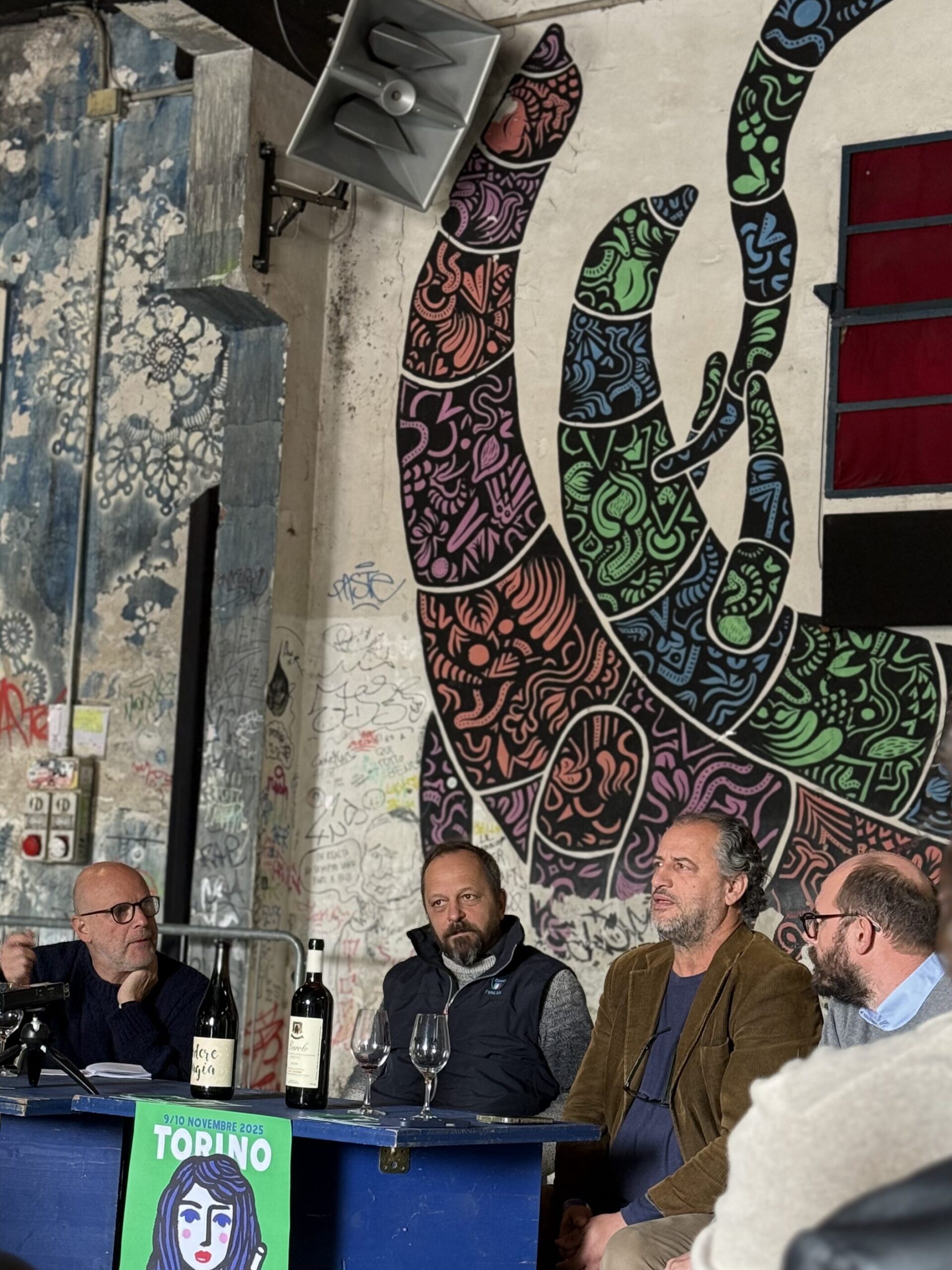
If for Stefano the natural is a bridge between ancestral knowledge and today’s eco-political struggle for organic farming, Elio Sandri shifts the focus to time. “For a winemaker, time is a precious resource. My wines evolve through a process of self-formation, without intervention on my part. I have been working since I was sixteen, and my experience has led me to a deep, attentive listening to the seasons and to the vineyard. Everything has its own time, and so does wine. It is not possible to intervene according to recipes, as many consulting oenologists would suggest. Each harvest is different, and wine behaves according to its own nature within that difference. I accompany it, but I do not intervene; if anything, I wait for it. From this approach come wines that are ever-changing, yet consistently expressive of their place of origin, each year in a unique way.”
The young people in the room listen in awe, suspended somewhere between disbelief and revelation, as the winegrowers speak. It suddenly feels possible that a single glass of wine might hold not just flavour, but conviction, memory, and a vast depth of values and emotion. They will leave and become new members of a community that Augusta is forming around the healthiest values of agriculture.