From Bangkok to London, Burmese food is finding new audiences. As chefs navigate questions of authenticity, adaptation and status, who gets to define a cuisine as diverse as the country it comes from?
Few cuisines make it globally. Italian and Japanese, for example, are culinary shorthand. Suggest either, and most diners will have a good idea of what to expect. Suggest Burmese, and many hesitate.
“They don’t know where Burma is … and they don’t know it’s called Myanmar,” says Zaw Mahesh, co-founder of Lahpet, a pioneering Burmese restaurant in London.
Myanmar sits between culinary giants: India, China, and Thailand. Its food has been shaped through centuries of exchange with its neighbours, while developing traditions that are distinctly its own. Yet ask what Burmese cuisine is and an answer is elusive.
The terminology itself is unsettled. In English, “Burmese” is often used as a national adjective, but it can also be understood as referring to the majority Bamar population. Here, it is used as an imperfect umbrella for food from Myanmar, and this ambiguity is part of the story.
In some ways, the cuisine’s limited international profile is surprising. “For fans of Southeast Asian cuisines”, as food writer Julia Moskin wrote in The New York Times, “discovering Burmese food is the adult equivalent of finding a new playground, right in your neighborhood.”
Myanmar’s decades of isolation, briefly eased in the 2010s before the 2021 coup and the triggering of a much broader phase of civil war, have limited exposure. Few outsiders encounter the cuisine at its source.
Yet, abroad, Burmese restaurants are quietly starting to thrive. Their growth has been driven by longstanding migration from Myanmar, including waves of conflict-driven displacement. Bangkok, a little over an hour’s flight from Yangon and home to a large community of Myanmar nationals, likely hosts the greatest concentration of Burmese eateries outside the country.
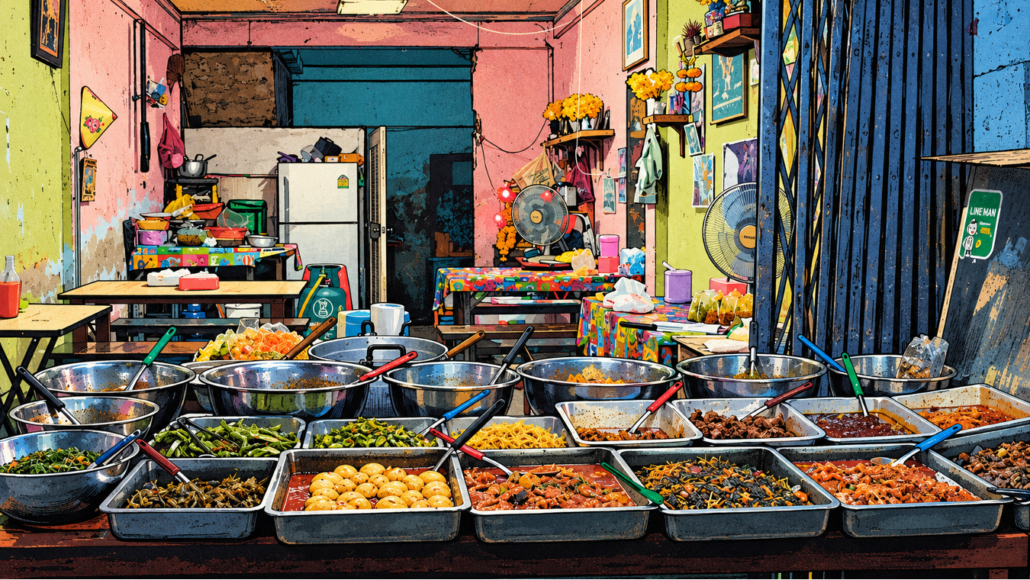
If you know where to look, Burmese fare abounds. You’ll find it served at street carts, shophouse eateries, canteen-style restaurants, and more polished dining rooms. You’ll even find Burmese dishes sneaking onto unlikely menus. At Propaganda Bar, “Myanmar tea leaf salad” sits beside “Chicken nuggets” and “Propa fried chicken”, added after a Burmese waitress persuaded the owner.
Most, like Hpa-An restaurant in Phra Khanong, referred to by some as Bangkok’s “Little Myanmar”, cater to migrants seeking an affordable taste of home.
For Rangoon Tea House, one of the few upscale restaurants taking the cuisine to new audiences, expanding from Yangon to Bangkok was an obvious move: ingredients are easy to source, and many former employees had already relocated to the city. “Proximity to Myanmar is a huge bonus,” says co-founder Htet Myet Oo.
With branches in Thong Lor, one of Bangkok’s more affluent neighbourhoods, and ICONSIAM, a luxury riverside shopping centre, Rangoon Tea House plates the cuisine on a glitzier stage with Instagram-ready décor.
Cities like Bangkok and London offer lesser-known cuisines a chance to gain recognition. But how does a cuisine introduce itself? Who decides what it represents, and the status it attains?
The challenge of defining Burmese cuisine
“When you’re in Myanmar itself, there’s no such thing as Burmese cuisine,” Htet says. “You have different regions and ethnicities.”
Myanmar is one of Asia’s most ethnically diverse countries. It is home to a Bamar majority and numerous ethnic minority groups, including the Shan, Karen, Rakhine, Chin, Kachin, Mon, Karenni, Rohingya, Wa, Naga, and Pa-O peoples. Many have fought for greater autonomy or self-determination since Myanmar gained independence from British colonial rule in 1948.
The country’s geography is equally varied, encompassing the fertile Ayeyarwady river delta, the dry central plains, the Shan highlands, the easternmost fringes of the Himalayas, and a long tropical coastline. Together, these landscapes form a rich tapestry of food traditions.
That diversity creates both freedom and responsibility. Without a fixed blueprint in the minds of international diners, chefs abroad have unusual power to define the canon as well as to flatten or preserve regional variation.
“There’s almost a responsibility on the diaspora,” says UK-based Burmese food writer MiMi Aye. “We could do a really good job at misleading people. No one is going to challenge us.”
For MiMi, some ingredient substitution is acceptable when a cuisine travels, provided flavours remain true. “We can’t get half the stuff we want,” she says. “If it tastes right, I’m happy.”
She draws the line where substitutions change a dish’s identity. “Let’s say you got served spaghetti Bolognese, right? And you were expecting them to bring out the Parmesan. And they came and crumbled Stilton over it … are you going to say, ‘Oh, it’s the same. It’s all cheese.’?”
This isn’t to say there is no room for experimentation. Reinterpretations, she says, are welcome so long as they are presented as such. She disagrees when diners are misled about how a dish should taste.
And, so what is Burmese food?
Arguably one of the more authoritative voices on the cuisine of Myanmar – at least for English-language audiences – is Naomi Duguid. In her book, Burma: Rivers of Flavor, she describes a pantry built around peanut or sesame oil, dried red chillies, turmeric powder, roasted chickpea flour, dried shrimp, shrimp paste, fish sauce, tamarind pulp, lime, shallots, garlic, and ginger. Compared with many neighbouring cuisines, chillies are used sparingly during cooking, with extra heat added at the table.
Rice is the staple. Noodles are common. Curries made with fish, beef, pork, chicken, vegetables or eggs play a central role. Thokes, or salads, for want of a better English word, are abundant, though they may bear little resemblance to what Western diners imagine (see tea leaf salad, below). According to Zaw, Thoke doesn’t necessarily mean salad and could be better translated as “hand-mixed”; they can be warm or cold dishes, he says.
Meals are generally served family-style. Dips, relishes, pickles, and fresh vegetables are integral to a meal. Combined with rice and curries to individual taste, they make each bite different. As Naomi Duguid writes, “it’s the extra dishes on the table that make eating in Burma such a special pleasure, mouthful by mouthful”.
Discussions over a possible national dish often settle on mohinga. This rice-noodle soup is made with a fish-based broth, with sliced banana stem adding texture. It is commonly eaten for breakfast. The recipe varies across the country: different regions favour different fish, broth thickness varies, either chickpea flour or toasted rice may be used as a thickener, and garnishes and spice levels differ from place to place.
Mohinga, according to Mimi, “is widespread enough that we can say it’s a national dish”. Though she is careful to note that there are “loads of variations”.
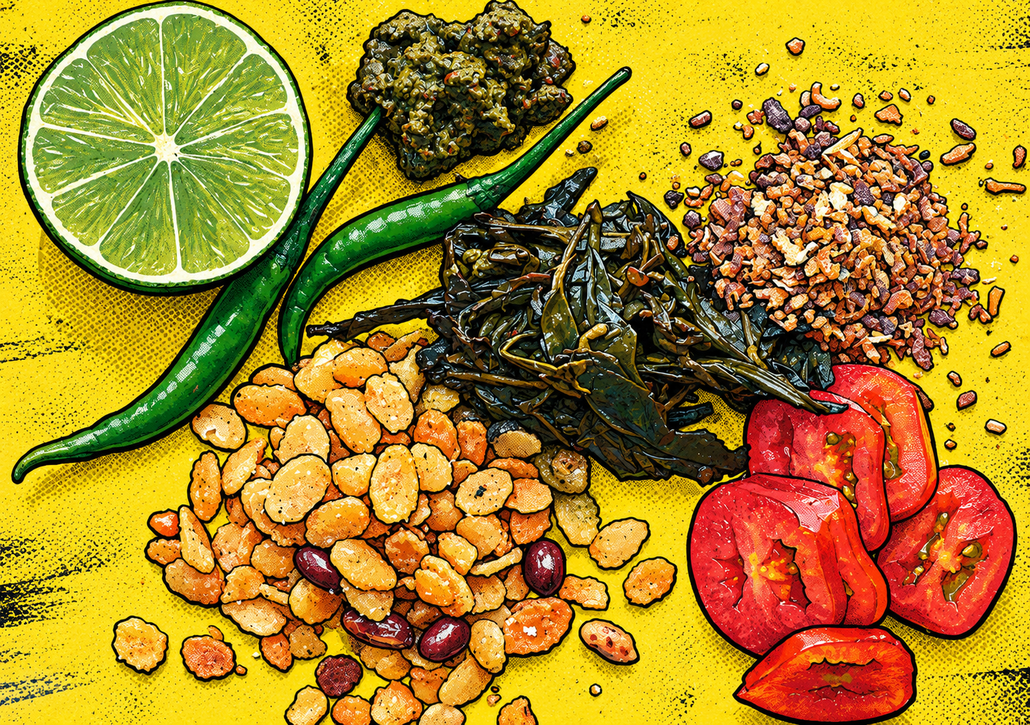
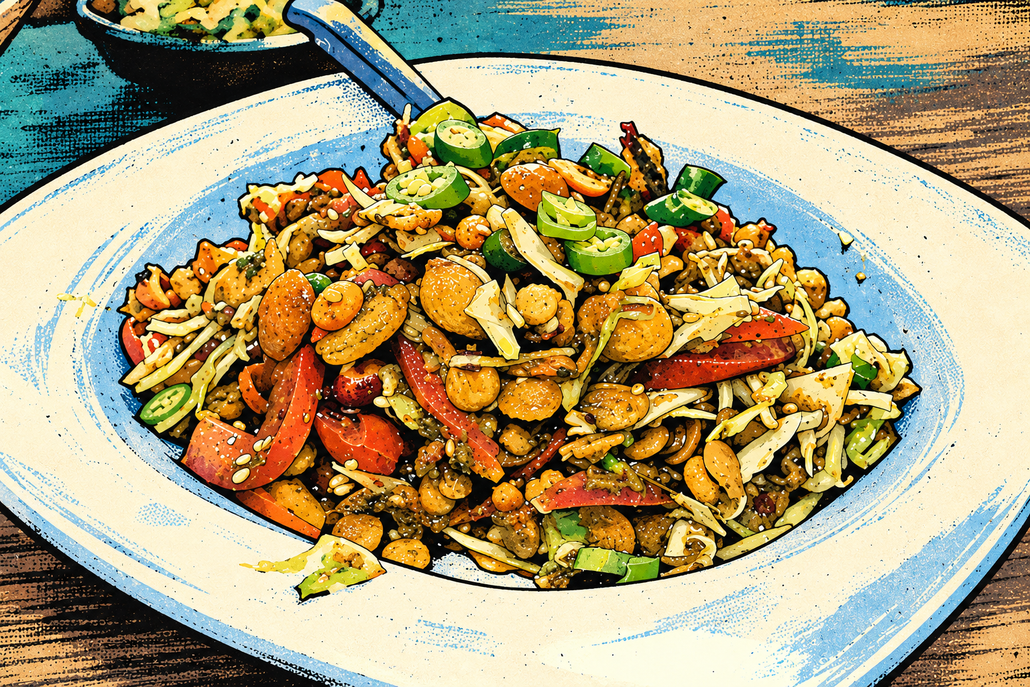
Tea leaf salad is the strongest rival candidate. “If you’re going to a Burmese restaurant anywhere in the world, I would assume tea leaf salad is top of the list of best-selling dishes,” says Htet. The dish combines fermented tea leaves with roasted peanuts, split peas and beans, dried shrimp, garlic, green chilli and lime. Diced tomato and shredded cabbage are sometimes added.
Reducing Burmese cuisine
Yet, just naming mohinga and tea leaf salad plays into another danger when a cuisine is exported: reduction to a handful of archetypes, as happened with Indian cuisine and its butter chickens and biryanis. Familiar dishes provide an accessible entry point, but they can flatten a national cuisine, obscuring the richness of its regional traditions.
Despite talking and writing about Burmese food for two decades, MiMi says she still doesn’t see herself as an authority. “I don’t think you can at all,” she says. “Whatever you try to introduce … is going to be a fraction of what is actually out there.”
Acknowledging this matters because cuisines are granted differing levels of nuance. In Britain, for example, French restaurants can readily identify themselves with regional traditions such as those of Provence, Alsace or Lyon. Indian restaurants, by contrast, have historically been more likely to present themselves as simply “Indian” than as Bengali, Goan, Keralan, or Kashmiri, although this has begun to change.
Familiarity helps to create demand for specificity. Where regional foods are unfamiliar, they are less likely to be sought, valued, or marketed. Food from Myanmar faces the same challenge.
Adapting and translating food for a new audience
With the “majority of people, you can’t spend a whole day explaining what the country is like,” says Htet from Bangkok. “There are dishes that we’ve created, trying to celebrate different parts of the country … but sometimes it doesn’t translate to the guest appreciating them as much as we had wanted.”
In London, Zaw says some adaptation is unavoidable: “The salt is different. The oil is different. You know, the water is different.” Even “proper Burmese rice” is unavailable.
Customers shape the menu too. “My diners are not Burmese, so I cannot go ‘Burmese Burmese’,” he says. “If you want proper Burmese food in the UK, come to my house. In my restaurant, I have to go for the British palate.” Some late-night diners and pregnant customers, for example, prefer to avoid the caffeine in tea leaf salad, while some dishes have been adapted to be eaten with a knife and fork.
Other changes are imposed by regulation. UK food-safety rules make it harder to serve food at room temperature or leave dishes on the table, practices that are common in Myanmar.
Sometimes a menu is not enough. At Rangoon Tea House’s ICONSIAM branch, a tea leaf salad station stands at the entrance to educate and draw new customers in. “The restaurant is beautifully designed. The team is really good. It looks like a very enticing place, but for a lot of people, just seeing a nice-looking restaurant is not enough, especially if they’re so unfamiliar with Burmese cuisine,” Htet says.
Moving through the hierarchy of taste
Not all cuisines are afforded the same level of prestige.
Sociologists describe a “global hierarchy of taste”: certain traditions, French and Japanese for instance, are perceived as refined and technically demanding, accruing cultural capital and commanding higher prices.
By contrast, food from much of the so-called Global South is often perceived as lacking culinary sophistication and is expected to be both cheap and “authentic”.
But authentic to whom? Food scholar Krishnendu Ray describes authenticity as a subjective search for accuracy and sincerity. Diners value it, but narrow expectations can confine chefs to the flavours or dishes that have already become stereotypical. Burmese cuisine has barely entered this hierarchy: by which yardstick are diners judging its “authenticity”?
Krishnendu sees Burmese cuisine benefiting from a broader cultural shift. Increasingly, he says, there is a search for the “more remote, more quaint, more distant, and less known”. Sociologists call this “omnivorousness”. First observed in studies of American musical taste, the idea is that acquiring cultural capital increasingly comes from demonstrating range, rather than exclusivity.
“Old-fashioned snobbery is being flipped on its head,” Krishnendu says. “To be cool, I’m listening to hip hop and bluegrass and global pop and maybe some Indian music, a little bit of Bollywood.”
The same logic can apply to food, and cuisines on the margins can leverage it for some degree of upward mobility in this global hierarchy of taste. Prestige comes less from eating at the most expensive restaurant than from cultivating a reputation as a curious, cosmopolitan diner with the knowledge to appreciate many culinary traditions.
Twenty-five years ago, culinary prestige in many Western countries was closely associated with French fine dining; today, the ability to move comfortably between Burmese tea leaf salad, regional Mexican cooking, natural wine and Korean makgeolli becomes its own form of cultural capital.
“To be cool, you rarely or never say, ‘I don’t eat that’ or ‘I don’t listen to that’,” Krishnendu says. “The coolest place to be is I eat everything, I have preferences, I like certain things.”
Krishnendu suggests that “food is almost a generation or two generations behind music”. Digitisation allows music to circulate almost instantly; food still depends on people travelling, migrating, or opening restaurants.
The power of geography
For Htet, geography may help. “One of the reasons Mexican cuisine is so popular is proximity to America,” he says. “If a certain percentage of India, China, Thailand, and Malaysia celebrate Burmese cuisine, I think that will start to go a really long way into putting it on the global map.”
Krishnendu sees the same opportunity. As millions in neighbouring China and India join the middle class, he argues, they seek experiences beyond their basic needs. “They want to see the world; they want to eat other people’s food.”
Bangkok, he suggests, is one of the cities at the centre of this growing flow of Asian tourism and, with it, coming back to omnivorousness, “a thin section of adventurous eating.”
The future
MiMi is optimistic about what’s coming. Reflecting on an article she wrote about London’s Burmese restaurant scene, she says it “was a real joy”. Only a few years earlier, she would have struggled to find enough restaurants to write about.
“For decades we had one place that was on Edgware Road, one place called Mandalay, and then the odd place that would pop up and then disappear.”
The arrival of Lahpet, Zaw’s restaurant, marked a turning point. “Lahpet came along, and that was just wildly exciting because it was the first time it felt like, oh my God, Burmese food, people will understand it.”
MiMi is also encouraged that flavours are not being overly softened to meet Western expectations. She points to ngapi, the fermented fish or shrimp paste that provides the deep savoury foundation of much Burmese cooking. Its pungent aroma can be challenging to the uninitiated, creating a temptation to tone it down.
“There has been a real danger historically that we just cook the stuff people get,” she says. “Now, I don’t think that is happening anymore … people are being proud about the flavours.”
She hopes that within five to ten years the cuisine will be familiar enough and she’ll no longer have to revert to saying “it’s a bit like Thai food” as an imperfect and inaccurate shortcut.
Fast-forward a decade, Htet says, and he would be surprised if Burmese cuisine were not better known, perhaps even mainstream in places. “All you need is one hip Burmese restaurant in a country you didn’t expect,” he says. “That might inspire the next generation.”
Perhaps, one day, the English language will adopt the word thoke, much as it has mezze, tapas, thali, and dim sum, to name but a few.
It’s about more than food
For MiMi, recognition is not only about culinary status. It is also about empathy.
“I want people to care about Myanmar,” she says. “If you’re interested in the cuisine … it might make you more interested in the country.”
The idea echoes the concept of gastrodiplomacy, typically a state-led effort to build soft-power and shape national image. In Myanmar’s case – amid military rule and civil war – where the state lacks the moral authority and capacity to undertake such efforts, the role can be assumed by citizens and diaspora.
Cooking, Krishnendu suggests, is a form of “people-to-people” diplomacy, a way of intervening in the world that is a little more material than words alone.