We do countless things without ever stopping to ask whether they still make sense. We celebrate birthdays by repeating tired rituals, stand in long, exhausting queues under the blazing sun for an ice cream, pack ourselves into concerts only to watch them through our phone screens. Other things, though, force us to ask a different question: do we still need them? Natural wine fairs fall squarely into that second category. It is far from a trivial question. In 2026, we buy bottles online, follow winemakers on social media, and all it takes is a barely trained algorithm for wine to keep appearing on our screens even when we were looking for a new pair of shoes. So if the entire wine world has become this seamless, immediate and ubiquitous, why spend an entire day wandering from one tasting table to the next?
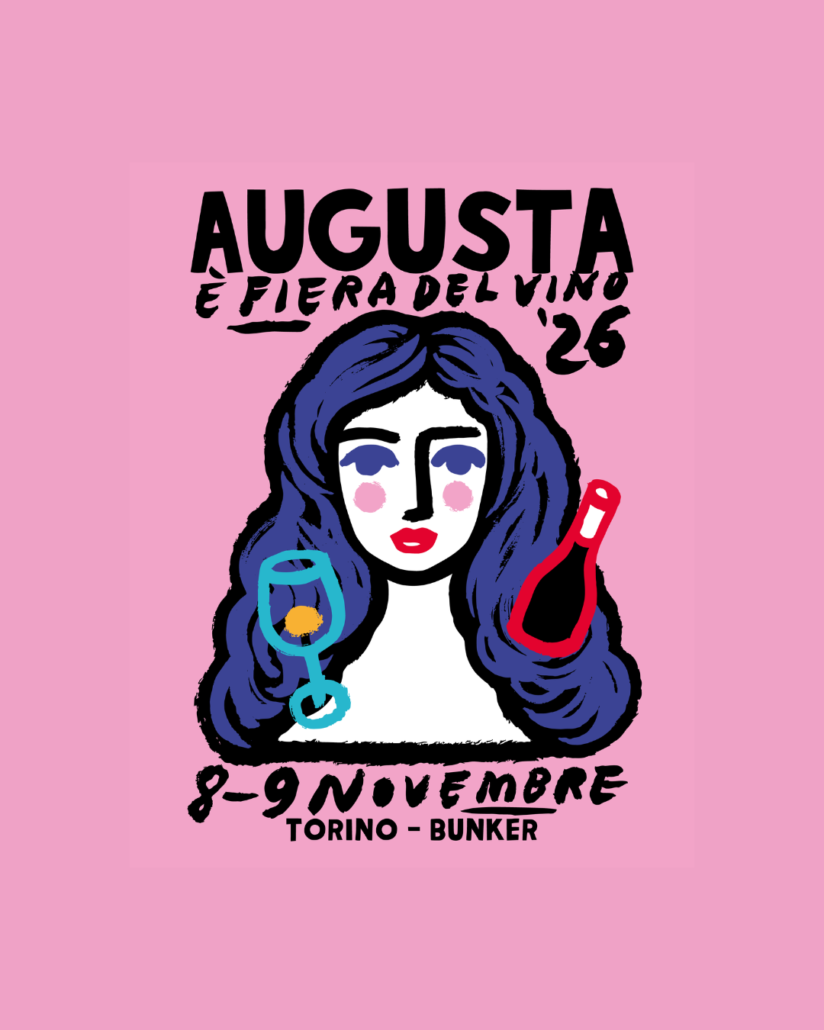
On 8 and 9 November, Augusta, Turin‘s natural wine fair, will once again fill the spaces of Bunker for its fourth edition. Ticket sales are already open, with early bird tickets available until 2 August. The occasion offers the perfect excuse to rewind three years and revisit a question that concerns not only Augusta, but the world of natural wine as a whole: does a wine fair still make sense?
The curious thing is that the first person to ask this question was the very man who conceived Augusta: Piero Crocenzi. Most people who organise a wine fair begin with the unshakeable conviction that a wine fair is worth having. Piero started from precisely the opposite assumption: doubt. In the summer of 2023, around this very time of year, when Augusta was still little more than a theoretical idea waiting to be tested, he got into his car and began clocking up miles across the hills of Piedmont and the wine valleys of France. He spent hours on the phone, but above all he did something we do less and less these days: he showed up in person. He wasn’t looking for exhibitors to slot into a catalogue through the kind of impersonal application process that so often defines a trade fair. He was looking for answers.
“I asked them very direct questions about the mood of the moment. I wanted to know whether they still felt the need for a wine fair, and whether they believed it could genuinely strengthen the natural wine movement – especially in a market that, as it has matured, has stretched the supply chain and pushed producers further away from consumers. Right from the start, I encountered an extraordinary level of trust. They believed that someone whose profession is organising events could create something truly meaningful and genuinely useful for the sector. For me, that was an immense vote of confidence.”
His research revolved around two main areas: Piedmont, for obvious geographical reasons, and France – particularly the Jura region. “It’s an extraordinary wine region, but one that has unfortunately become the object of intense speculation, fuelled by the current obsession with ‘Instagrammable’ labels. Augusta, by contrast, wants to tell the story of a deeper France—one that never loses sight of substance beyond the social media image. That core group of producers undoubtedly helped shape the fair’s international identity.”
Over the past twenty years, the landscape of artisanal wine has changed dramatically. From the pioneering days of the early 2000s to the media-fuelled boom of more recent years, the surge in public interest has brought undeniable economic benefits – but it has also widened the gap between producer and drinker. Between those who work the land every day and those who eventually pour that wine into a glass now stand agents, distributors – even influencers – along with an increasingly opaque pricing system that risks turning what was once a fundamentally democratic product into a speculative luxury. This was precisely the landscape Piero was trying to make sense of during that journey: to understand whether there was still a need for a place capable of bringing those worlds back together. The answer came just a few months later.
“I remember the closing moments of the first edition with absolute clarity. I’m a perfectionist—the sort of person who’s never completely satisfied. And yet, at that moment, we were met with such profound gratitude from everyone who had taken part that it suddenly expanded the boundaries of what I thought this project could be. Until then, the goal had simply been to lay the first foundation stone. But when producers – even those who were less expressive or with whom I hadn’t built a particularly close relationship – came up to me in the days afterwards and said, ‘Something different happened here,’ I realised that Augusta wasn’t just a one-off event. It could – and it should – become a long-term project.”
Looking back now, that first edition laid the foundations for something Italy had arguably been missing: a distinctly human architecture, long familiar at natural wine fairs across the Alps, where conviviality and the pleasure of sharing take precedence over the rigidity and exhibition formalism that still characterise many Italian trade fairs. “A great deal of the project’s emotional drive came from the fairs I started attending in France after 2015. Experiencing them both as an event organiser and as an enthusiast made me realise that Italy lacked anything with that kind of atmosphere. Italian fairs often felt rather uninspiring, whereas crossing the border sparked something in me: I caught a glimpse of an environment that simply didn’t exist back home, and I wanted to build it.”
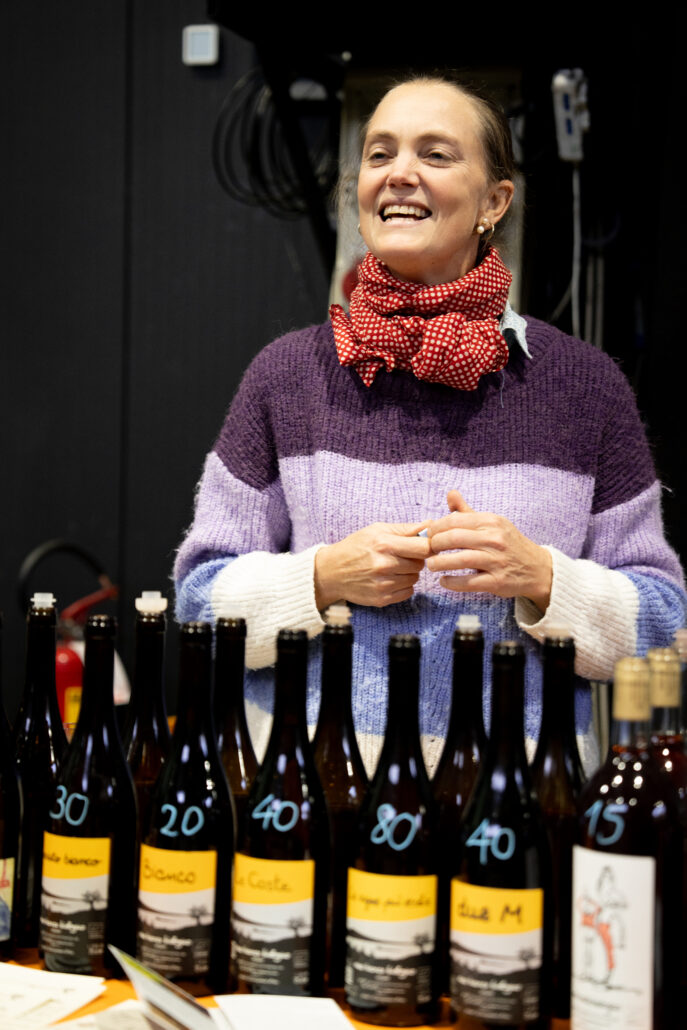
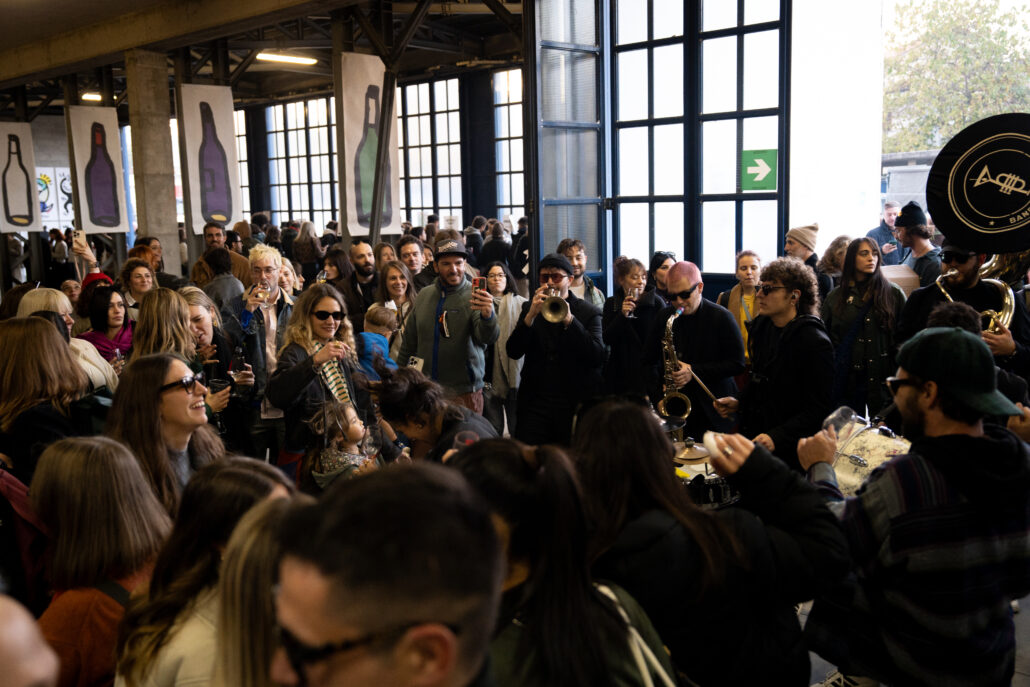
The decision to anchor the fair in Turin—resisting the temptation to turn it into a travelling format with a second edition in Rome—proved to be one of Augusta’s defining choices. As Piero admits with disarming honesty: “One thing I wouldn’t do again is rethink the event as a double edition. Perhaps the fact that it never materialised was proof that it wasn’t the right idea in the first place.” To understand what Augusta really is, you have to start with its roots—and not just its geographical ones. Augusta is Turin’s natural wine fair, and even its name makes that claim, borrowing the city’s Roman name: Augusta Taurinorum. The project was conceived by Piero Crocenzi and developed together with project manager Lucia Telori, art director Gianluca Cannizzo (My Poster Sucks), and a team united by a clear ambition: not to create another wine marketplace, but a place where wine is, before it is a product, a meeting between people.
The mistake we make most often when standing at a tasting table is turning the conversation with the winemaker into a viva in applied oenology. We ask about days of skin contact, fermentation methods, barriques, percentages. We nod knowingly, as though that’s the best way to understand a wine. But is it? I put the question to Piero: what’s the one question visitors should be asking – yet almost nobody does?
“People usually come to the stand with highly technical questions. I’d much rather see the conversation shift towards everyday life: the rhythm of the seasons, what a year looks like for a grower, the deeply personal reasons why a wine is made the way it is in relation to a particular place. Once you understand the person and the land, you begin to see why two completely opposite winemaking decisions, made in two different contexts, can both be the right choice. We need to look beyond the liquid in the glass and start asking about life.”
The lives of the producers. Perhaps that is what you really taste at Augusta—and what we set out to tell through our Augusta Stories series. Farming that refuses shortcuts is an all-consuming vocation, one that leaves very little room for time off. Piero recalls something Ezio Cerruti, winemaker, once told him during one of their conversations: “I don’t go on summer holidays the way you do. I might steal the occasional weekend away, but I can’t leave the vineyards unattended for days at a time. I have to be here to see what’s happening.” That single sentence captures the very idea of agriculture that Augusta seeks to bring together. “What all these producers share is the complete overlap between their lives and their work. Making wine isn’t a profession they step into each morning—it’s woven into the fabric of their existence. Unlike many other fairs, we’ve built Augusta around agriculture first and foremost, and around the ability to carry out every stage of winemaking independently. Our producers don’t rely on consulting oenologists: they’re winegrowers who look after both the vineyard and the cellar. They’re united by a radical commitment to farming without synthetic chemicals, fermenting without selected yeasts, and avoiding forced stabilisation. These are practices that would make life considerably easier. Instead, they consciously choose the longer, steeper and far less predictable path. Even in difficult vintages or when fermentations become challenging, they refuse to compromise.” That commitment is also what inspired the desire to distil these shared principles into a manifesto—not to draw the boundaries of an exclusive identity, but to state, with complete transparency, what Augusta is, and what it intends to keep building.
It is a vision that has also been shaped by looking towards France, and to figures such as Bruno Schueller and Patrick Meyer.““They see wine as something for everyday consumption, no different from bread. When the supply chain becomes too long and too many intermediaries get involved, the final price risks distorting the place that the grower originally intended for that bottle. Producers like Patrick and Bruno think about this constantly. For them, it’s essential that wine remains something everyday, something accessible.” Bringing producers face to face with the people who ultimately drink their wines is also Augusta’s way of stripping away the aura of luxury – and the opacity around pricing – that can sometimes come to surround natural wine.
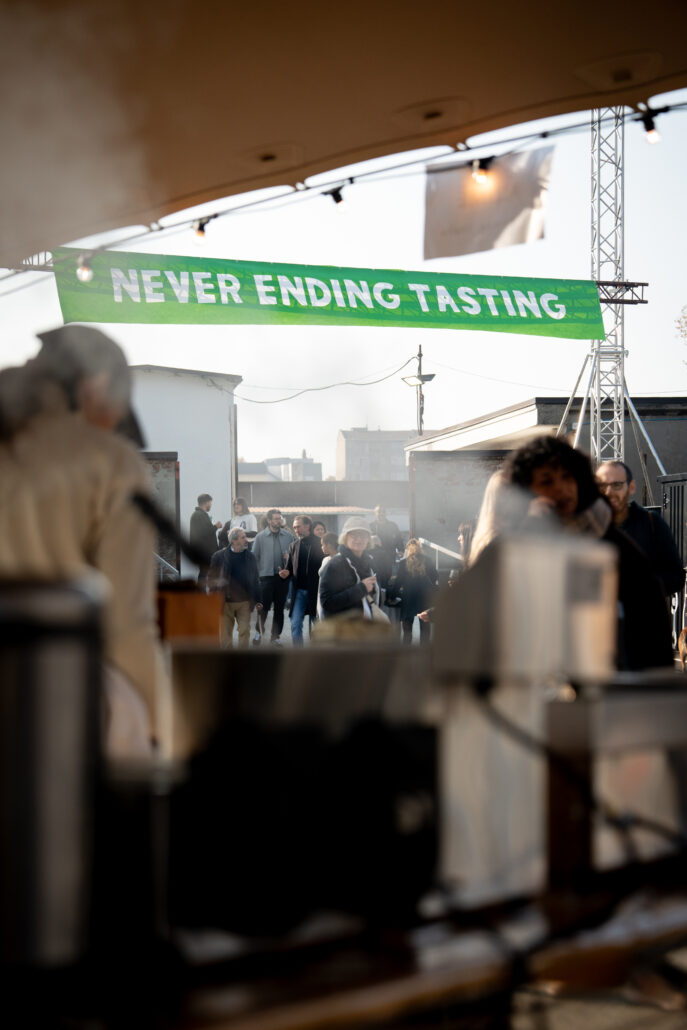
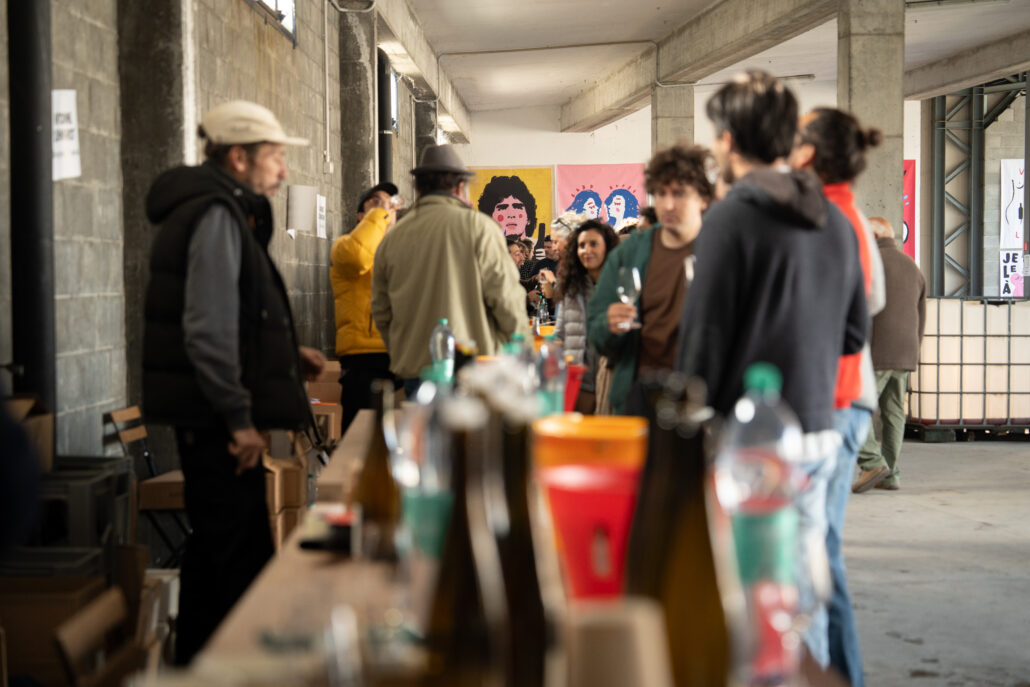
Augusta has grown into one of Italy’s key reference points for natural wine – with more than 70 producers from across Europe taking part last year, and a similar number expected this November. Much of that success lies in its remarkable ability to foster a genuine sense of community through an atmosphere that is relaxed, celebratory and genuinely inclusive. “At Augusta, wine sits at the centre of everything – but never on a pedestal. We bring together historic winegrowers and emerging producers who share the same philosophy, and we try to convey that ethos both to private visitors and to people working in the trade. At the same time, we create a welcoming environment for the growers themselves: an informal space where different generations can meet, exchange ideas and spend time together. Standing behind a tasting table pouring wine all day can be exhausting, but at Augusta the atmosphere is so easy-going that everyone does it naturally – with enthusiasm and genuine pleasure.”
Augusta’s identity is reflected unmistakably in the people who attend it: well over half of its visitors are under forty. For many of them, buying a ticket is not simply about tasting hundreds of wines. It’s about the opportunity to speak directly to the people who make them – without intermediaries. That same philosophy informs many of the fair’s organisational choices. There’s Augustina, a dedicated space for children, created so that families can experience the fair without having to choose between their passion for wine and caring for their children. Monday is reserved entirely for trade professionals, offering restaurateurs, wine merchants and distributors a quieter, more focused setting. And visitors can buy bottles directly from the producers themselves, shortening in a very tangible way the supply chain that has been at the heart of this story.
If the first edition was an act of faith, and the ones that followed helped cement Augusta’s identity, then 2026 marks the fair’s coming of age. As it does every year, Augusta has also given its visual identity a new skin, allowing the imagery to evolve alongside the story it wants to tell. After yellow, red and green, this year’s colour is pink: expressive, open-hearted and unapologetically free. Much like the wines Augusta celebrates. Much like the future it imagines.
“We’re now at a point where the natural wine bubble of recent years needs to be thoughtfully recalibrated. The supply chain has grown longer, and that once direct relationship between producer and consumer has been lost. In this context, Augusta feels a responsibility to reinforce those connections—to join the dots and restore direct relationships between everyone involved: winegrowers, distributors, restaurateurs, wine merchants, and ultimately the people who drink the wine. 2026 must be the year in which this network is truly consolidated.”
Don’t expect Augusta to grow by simply adding more producers – “there’s a limit, both in scale and identity, that we want to preserve.” The line-up, already available online, will once again bring together winegrowers from across Europe. Augusta’s growth is measured differently. It is qualitative rather than quantitative, reflected in a more informed public, in the cultural evolution of the natural wine world as a whole, and in its ability to preserve the sense of community it has patiently built over the years. I ask Piero if there’s a single word that captures the spirit of Augusta 2026 more than any other.
“I always struggle to choose just one word, but this year I’d say energy. The energy a wine conveys the moment you taste it is the defining criterion of our selection – and it’s what made me fall in love with natural wine twenty years ago. Too often it’s dismissed as a trend or treated as a niche choice. In reality, deciding not to use synthetic chemicals in the vineyard or selected yeasts in the cellar is a far more demanding path, pursued with a very clear purpose: to allow the wine to express a different kind of energy—something vibrant and alive. That vitality also carries its own fragilities. Technicians might call them faults. I prefer to call them fragilities, because when a winegrower chooses to release that bottle anyway, it means that characteristic is part of its identity. And when those fragilities find their balance, something remarkable happens in the glass. It’s something the natural wine world too often forgets. That’s why I want 2026 to put energy back at the centre.”
I’m not sure we still need another natural wine fair. I am sure we need Augusta. Our glasses are already full of fairs and marketplaces. What we’re still thirsty for this energy.