How long does it take to make a single nigiri?
I mutter it under my breath, annoyed, to the man sitting beside me. I’ve been waiting for twenty minutes. The restaurant feels like a furnace. No fans. My T-shirt is plastered to my skin. The man next to me is soaked with sweat too, he loosens the knot of his tie. Instead of answering my question, he simply clears his throat. People in Tokyo are incredibly formal.
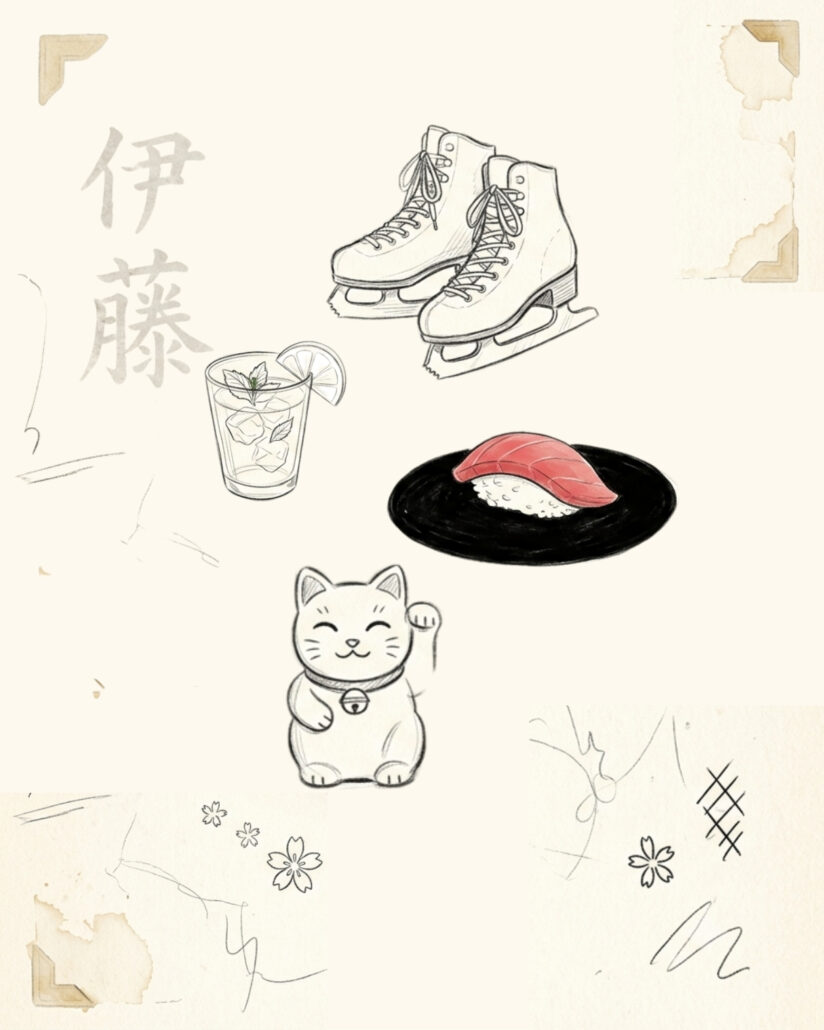
I came here straight after practice. My skate bag rests at my feet, my legs still throbbing from the workout. For a moment, I’m back on the ice. I hear my blades carving into it. Focus. Jump. My body spins into the air. Then the fall. I’ve been trying for weeks, and it always ends the same way.
The sushi chef has to be at least ninety. His eyes never leave his work. His wrinkled hands tremble almost imperceptibly as he slices the fish with excruciating slowness. The restaurant seats ten people at most. Every stool is taken, yet no one is really talking. Just the occasional complaint murmured under someone’s breath. A chair scraping across the floor.
I open my calendar. It looks like a rainbow. Private lessons are red. Group sessions are yellow. And green? Green is free time. Ever since I moved here, there hasn’t been a single patch of it. I check WhatsApp. Refresh my chats. Still nothing, and it’s already nine.
Excuse me.
I raise my voice a little toward the chef. He doesn’t seem to hear me.
Excuse me. How much longer?
Slowly, he looks up, as though I’ve interrupted a thought. Then he picks up a small black plate from the counter and slides it toward me. There’s one nigiri on it.
…And the rest?
The words come out louder than I intended.
I’ve been here over twenty minutes.
He lifts one hand just enough to mean later, then goes back to work. I’m left sitting there with my chopsticks, unsure what to say. Then my phone vibrates. My coach.
Akari, I know Nationals are around the corner. But I don’t have room to squeeze in another training session.
I type back immediately.
Just one hour. I won’t take up any more of your time. Tomorrow at ten?
The typing bubble appears.
Akari, it’s not that I don’t want to give you extra sessions. I don’t even want you coming to tomorrow’s practice. It’s obvious you need to rest.
Without thinking, I brush the knee I landed on today. Pain shoots up my leg. I ignore it. Another message appears.
See you Wednesday. Not before.
I turn my phone face down. Then I shove my skate bag farther beneath the counter with the tip of my foot, a little harder than I mean to. The man in the tie shoots me a disapproving look.
I start rummaging through the pockets of my tracksuit for my wallet when a small hand sets a cup of tea in front of me. It belongs to the waitress, the only one in the restaurant. She’s elderly too, slightly stooped, wearing a white apron embroidered with tiny red flowers.
Please forgive my husband. He can be a little gruff. She smiles. Old age. And he’s deaf in one ear. She nudges the cup toward me.
This one’s on the house.
I return the smile, barely, and lift the glass to my lips more out of politeness than curiosity. I expect something weak, watery. Instead, the tea is bright and refreshing. The lemon arrives first. Then a warm hint of spice lingers on my tongue. For one brief moment, the heat stops crushing me. I take another sip, the ice clinks softly against the glass. She watches me with quiet satisfaction before retreating with a small bow.
Outside, a light rain begins drumming against the gray pavement.
The nigiri still sits untouched on its little black plate. I study it for a moment before picking it up with my chopsticks. At first, all I notice is the warm rice and the delicate flavour of the hamachi, the Japanese amberjack, but as I chew and close my eyes, letting it fill my mouth, the fish begins to melt slowly on my tongue, soft, almost buttery, mingling with the gentle tang of the rice. I eat it in a single bite, not a grain of rice falling back onto the plate, and before I can even slide it toward the counter, the chef sets another plate in front of me without a word. This one holds four nigiri, and I thank him with a small bow.
For the first time since I arrived, I really watch him.
Every plate is prepared with care. Every movement has purpose. He wets his hands, scoops rice from a wooden container, shapes it with gentle, practiced fingers. The waitress moves beside him in silence, placing bowls and ingredients in his hands before he even reaches for them.
When I’ve finished, she smiles at me again and sets another plate in front of me. We always end with something sweet. It’s an Anpan. I look at the golden bun, and before I even take a bite, I can already imagine its soft, pillowy texture. The image comes to me at once: my mother in the kitchen, her hands kneading dough.
My mom used to make these for me before every competition – I say – she always said they brought good luck.
She used to make these for me before every competition,” I say. “She always said they brought good luck.”
So did my mother.
The waitress takes a large book down from a shelf and hands it to me. It smells of old paper, its pages filled with faded photographs of the restaurant through the years. She points to one of them. I recognise her at once: a little girl with two black pigtails sticking out from her head, holding a woman’s hand, the restaurant in the background. I learn that her name is Kiko. The chef’s is Hiroku.
There used to be lots of places like this. Kiko gives a small shrug. But they’ve all disappeared. The big chains drove them out, one after another. I think of the giant red sign for Sushiii, a three-story fast-sushi restaurant just a few streets away. Kiko turns to Hiroku, who goes on working as calmly as ever.
Restaurants are different now. You tap a screen, and a few minutes later your food arrives at the table on a conveyor belt. We’re too old for that.
Here, we still make sushi right in front of people, one piece at a time. It costs more, but we’re fine with that. Some things can’t be rushed or left to machines. They need care. They need time to breathe.
I take out my phone to send my mother a picture of the Anpan, but all I see on the screen is the rainbow of my calendar. I press and hold tomorrow’s red block, then delete it. In its place, a blank space remains.