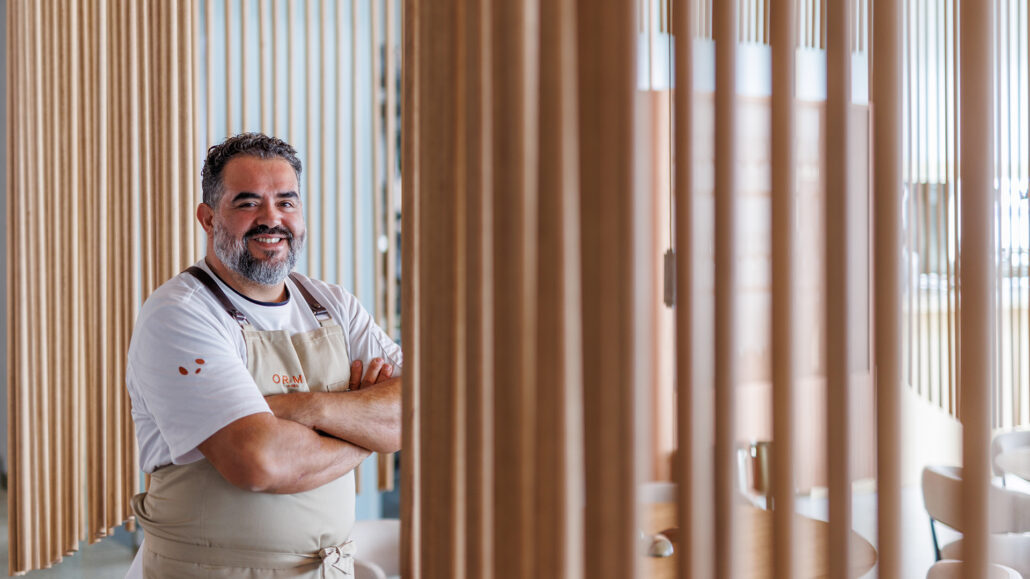
Imagine a noisy group of teenagers strolling the streets of Bogotà in the 1990s with a single goal in mind: to reach the arcade and spend all the money they’ve saved in the past few days. Among them, there is an unusually tall teenager, who accompanies the group with one particular thought in mind: to invest his pesos at the fruit kiosk, in order to once again savor one of his favorite foods. That boy watches in reverent silence as the papaya is being cleaned, waiting to sprinkle a dash of lime on his slice to make the bite even more delicious and refreshing. “I’ve always had a visceral relationship with food; even today, I can’t resist, I have to taste everything. But it’s thanks to this curiosity that I’ve been able to build my culinary consciousness and knowledge.” Roy Salomon Caceres can easily be described as a citizen of the world: Colombia, Mexico, Syria, and Italy are just the main stages of a life and professional journey with novelistic traits, spanning across continents and often developing unpredictably, thanks to a series of events fueled by a good dose of enthusiasm and recklessness. Roy is now an established chef who has made his extremely identity-driven gastronomic vision his hallmark, an approach to raw materials and creative ideas that has found a new home at Orma in Rome, his latest challenge.


“When I thought about the project, I understood that Orma had to be for me a space where customers could have the opportunity to relax; a place where it is pleasant to be, designed to have the fewest corners and edges in the architecture, to be soft, rounded through waves and curves.”
It’s a concept of emotional well-being that pays tribute to nature and naturalness with colors and materials,
“engaging people in a dynamic and never static path, starting from an open space and continuing into the heart of the venue. Interaction and dialogue are the key elements to understand the type of work we’re doing,” Roy reveals at the center of his new “home,” a place he admired for years (for its large windows and beautiful terrace) and has now become, almost by chance, the new gastronomic stage.”
Log in or subscribe.