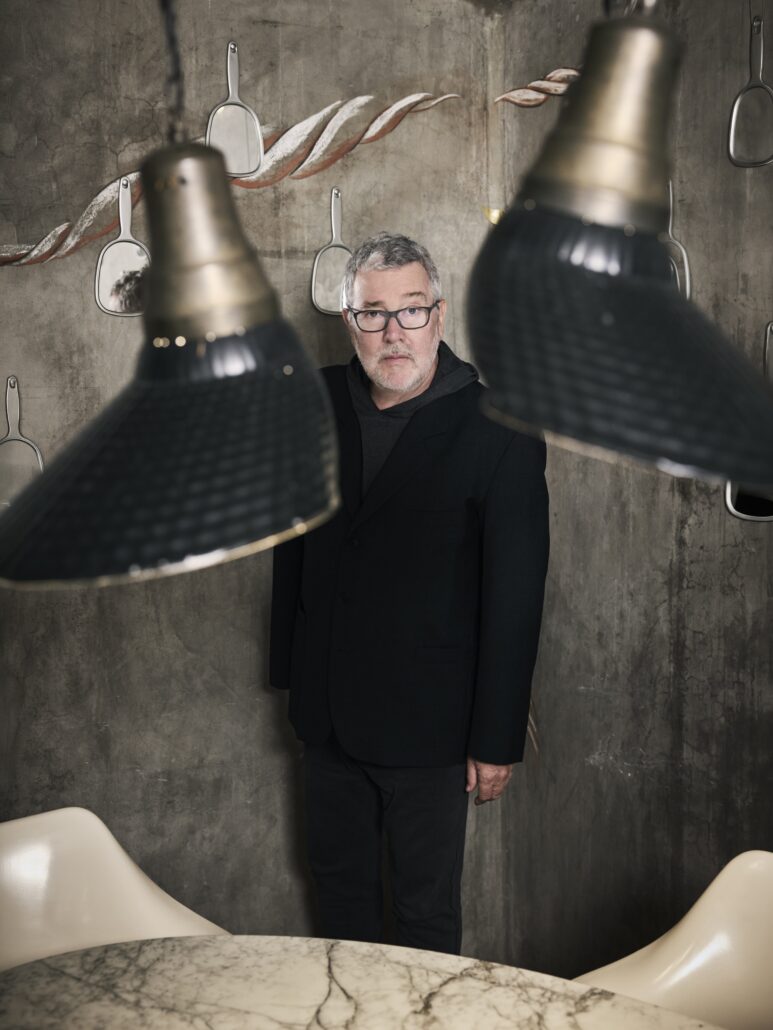
Between Paris and Venice, historic restaurants and unconventional ideas, Philippe Starck and brothers Massimiliano and Raffaele Alajmo have spent almost fifteen years building a creative partnership shaped by mutual understanding, a sense of play and artistic freedom. Two stories, two perspectives, offering a look at a unique collaboration from both sides, where design and gastronomy meet.
Interviewing Philippe Starck is a little like pressing the “PLAY” button without knowing the rules of the game. He is mischievous, brilliant, gently provocative and rarely where you expect him to be. A devotee of simplicity in the kitchen, he can – by his own admission – give complex answers. Beneath the rigour and precision of the designer, you glimpse the eccentric epicurean, the indefatigable dreamer. He may joke as he asks for “short questions, please, because I have the memory of an oyster”, but nothing escapes him. After a knowing glance at his wife Jasmine, he willingly plays along with the interview, provided it doesn’t encroach on aperitivo time.
The critic Curnonsky famously said that “you don’t go to a restaurant to eat the curtains”. And yet… Why do you think the décor and lighting have become such an integral part of the restaurant experience today?
PS: Everything is a sign, everything is a symbol, and everything influences us: volumes, materials, reflections, colours… Each element carries meaning and sends a subliminal message to our brain. It is all part of the experience you are about to have at the table.
So, what does a designer really bring to a restaurant?
PS: Everything matters, but above all the flow, the way people move through a space. More important still is the film you want them to step into. You do not create a restaurant simply to decorate it. You prepare a restaurant as you would a film. A book. A story you are about to tell. A designer has to imagine what guests will see, but above all, what they will feel. What will they take away from it? What will it add to their lives? Will it make them more creative? More in love? Will it wake them up? Design is a wonderful educational tool, a beautiful machine for speaking to the subconscious.
You’ve shaped the identity of many restaurants over the years. Do you remember the first one you designed?
PS: Yes, a very long time ago, in Les Halles in Paris, which was still a place of freedom then, a subversive neighbourhood, for better and for worse. That was where the first slightly chic restaurant opened. Well, not chic exactly, but a little more considered. It was called Centre-Ville, and I was quite pleased with it because it was very warm, very pleasant, with a central bar. But above all, I had invented movable illuminated walls. The geometry of the space could change constantly thanks to these panels on wheels, which provided light while also creating separate areas. It was completely new, and it worked incredibly well.
Does creativity, for you, start with the stomach? In other words, do you need to taste the food before agreeing to design a restaurant?
PS: Oh, absolutely. In fact, I’ve been eating 100% organic for about forty years, and for the past twenty I’ve only drunk wines without sulphites. My wife Jasmine and I try to eat as healthily as possible. We’re so obsessive about it that we even have our own farm, where we produce our eggs and grow our vegetables… So yes, it’s true, I wouldn’t get involved with just any restaurant. And even when I agree to design one, I can’t help – with permission, of course – offering a little advice to the chef and the client. Advice which, I admit, very quickly turns into lessons, and then into moral lectures (laughs). I always try to steer the chefs in the places I design towards healthier, more wholesome food, because we’re not there to poison the people we welcome.
Did you first meet the Alajmo brothers around a table?
PS: “We met through a Parisian restaurateur who ran several places serving wines without sulphites. He introduced me to the Alajmo brothers and that was when, for the first and last time in my life, I cheated on my wife (laughs). Because we fell madly in love. Me with them and, perhaps, them with me. I’ve had the most wonderful times with Raf and Max. They have an immeasurable humanity, an elegant sense of freedom and a kind of structural humour. It was with them that I learnt not to empty my glass before moving on to another wine, even if it was a different colour. And many other liberating, creative things. They are quite an extraordinary duo. Raf is a sort of Falstaff, concealing a man of great sensitivity, an almost feminine sensitivity. And then there’s Max, with his rare elegance, who only ever says things of astonishing intelligence, brilliance and poetry. When he says something, you need to pause for a moment to grasp the quality of what he has just told you. And he does it all without seeming to, in this soft voice, like an ear of wheat swaying in a dream.” (He slowly mimics the movement with his arm.)

After agreeing to work with them on the renovation of Stern and later Quadri, you said you wanted to preserve a sense of mystery and create a feeling of escape…
PS: Yes, it’s mystery that interests me. There’s a song by Alain Souchon (Ed.: a hugely popular French singer) that says: ‘It’s not so much Suzanne that I love, it’s the mystery inside her.’ And I still believe that, of course. About women, and about everything. I don’t believe in anything supernatural, but I do think everything gains depth through the stories that materials, colours and light are constantly telling. Here at Stern, the place is very dense, very weighty, with unusual materials such as gilded Cordoba leather and strongrooms with these telluric, Cyclopean doors. I simply amplified a place that was already an “elsewhere” and turned it into an “elsewhere beyond elsewhere”. A place with rabbits hidden in corners, strange little drawings on the ceiling of the safe, texts that can only be read backwards, wolves in the window wearing diamond rivière necklaces, and all these photographs that we bought ourselves, almost one by one, and tucked into the frame of the mirror.
How do you make your mark as a designer when working with listed historic interiors?
PS: The point is not to leave your mark. When I arrived at Stern, and later at Quadri, those places were asleep. Some of the life had gone out of them. They existed in two or three dimensions, and I wanted to give them a fourth – perhaps even an infinite dimension: the dimension of dreams.
Mirrors are a recurring presence at both Quadri and Stern. Are they a way of opening a passage into another dimension?
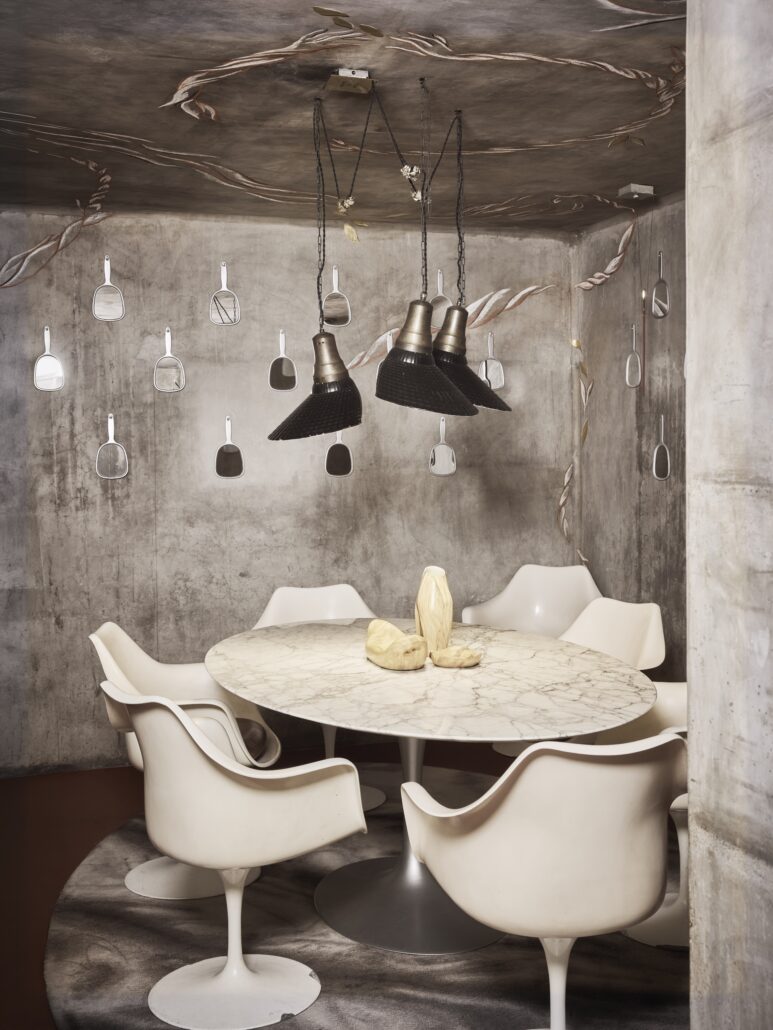
PS: Mirrors are very important to me. They remind us that every way of seeing is subjective. Even when we believe it to be objective. Their reflections, their diffractions and refractions of light are mathematics invented by human beings. When you look into a mirror, you see human genius in its most beautiful expression: the poetry of mathematics.
Can a designer’s creative, visionary, sometimes provocative side exist without drawing on traditional craftsmanship?
PS: I don’t think the two are connected. If I take myself as an example, when it comes to creativity, I’m like a high-level athlete. I’m talking in terms of quantity – I wouldn’t presume to speak about quality. All my ideas come out of nowhere. They arrive like diagonals, mostly in the shower, and very often I’m completely unable to explain them.
At Quadri, you asked the Venetian Bevilacqua workshops to reinterpret traditional grotesque motifs in a modern, surrealist way, including the faces of Massimiliano and Raffaele. How did they react?
PS: (Smiles) Raf and Max said something very, very, very sweet. They said: ‘It’s a shame, we forgot to put yours in.’ With Raffaele and Max, there are mind games going on all the time. Everything with them becomes playful, poetic. They’re the best partners in those games of the mind.
You’ve had fun rethinking all sorts of tableware – the “Hot Bertaa” kettle, the “Juicy Salif” citrus squeezer… What about doing something with the Alajmos?
PS: Five or six years ago, I was supposed to design a tableware collection with them. I never did it. They’re furious, and I’m sad. (laughs)


In the meantime – until you perhaps get around to designing it – do you have a favourite kitchen utensil?
PS: I’d say the chopping board. I don’t cook any more, but when I had the time, I loved peeling and chopping vegetables. So, at six in the evening, I’d take out my chopping board, my Laguiole knife, and start peeling onions, cutting them into little pieces, slicing away with this very Japanese sense of pleasure, efficiency, precision and elegance. Everyone was happy to have a drink and watch me do it. It became a kind of performance, a ritual.”
“I’d say the chopping board. I don’t cook any more, but when I had time, I loved peeling and chopping vegetables. Around six, I’d get out my chopping board and my Laguiole knife and start peeling onions, dicing them, slicing away with this almost Japanese sense of pleasure, efficiency, precision and elegance. Everyone would happily have a drink and watch me. It became a kind of performance, a ritual.
Did you have a signature dish?
PS: Let me tell you how it used to work, back when I lived in Montfort-l’Amaury, west of Paris. Florent Pagny (Ed.: a well-known French singer) – who is a bit like an adopted son to me – would always come and spend the weekend with us. On Saturday mornings we’d set off on our off-road bikes and head to the market in Rambouillet. We’d buy vegetables, stuff them into our rucksacks and, because we’d kept the stallholders chatting so long that we’d made them late, we’d help them load their vans. Back home, we’d empty the contents of our rucksacks onto the table and eat almost everything raw. I don’t like complicated things and, strangely enough, I don’t really like mixing things either. One of my favourite dishes, in all its purity, is a soft-boiled egg in three versions: one with white truffle, one with caviar and one with salmon roe. That kind of thing makes me very happy. I like dishes that are very simple, but incredibly fresh and made with excellent ingredients. That’s why my two favourite cuisines are Japanese and Italian. Both are about bringing out the best in the ingredient, rather than overpowering it.
What is it about you that feels Italian?
PS: Probably a sense of proportion, an instinct for scale and dimensions. That changes everything, because harmony comes from composition and proportion. And that is something we’re losing, even though it makes all the difference. Italians have it in their DNA. There’s always that extra touch of elegance.
What would you say is the definition of bad taste?
PS: My idea of bad taste would be wanting to do what everyone else does. Worse: actually, doing it
Do you have a guilty pleasure?
PS: Italian pop music (musica leggera), French pop music… popular music from everywhere. I have a fairly good knowledge of what is known as classical music, so I can recognise what is beautiful in other kinds of music too. And in popular music there is more respect in the way it is performed, because the freedom of that music does not require you to respect a prescribed interpretation, whereas classical music does – and yet it is often scandalously mistreated. I know that sentence is convoluted. I have no idea how the translator is going to get out of that one. (laughs)
What does your ideal dinner look like?
PS: It’ll be the meal I’m having later with Raf and Max. Not because it’ll be good – it will be – but because we’ll be together. The ideal dinner is the one you share with the people you love. I could eat instant mashed potato if I were with the woman I love. Shame she’s not here…” (He pretends not to look at Jasmine. She shakes her head, amused. It is already time to move on to the ideal dinner itself.)
All right? Can we go and have a glass of wine now?


If walls could talk
Can you mix a superstar French designer, two ambassadors of Italian gastronomy and heritage-listed settings, and expect the recipe to work? Apparently so, judging by what came out of the meeting between Philippe Starck and the Alajmo brothers, and the transformation of two institutions: Quadri in Venice and Stern in Paris.
What happens when you bring together a superstar French designer, two ambassadors of Italian gastronomy and heritage-listed interiors? In the case of Philippe Starck and the Alajmo brothers, the result is the reinvention of two institutions: restaurant Quadri in Venice and Stern Ristorante in Paris.
The designer first met the Alajmo brothers nearly fifteen years ago at the Passage des Panoramas, one of the covered shopping arcades that began appearing in Paris at the very end of the eighteenth century. At number 47 stood the workshop of the celebrated engraver Stern, whose commissions included printing menus for the Élysée Palace. It was here, in a historic setting already shaped by an attention to both décor and gastronomy, that Raffaele and Massimiliano decided to open their first establishment in France.
The idea of bringing the place back to life quickly took hold – provided they could find a designer who shared their vision of what a restaurant should be: somewhere you simply feel good.
RA: I was a great admirer of Philippe Starck’s work. Two weeks after we first met, he happened to be in Venice with his wife Jasmine. He asked me to explain what we wanted to do at Caffè Stern. They had a dinner reservation half an hour later. I convinced them we needed more time. They changed their plans. We had dinner, we laughed, and that was it!
The adventure could begin.
An invitation through the looking glass
A joyful, playful adventure, judging by the fantastical world that still unfolds as you step into Stern today. A breath of Baroque spirit has brought the old wood panelling, gilding, Cordovan leather and former vault room back to life. Murano glass chandeliers cast a soft light that flatters the complexion and warms the interiors: here, a stack of books inviting you to settle in for the day; there, hats seemingly left behind with studied carelessness by gentlemen passing through.
In place of conventional pendant lights are glowing tea towels, as though they had simply been hung up after service. A profusion of colourful cushions adds to the feeling of home. But don’t be fooled by the cosy appearance. There is something highly considered about this nonchalance – a kind of sprezzatura applied to the interiors, cleverly echoing the idea of “thoughtful simplicity” that Massimiliano Alajmo uses to describe the cuisine at Stern.
In this reinvented bacaro, where playfulness and trompe-l’œil also make their way onto the menu – as in the cappuccino alla bolognese, served in a cup but made with potato cream and ragù – Philippe Starck has added his own sense of fantasy and a touch of children’s storytelling. There are coyotes posing in the window with diamond necklaces around their necks, and a winged rabbit wearing a watch on a long chain, unmistakably reminiscent of the White Rabbit from Alice in Wonderland. From there, it is only a small step to imagine Starck inviting us through the looking glass. And it is a step easily taken, as if by magic, transporting us to Piazza San Marco in Venice, where the designer also set out to “make the walls speak” at Quadri.
MA: Wherever Philippe Starck works, he likes to tell a fable. But he never imposes anything on you. He leaves you free to tell your own story.”
RA: He’s a visionary. “Not someone who wants to impose his ego or personality on everything. He listens. Always. And when he takes on a project, he puts himself in the customer’s shoes and thinks about the experience he wants to give them. There are so many details that 99% of people never even notice.”
Like the faces of the two Alajmo brothers, hidden among the bronze and gold motifs of the surrealist wall covering Starck commissioned from the Bevilacqua weaving workshops to replace the old red walls.
A logo that reflects the acqua alta
While Venice’s finest craftsmen restored the floors, frescoes and window frames to their original beauty, Philippe Starck brought back a sense of magic. Without ever ignoring the history of the city, or the regular rise of the lagoon waters. On the ground floor, all the table legs and the furniture at Quadrino and Gran Caffè Quadri – both exposed to the acqua alta – are made from raw brass. As it oxidises, the material retains the marks left by successive floods.
Quadri’s logo, too, had to reflect this defining feature of life in Venice. Each letter was therefore crafted in brass by the renowned Venetian foundry Valese. The letters combine two finishes: polished and gleaming above, raw and oxidised below. As though they, too, had been touched by the rising water.
Light, touch, form, music…
The craftsmanship of Murano’s glassmakers also makes its presence felt upstairs, through spectacular chandeliers and the orange-tinted glass plates that decorate the tables, as though coloured glass had melted into pools in the sun. The enveloping play of light creates a cocoon around each table.
M&R: Lighting, light itself, is the first thing we notice in a restaurant. It changes the entire atmosphere.
For them, the design of a place begins with its mood. Then comes the tactile dimension.
MA: Even with the glasses, which Raf designed, it was important to create different sensations. That’s why there are slight variations, tiny imperfections in each stem, which reveal that they are handmade.
And the XXL glass created by Raffaele? A mischievous response to the doctor who advised him to stick to one glass of wine a day… This particular glass can hold the equivalent of a full bottle!
Massimiliano designs all the tableware himself, working in collaboration with a ceramicist.
MA: Shape and colour matter because experiments have shown that they can alter our perception of taste,” the chef explains. “Flavours seem sweeter on a round white plate. A square plate can make them seem more acidic. You can even trick the brain through what the food is served on. That’s what we wanted to do, for example, with the fish hot dog, which we serve on a dog-shaped holder. People really feel as though they’re eating a classic sausage (laughs). Sound also affects our perception: when the music is loud, we perceive alcohol and crispness less. With techno music, on the other hand, we tend to focus more on acidity
For anyone who still thinks restaurants and design are two disciplines too far apart to complement one another, the Alajmo brothers offer a culinary metaphor:
M&R: What is an emulsion? It is fat and water mixed together. Two things that, on paper, are opposites. And yet there is a way, a technique, that allows them to come together – and what emerges is extraordinary. It becomes something else entirely.