It’s impossible to visit Il Gusto di Xinge twice in a row and find it exactly as you left it. The rooms seem to have a mind of their own, constantly changing, rearranging themselves and putting their pieces back together according to some categorical imperative. Or at least, that’s how it feels to someone who, like me, doesn’t live in Florence.
Viale Belfiore: not far from Santa Maria Novella, but far enough beyond the Fortezza da Basso to find yourself surrounded by more cars than tourists. Approaching from across the street, the restaurant named after its founder has a distinctly Hopperesque silhouette: a corner window, vertical blinds on one side, neon lights wrapped around a strobe-lit sphere on the other. Inside, however, there are no cigarettes, bourbon or beers ordered in the moonlight during a late-night stop along the highway. Instead, it feels like a scene from a David Lynch dream that was never filmed: Mulholland Drive has somehow found its way to Florence, and the boundary between dreaming and waking has grown so thin it has disappeared altogether.
The chef and owner is Xin Ge Liu, a young Chinese woman born in 1993 who moved to Italy at the age of eighteen to study Fashion Design at Florence’s prestigious Polimoda. And, with a little help from fate, this is our third conversation in what I hope will be a long series. Sitting down with Xin Ge, who is practically my age but somehow carries herself with a hell of a lot more wisdom, is both remarkably easy and almost impossible when it comes to getting her to reveal what’s going on inside her head. Perhaps because her thoughts simply move at a different speed: instinct leads, action follows. Or, to put it another way, Xin Ge doesn’t wait for anything to be handed to her on a silver platter. If you can dream it, you can do it. And here, we’re well beyond the realms of metaphor.
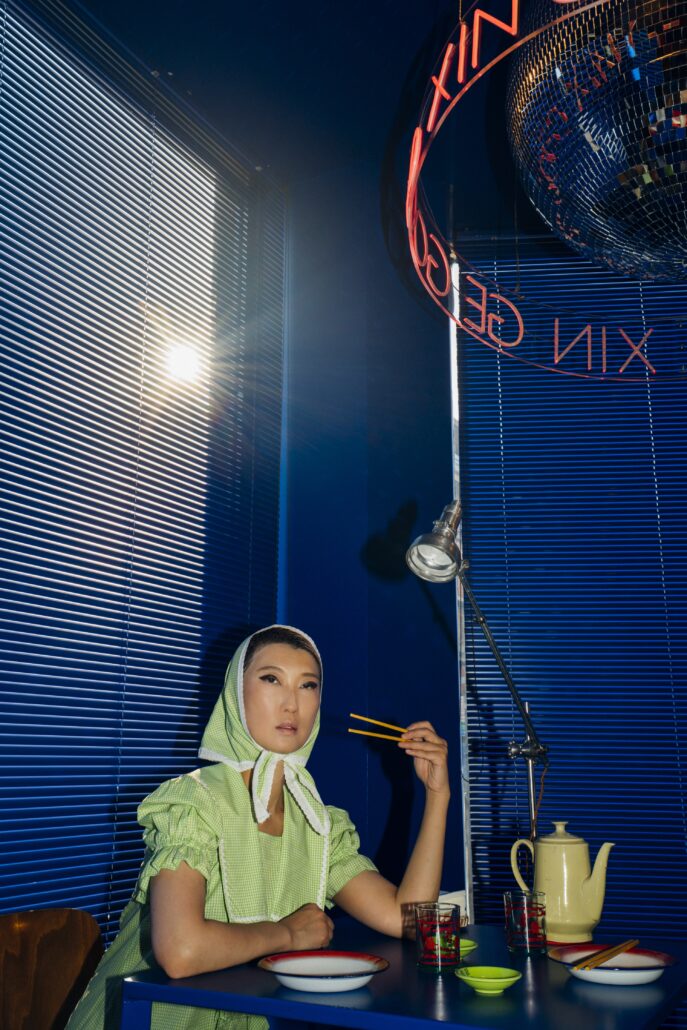
Xin Ge Liu hadn’t always planned to open a restaurant. Her story begins in Hebei, a Chinese province between Beijing and the Mongolian border. She comes from a working-class family. After completing her studies in Florence, she trained at the renowned Le Cordon Bleu culinary school. Her first venture, a takeaway-only operation called Il Gusto Dim Sum, opened in 2019. Shortly after the first wave of Covid-19, Il Gusto di Xinge opened its doors (the restaurant has been recognised by the Michelin Guide for two consecutive years): a place where cooking is driven by ideas, but never at the expense of flavour. In other words, forget any notions of a Chinese takeaway, along with all the stereotypes that come with it. Xin Ge is playing in an entirely different league, one where cultures come together. Her raison d’être is to build bridges between worlds, as she explained to me during one of our first meetings. One dim sum at a time. And a great many have been eaten since. This is where my latest conversation with Xin Ge begins, as I step into her Gusto, completely revamped in 2026 in collaboration with B-Arch, the studio founded by Sabrina Bignami and Alessandro Capellaro. What was once a single space is now two. At the entrance, a wash of pure Klein blue. Communal tables, floor-to-ceiling windows that blur the boundary between inside and out, and the strobe light we mentioned earlier. Soy sauce is already on the tables: this is the spirit of GoGo, until recently a separate entity, Xin Ge’s second creation, now an integrated antechamber to the restaurant. Its menu offers familiar classics and inventive twists, drawing freely on the culinary traditions of every corner of China. The idea is to preserve the mystery of Il Gusto, while giving newcomers and regulars alike a space to decompress before stepping inside. It also provides a dedicated area for takeaway orders and, of course, a more immediate connection with customers, encouraging them to return more frequently.
XGL: “We’ve divided the restaurant into two distinct spaces. Here, we’re in the cocktail bar area, where the food is quick, simple and familiar.”


She explains as she darts from one end of her kingdom to the other. As far as she’s concerned, I’m living in the past. The future is far more interesting to talk about. And sure enough, she shows me the upper half of a female mannequin and points to its face.
XGL: “I’ve been thinking about using it as the base for a dish for quite some time. I just need to work out how to cut it, which parts to remove. I want the lips to stay, so that anyone who wants to eat the dish has to kiss them first.”
Hainan Chicken (served with rice and condiments, originally a snack bursting with local flavours before becoming a symbol of the Hainan region itself), Aubergines in a sweet, sour and spicy sauce, Char Siu (Chinese barbecued pork) with rice, Cantonese Fried Rice (“it’s not as humble a dish as people might think; even in China, every family has its own tricks for making the most of leftovers”), Dim Sum, of course, Sweet and Sour Chicken, Ramen with Braised Pork: these are just a few examples of what GoGo has to offer. Next comes a stop at the Drinx bar (ranked 443rd in the international Top 500 Bars list for 2026 and, as Xin Ge points out, doing very well indeed). Since it’s still early, a non-alcoholic drink seems the wiser choice. Into the mix goes a sachet of Chinese bayberry powder, also known as yangmei, or Myrica rubra. The drink is called Dragon and contains beetroot, hibiscus, orange, pineapple, cloves and star anise. It’s delicious, with a beautifully clear, deep-purple hue.

XGL: “You wouldn’t believe how many customers help themselves to pieces of our tableware and take them home without asking.”
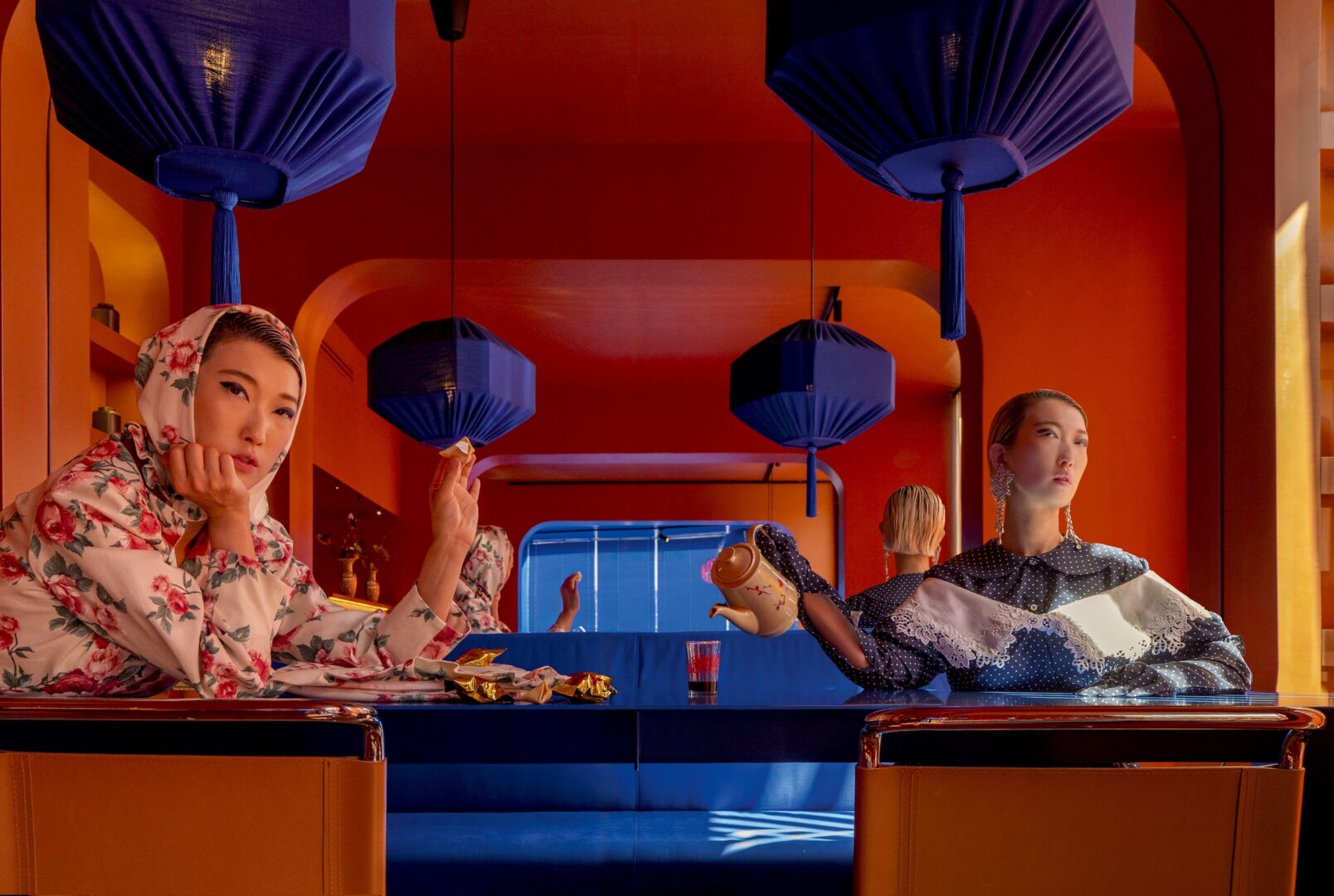
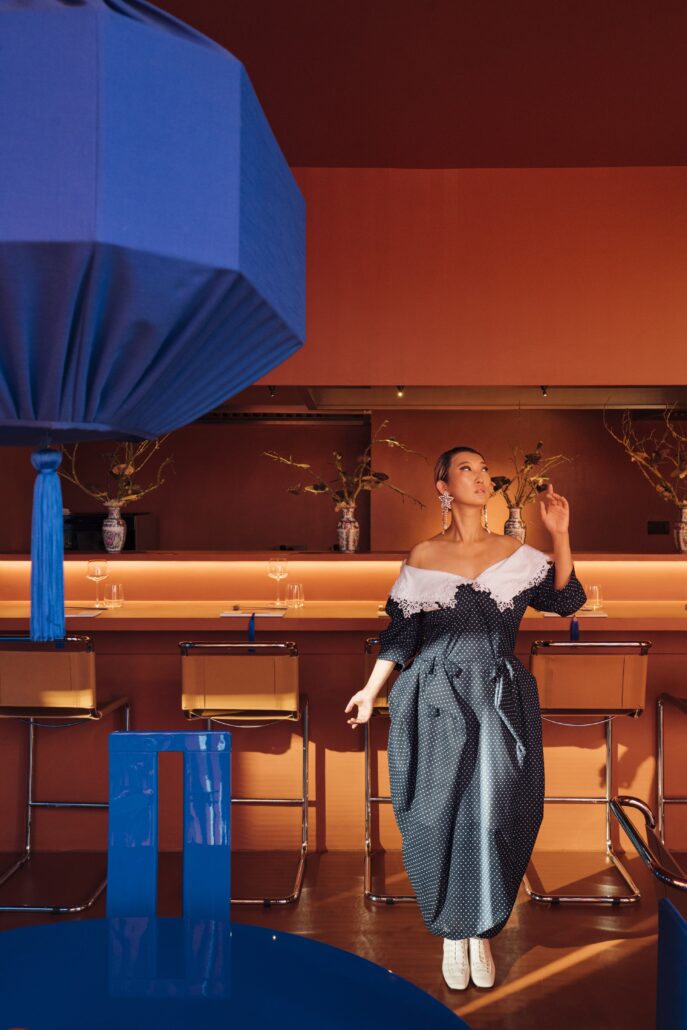
Xin Ge confides as I sip my drink. What a strange way, I think, to try to hold on to a dream that keeps slipping away. Because that is precisely what it feels like to step into Il Gusto di Xinge: falling asleep without any sense of where you are, crossing the threshold into another universe. The contrast in colour could hardly be more striking: a warm brick red, inspired by traditional Chinese lacquer, dominates the space. Tables and chairs trace sinuous curves across the floor, transporting us back to the Space Age aesthetic of the 1970s. Each table is greeted by a pair of poems, written by Xin Ge herself. One begins: Spades / Time to leave the island / Without you is a desert one. And the other: My love / You are an island / Far out at sea / Your infinite courage / Bring you to galaxy. These are part of the journey, never mere coincidence. An instinctive direction to follow, an experience to share. And Xin Ge makes sure we can. She scatters clues and layers of meaning along the way. Two years ago, I encountered what I still consider one of her most extraordinary and accomplished dishes: a sea bass divided in two by sauces and colours. Two variations on a sweet-and-sour base, one enriched with fresh orange juice, the other with squid ink, representing the sweetness and bitterness of existence. The inspiration came from a cancer diagnosis in her family, with X-ray images of the tumour presented alongside the dish. It comes from fashion, Xin Ge explains. And by this she means the very way she conceives a restaurant, the guest’s experience (not the experience), the narrative that holds everything together and, I would add, this constant state of movement, evolution and experimentation. “It’s what everyone calls having a vision. What we do here is shape creativity, invent it. We work in collections, and we make good food. It’s no coincidence that our regulars particularly appreciate this very deliberate, design-led approach”, racconta Xin Ge.
I’ve seen the mood boards Xin Ge works on to create each new season.
XGL: “It’s July, and we’re already thinking about September. I have a dish in mind… a lasagne somewhere between China and Italy, using a traditional Beijing-style noodle instead of the egg pasta we use here.”
The first thing that strikes you about Xin Ge’s dishes is their composition and presentation (she works alongside her business partner Lapo Bandinelli, both in the kitchen and in the day-to-day running of the restaurant). And what beautiful dishes they are. Then comes the angels’ share, to borrow the expression rather irreverently: delicate wisps of soot floating around each creation. Even when there is no accompanying poem, every dish carries something of the past, present or future. This is especially welcome in the tasting menu, available in both shorter and longer versions, as well as a vegetarian option.
The opening is always the same: Dream of Red Chambers. A dreamlike journey into what lies ahead, an introduction to the depths of the unconscious from which every one of Xin Ge’s creations seems to spring. Crispy fried prawn balls, with a melting mozzarella filling, served like fruit on a tree at the centre of the table. During my most recent visit, in July 2026, the menu also featured Sweet and Salty Tears Martini (oyster with apple granita, shallot granita and Champagne foam) and Shanghai Smoked Fish (sea bass glazed with Shanghai five-spice seasoning and smoked over cherrywood, another all-time favourite at Il Gusto di Xinge).
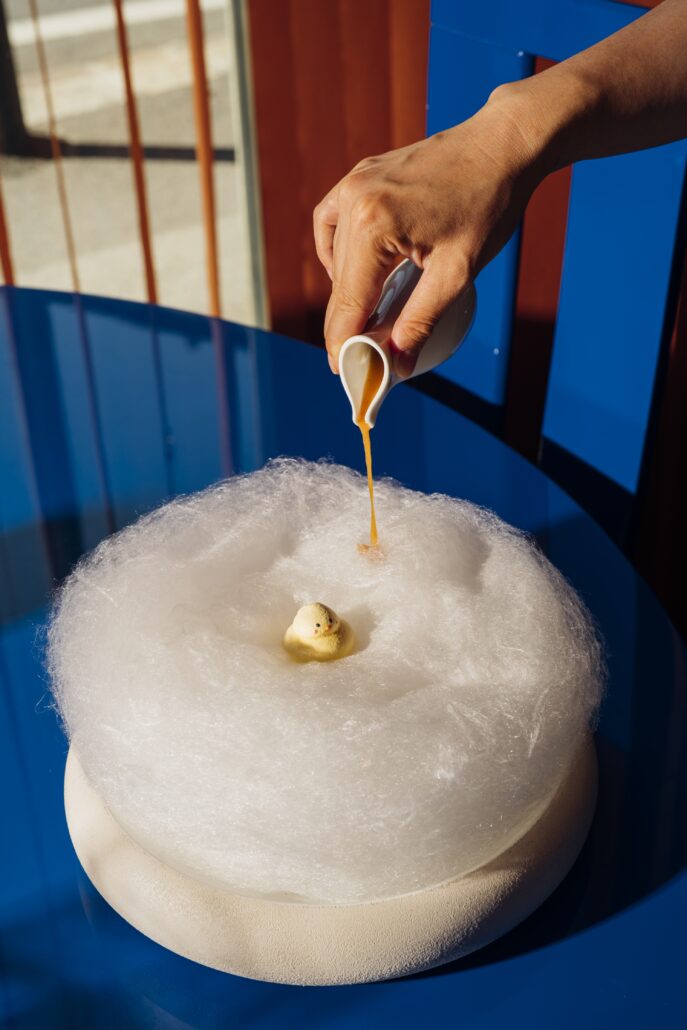
And then there’s Duck in the Clouds, the pièce de résistance: a little duck perched on a cloud of candyfloss. Beneath it, succulent duck breast and orange sauce. The dish is finished by pouring more sauce over the cloud, making it look as though the little duck were off on a little adventure among the clouds.
XGL: “In Beijing, people eat the skin of Peking duck with sugar, and I wanted to recreate that tradition and the sensation that goes with it. It’s a playful question: is it sweet or savoury? Neither really. And to think that the cuisine of the region I come from is generally less sweet than that of other parts of China. The reaction I usually get from customers is: That’s fun!“
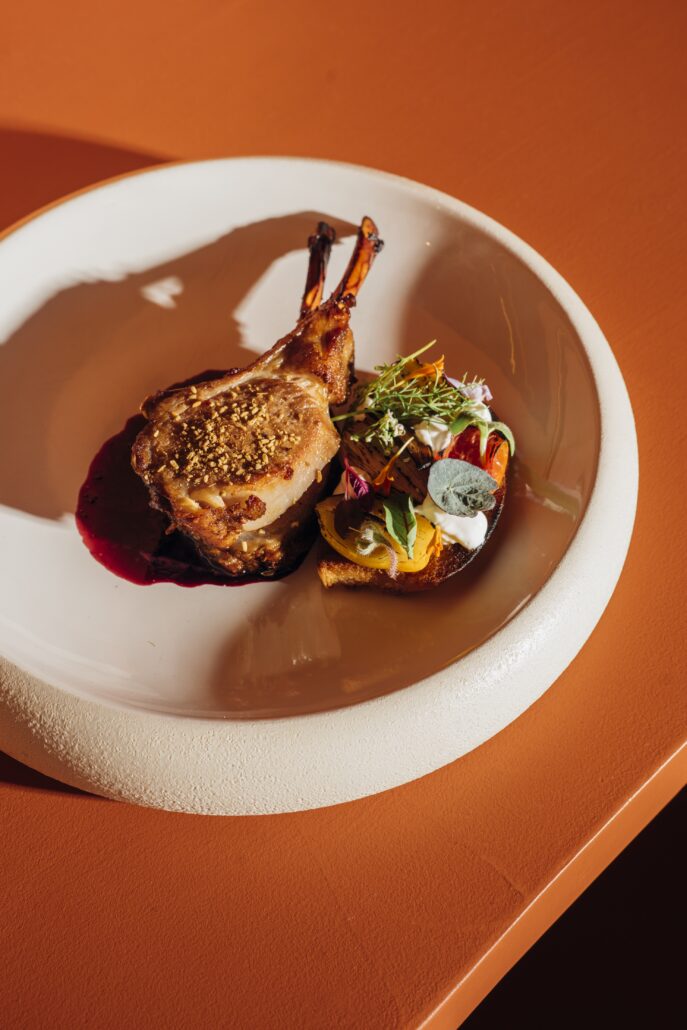
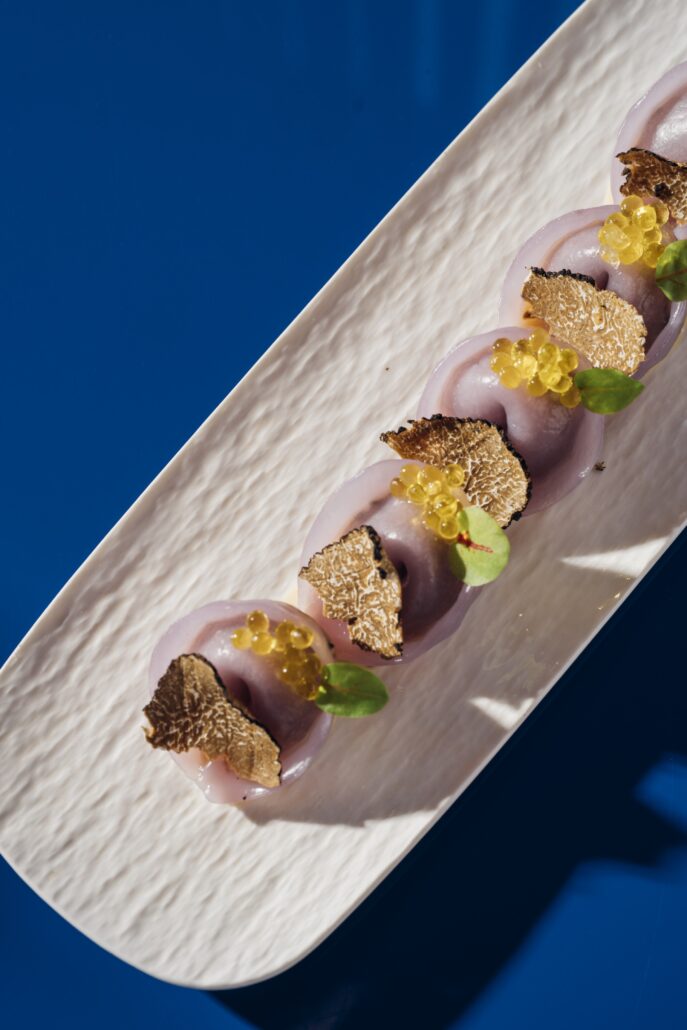
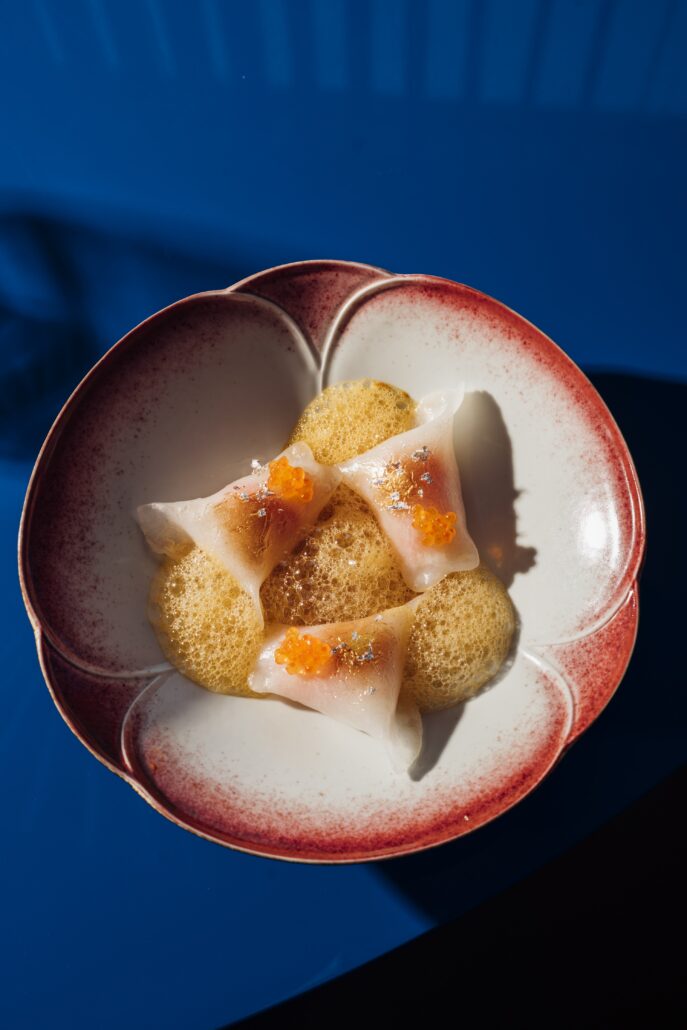
We both laugh at how awkward we can sometimes be when faced with the unexpected, especially when it comes to food. Then there’s Spiced Lamb (lamb ribs served with an Asian-style red wine sauce), Four Happiness Salad (shiitake mushrooms, wood ear mushrooms, carrots and seitan soaked in soy sauce, another classic and a personal favourite of mine), and, to finish on a high note, Xinge’s Mont Blanc (meringue, taro and sweet potato paste, blueberries and pandan cream). Taking a small step back, it would be impossible not to mention the Har Gow, or rather, Xin Ge’s interpretation of these traditional Cantonese prawn dumplings. A dish that has evolved alongside Xin Ge, taking on different forms without ever losing its intensity of flavour. Her latest interpretation combines bamboo shoots and prawns with ají amarillo and coriander, a manifesto of her culinary philosophy: cultural crossovers and intensified flavours.
Indeed, Xin Ge Liu’s dishes may be beautiful, but that doesn’t mean flavour takes a back seat when it comes to the ultimate test of the palate. Dining at Xin Ge’s, whether at Il Gusto or GoGo, has something of the suspended magic of a dream. All she asks of her guests is that they be present, in mind even more than in body, and willing to venture into unfamiliar territories of taste and inner experience. It all happens at once. The first time, you lose your bearings. But as the journey unfolds, you begin to discover quite a few things, about Chinese culinary traditions and your own palate. And with Xin Ge as your guide, whose touch could effortlessly put any tablescaping influencer to shame, you know you’ve found somewhere worth returning to, somewhere no visit will ever feel like the last. She offers me what is, inevitably, an impossible summary of everything that happens within these walls:
XGL: “I’m trying to cook up a cinematic feeling, to make everyone who walks through these doors feel as though they’ve stepped into another world. A kind of retro-futurist nostalgia, something that makes your eyes widen in wonder. I picture the silhouettes of guests seated at their tables, glimpsed from outside through the curtains, creating a sense of strangeness and curiosity. You know Blade Runner? That whole visual world, that atmosphere, has had a huge influence on me, and still does today.”
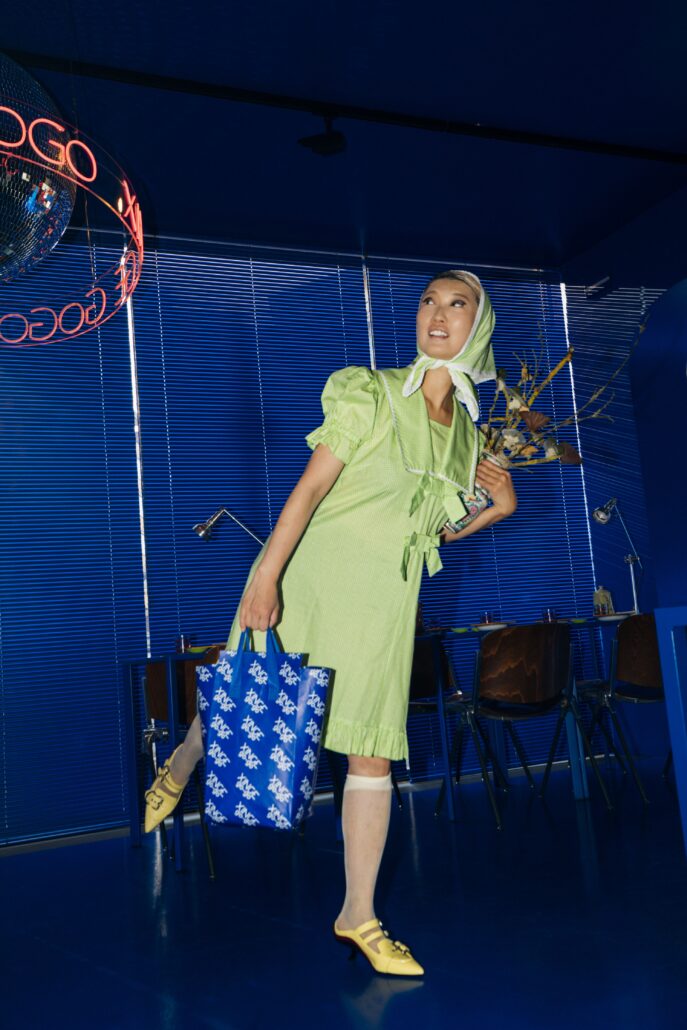
Despite these cinematic influences, Xin Ge has chosen a different direction to reaffirm, on these very pages, her seemingly instinctive relationship with artistic creation and the world of fashion. And she has done so by going in precisely the opposite direction: go small or go home. Vivetta Ponti and her label Venerdì Pomeriggio offer a glimpse into Xin Ge’s world and her fabulous destiny. Xin Ge tells me about meeting Ponti and the immediate, deeply felt connection between them. Originally from Umbria and now based in Florence, Ponti is a fashion designer who founded her eponymous label, Vivetta, in 2008. The brand was subsequently acquired by the Modamet holding company, which she announced she was leaving in 2025. And so Venerdì Pomeriggio was born, a name that evokes the optimism of the end of the working week, the restorative pleasures of otium, but also a wealth of family memories for the designer (as she has recounted in recent interviews, including one with Vogue Italia). Collections conceived as micro-capsules rather than dictated by the conventional fashion calendar; garments made from deadstock fabrics and therefore unique, quite literally impossible to reproduce; clothing that transcends boundaries of gender and identity; inspirations drawn from the streets of Florence and the people who walk them, and beyond.
One look at Venerdì Pomeriggio’s creations is enough to see the shared vision of Xin Ge and Vivetta: not so much in their outward aesthetics, but in their desire to push the boundaries of taste (and the creative act itself), giving life to alternative worlds, free from convention and any need for a definitive explanation.
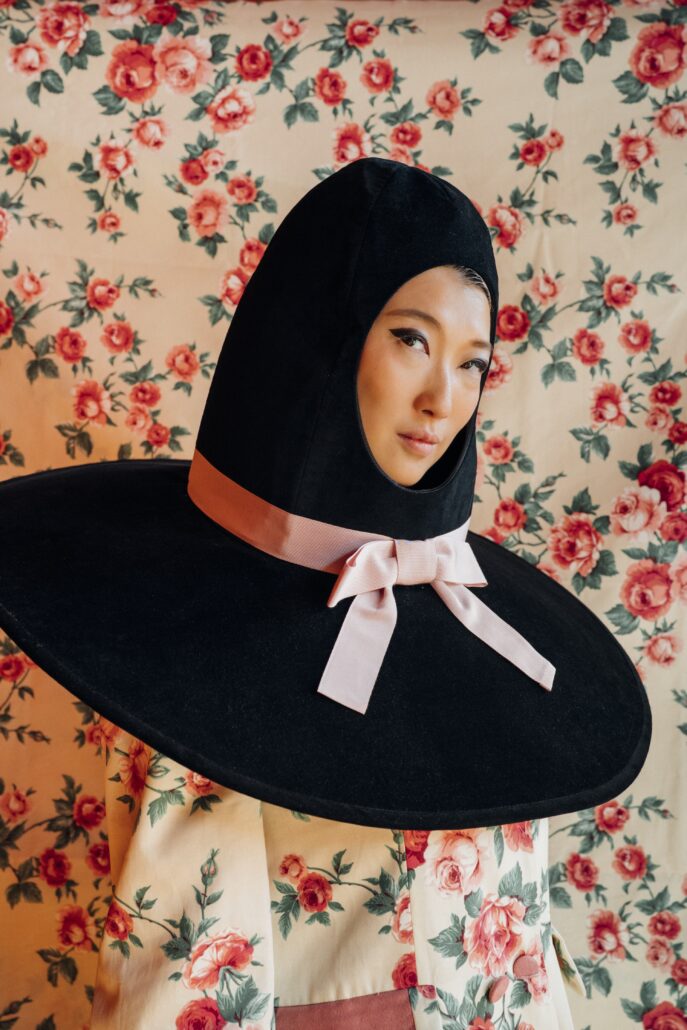
While Xin Ge’s world looks to the future, Vivetta Ponti’s turns to the past, combining countryside chic influences with a certain post-Victorian flair.
Completing the picture are the shoes of Lili Curia, a label created by Chili Palmer, a third-generation shoemaker who trained at Milan’s Arsutoria school of footwear and leather goods design. Last year, Lili Curia emerged as a favourite among London’s ‘It girls’. In a remarkably short time, the brand established itself as something of an arbiter elegantiae in the world of cool, thanks to designs that are unmistakably contemporary yet draw on (and playfully exaggerate) elements of vintage and second-hand footwear. Retro-now: looking back at fashion and costume history to create precisely what the present was missing. It’s hardly an official definition, but it does describe an intriguing creative territory.
“What do you think?” Xin Ge asks, showing me an enormous wide-brimmed hat by Venerdì Pomeriggio, which, when worn, makes the wearer look like little more than a mannequin for the hat itself, its proportions entirely at odds with the human body. I feel just like the enigmatic Giant from Twin Peaks, I want to reply. But I suspect this conversation already has enough layers of meaning to unravel.
This isn’t the only time the interview has taken an unexpected turn, with the roles reversed. Curiosity runs both ways, along parallel paths. Perhaps that’s why it’s so easy to find ourselves reading the world together, rather than simply seeing it through Xin Ge’s eyes. It’s just something she does. I suspect it’s one of the reasons why this place feels so much like a refuge. In other words, Xin Ge Liu is genuinely interested in dialogue, in conversation. A polite, conventional answer is out of the question. More often than not, a conversation will take an unexpected detour through the photo gallery on her phone, where she shares inspirations, sketches and pictures of her eight-year-old daughter.
It’s impossible to step into the same dream twice. Perhaps that’s why Il Gusto feels different every time, and not just because I don’t live in Florence. But that doesn’t mean you lose your way. Quite the opposite: even far from home, you somehow find yourself. We’re not the ones dreaming, yet we’re part of it. We don’t control the story, but we’re drawn into it from the very beginning. Everything feels both strange and familiar. It’s impossible to step into the same Il Gusto di Xinge twice. One thing is certain, though: you’re already looking forward to the next time you take your seat.