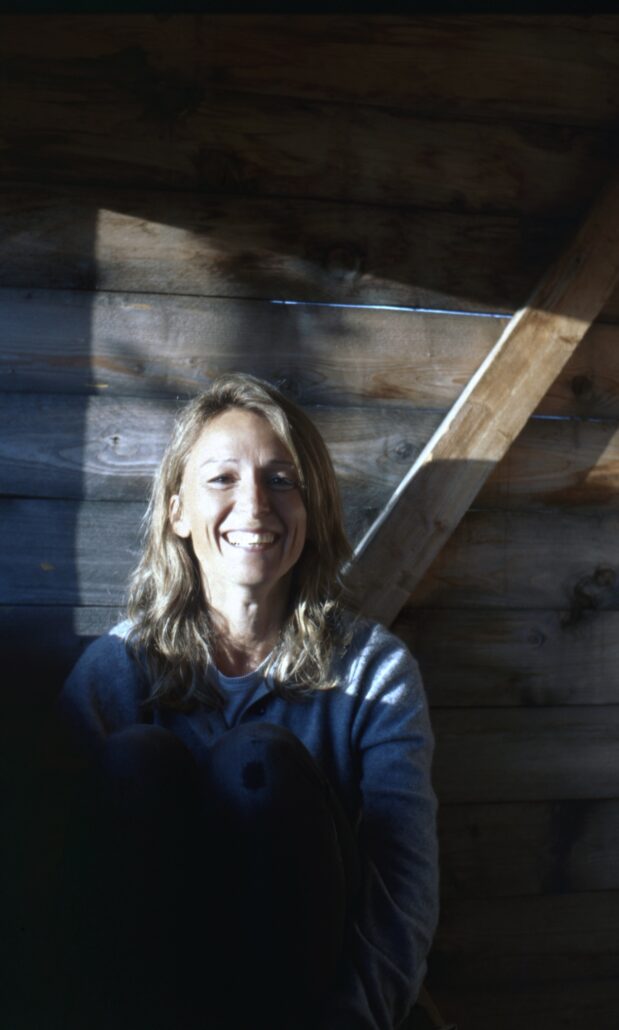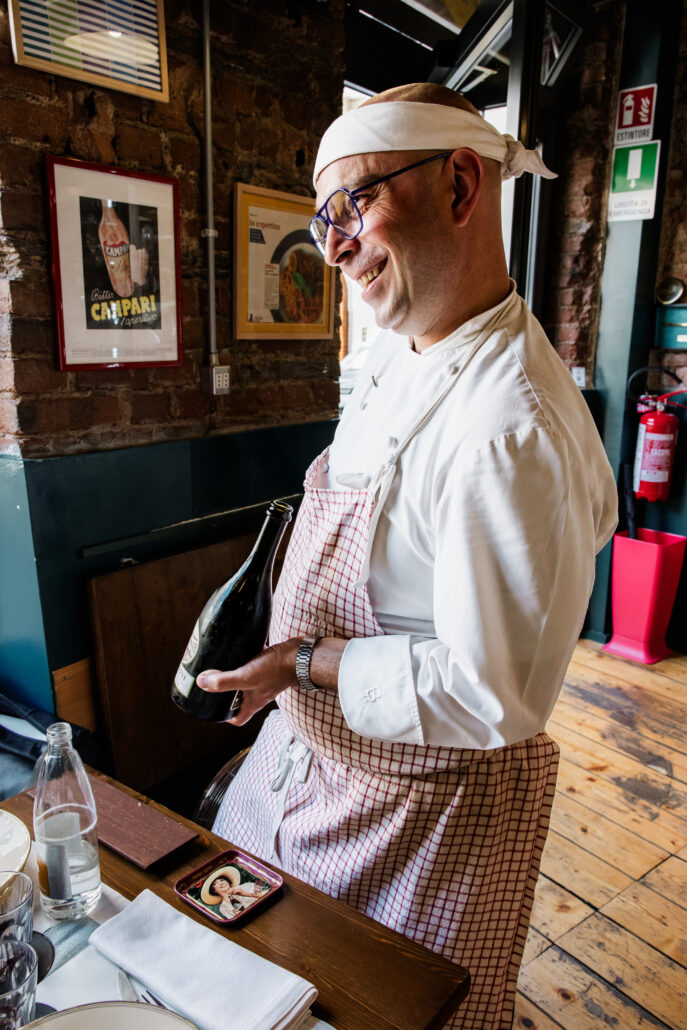
“To invite someone to our table means taking responsibility for their happiness during the hours they spend under our roof.”
The Physiology of Taste– Anthelme Brillat-Savarin
Sometimes life takes rather unexpected turns. You might meet in fascinating, hyper-energetic Copenhagen and then end up changing your life entirely, buying a piece of land and a farmhouse in the vast quiet of the equally captivating Valchiusella.
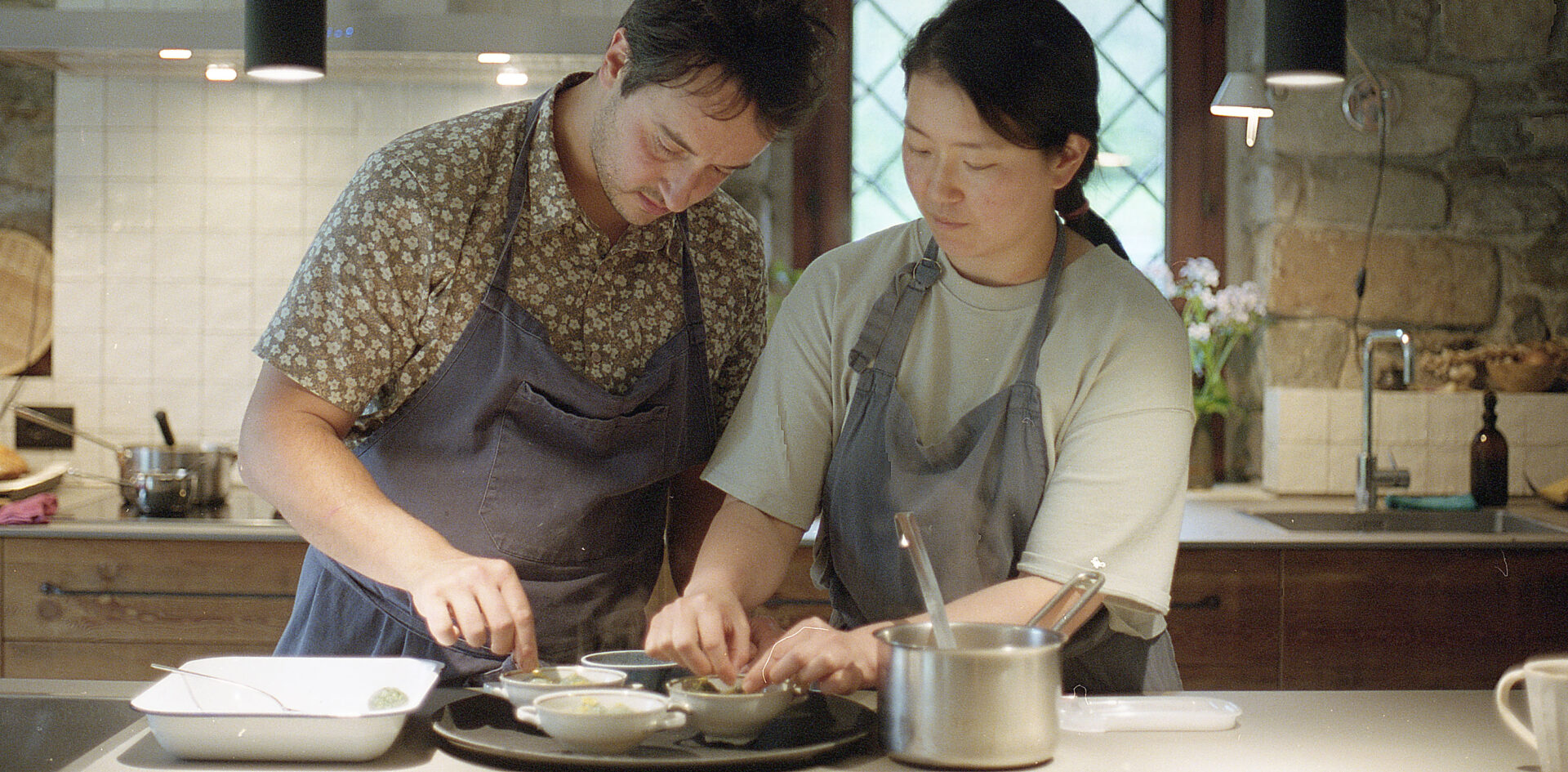
This is the story of Rantan, the blissful farmhouse that rises out of nowhere in Trausella (Turin), of Carol Choi and Francesco Scarrone: wife and husband, cooks and farmers, hosts and bakers, a bit of everything, but only ever together, moving at the rhythm of nature.


Our story begins with bread and salami, half a joke, though not entirely. It’s 2012: Copenhagen is buzzing, and Christian Puglisi’s restaurants – Relæ and Manfreds – are at the core of a movement that, in the years to come, would reshape gastronomic culture worldwide. Francesco Scarrone, a Piedmontese from the Canavese area, has just finished Alma and is searching for a radical shift in his approach to cooking. At Relæ he finds something completely different from his background: a single omnivore/vegetarian tasting menu, no pasta, no primi; apart from the bread, there were no starches, the entire focus was on vegetables. A year and a half later, he wants hands-on experience in agriculture. He already has theoretical foundations, thanks to obsessive study and countless books, but needs the land beneath his feet. Then Christian brings him into the opening of Bæst (the pizzeria with in-house production) and entrusts him with developing the restaurant’s charcuterie and cheese recipes—a world built on deep research and an equal degree of creative freedom.
Let’s go back to 2012, still in Copenhagen. Carol Choi has been at Noma since 2010 – in the bread & pastry section – when she decides to take a break and head off for a series of more Nordic stages in Sweden, including a period in the kitchen at Magnus Nilsson’s Fäviken. When she returns to Copenhagen, she finds herself in the pastry department at Relæ and Manfreds, spending half her time baking bread and becoming utterly captivated by it. Not long after, Christian chooses Carol to lead the bread and pastry production at Mirabelle, the bakery–eatery sharing the same space as Bæst. It’s easy to imagine that this is where Carol’s and Francesco’s paths cross (between sourdough and charcuterie, indeed) and where their stories intertwine, culminating in marriage on a freezing Danish December day, under a snowfall that was anything but romantic, yet crowned by a homemade feast of oysters and all sorts of sweets.
We meet Carol and Francesco in mid-May, in a whimsical spring when the vegetable garden is not yet in full celebration and the weather gifts us a flash snowfall followed by a clear, bright blue sky. Valchiusella is beautiful, all dressed in vivid green; nature still reigns supreme here, and the quiet is broken only by the occasional cowbell and the gurgling of the river. Two centuries-old copper beeches mark the entrance to Rantan and open onto a wide green meadow and an old stone farmhouse. We are welcomed with two wide, beaming smiles, a cup of single-origin Ethiopian filter coffee – Francesco’s obsession: no espresso, only filter – and a pair of slippers each. We take off our shoes and step into the micro–macro world of Rantan, which is a life choice before it is what it is and what it may become. The whole project is built on them, Carol and Francesco. Are they interchangeable? No. They each have personal interests and inclinations, brought together in synergy to form a winning team. In the kitchen she is the pastry chef–baker and he is the cook, and he doesn’t lay a finger on the bread. Because you won’t ever want any bread other than Carol’s again, it’s extraordinary. Sourdough and a complex blend perfectly balanced between: grains of ancient Piedmontese varieties, spelt with a delightful sweet minerality, Sicilian durum wheat with a hint of hazelnut, chamomile, liquorice, soft wheat because it is essential, and a touch of rye, indispensable because, as Carol says, “it makes the fermentation magical and the depth of flavour improves surprising.”


They decide the entire menu together and, much like complex kitchen brigades, every Monday morning they hold a briefing to organise the week and divide the tasks. Francesco has always been drawn to agriculture: he enjoyed himself in the kitchen, but he felt he needed to get his hands dirtier to truly understand how a product ends up on the plate. Carol, on the other hand, loved hospitality and the atmosphere that would come alive in Copenhagen during the visits to producers with fellow chefs: you would take whatever you found in the garden, light a fire, and cook.
We wanna change our lifestyle, they wrote in the very first line of their project, and everything was built around that.

Between saying and doing, Turin lay in the middle: Francesco worked for two years at Consorzio, while Carol dedicated herself to consultancy work on baked goods. They were searching for their right place and thought they had found it in Auvergne, in the heart of France, but it turned out to be too in the middle of nowhere. They wanted mountains, tired of Denmark’s flat, open landscape, remote yet not unreachable, with a bit of arable land that could be worked by hand without the need for terraces. By complete chance, they came across the ideal farmhouse in an unknown clearing in Valchiusella, not far from the spot where Francesco used to go skiing as a child. They became the owners in 2017; renovation work began in 2018 and was completed the following April. In July 2019, they opened “Rantan. Farm, house, conviviality”, a very Piedmontese name meaning “swamp”, yet carrying with it the charm, and uncertainty, of foreign words whose pronunciation is never entirely clear.
The experience at Rantan is different because, first and foremost, it is Carol and Francesco’s home (and Ben and Ozzy’s too two magnificent cats who are an integral part of the décor). Here they practise that brilliant concept known as Rural Hospitality, a regional scheme that allows one’s own home to be used for dining and overnight stays. Eighty-five per cent of the raw ingredients used must be produced on site or within the region and purchased directly from farms. The remaining fifteen per cent—things like salt, sugar, oil—may come from anywhere. The regulations on supplies fit perfectly with what Carol and Francesco had in mind: they allow them to maintain direct relationships with producers, keep prices more accessible, and wander about in search of exceptional products and people. As with the wine, almost entirely Piedmontese, with a selection of bottles available only in tiny quantities, souvenirs from their wanderings around Europe.
What happens here can be summed up in a few words: everything that takes place before the food is picked is given value, and the ingredient itself is placed centre stage, without complications. In a casual, comfortable, hygge atmosphere; from garden to table in the most bucolic and delicious way one could imagine. From Monday to Friday, Carol and Francesco are farmers; from Friday to Sunday, they are cooks (for three services: Friday and Sunday lunch, and Saturday dinner) and hosts. For their own wellbeing, for the garden’s, and for that of their guests.


Before strolling through the vegetable garden, we visit the nursery that hosts all the seedlings in the stage before they reach the field. There are Korean chillies, habaneros and the small naga with its killer heat; Korean shiso, the aubergine from an old Japanese variety that has found its perfect microclimate here in Valchiusella; baby celeriac, courgettes, cucumbers, peppers, cavolo nero, red kale, green kale, Brussels sprouts, cabbages, leeks. Everything is on a small scale little of many things. There is only what they want and use; they don’t sell directly. They choose the varieties: local, Korean, Japanese, Danish. They source the seeds and use 95% of what they grow.
The approach in the field is genuine, integrated and low-impact. It does not involve the use of chemical agents, but rather manual work and the ability to understand and read the plants.
Without the need to flaunt the organic label, for them working in these terms is the bare minimum to speak of agriculture. Take the strawberries, for example, of two varieties passed down from Denmark. They are in their natural environment, without plastic around them, alongside fungi, surrounded by small pieces of wood. The agricultural system is something complex and intricate and must be investigated; this is why, when a crop struggles, they try to understand the cause of the problem. It’s called regenerative agriculture. For Francesco, soil conservation and rehabilitation has become an obsession, just like coffee. It is essential to understand the activity of the microbes in the soil, just as it is necessary to interpret the activity of the microorganisms that help preserve products in the kitchen. With mulching, they protect the soil, inhibit weed growth, improve fertility, and retain moisture. They cover the land (which is fairly poor and sandy) with a generous layer of compost, optimise space by associating crops, and rationalise the use of resources, trying to water as little as possible. They create strong, complex systems, like those in the wild, which require minimal resource investment and stimulate the microbiology in the soil.
The interiors of the house radiate warmth in every corner, with wood, stone, fireplaces, books to leaf through, and cats to stroke. We’ll let Olivia’s photos give you the full sense of it.
Carol and Francesco’s dining room is the restaurant, and the kitchen is truly their home kitchen—induction, very spacious, with everything in its proper place.
The only difference is the oven, which had to be professional for Carol’s leavened creations. A single large wooden table occupies the centre of the room; pre-Covid it could seat 14 guests (16 if squeezed), now it accommodates a maximum of 8.

What’s on the table is eaten together, all at once. The menu is fixed and omnivorous, there are no alternatives. It is dictated by the current season and strictly depends on the previous ones. It adapts to what is happening in the garden and forces flexibility on the chefs, who plan it carefully and make sure it is beautiful, very tasty, and satisfying for everyone. It’s a practically daily menu consisting of 7–8 dishes, featuring vegetables from their garden, wild herbs from the woods, and proteins sourced from friend-producers. “Valli Unite supplies us with meat; we fell in love with their project immediately. We take half a pig and make what we can: lard, cooked charcuterie, headcheese, rillettes. We almost never serve beef; it’s very difficult to have the same traceability as the Valli Unite pigs, which live and are slaughtered in the same place without suffering transport trauma.” For cheeses, they rely on Vittorio, the local cheesemaker, and Matteo, the affineur at Le Tome di Villa. When the garden yields less, during the cold months or transitional periods, they rely on preserved fermented stocks (in oil, vinegar, sugar, or salt), drawing from culinary traditions across the globe. Like the Korean soy sauce, Carol’s creation, fermenting with homemade koji in an amphora carefully coated with beeswax.
Bread at the centre and valley butter on the side, whipped à la minute in a stand mixer. The setup is unconventional: there are no first courses or pasta, the focus is on bread as the main element. Everything around it is without a homeland or geography, yet it couldn’t be more local than this.
“We appreciate all culinary cultures in the world; we take techniques and traditions from one gastronomic heritage and then another, and we put them together.”

Rantan is home, and home means sharing: many of the dishes are meant to be shared among guests. The mind-blowing Headcheese – somewhere between an aspic and a pressed pork head, made by Francesco with a whole pig’s head from Valli Unite, cut into pieces, cooked, and pressed – sliced with a few nasturtium leaves for a spicy kick; last year’s Carrots, sweet and crunchy, lightly steamed and marinated for about an hour in La Rina red wine vinegar from Cascina Iuli, dressed with finely sliced red spring onion, oil, and a touch of Artemisia abrotanum (blanched for 30 seconds in salted water to remove bitterness); the Gherkins, pickled cucumbers with soy sauce (which Carol prefers to call cornichons); and Pork Shoulder Rillettes with brown fennel. Everything goes with bread, and vice versa. Then there are the Friciule, little fritters of wild herbs typical of Monferrato, which taste exactly like the multitude of herbs that compose them: false nettle, wild gerardia, silene, pennyroyal, wild garlic, pimpinella, lovage, artemisia, fennel, lemon balm, dandelion, honesty, borage, chervil, coriander, St. Peter’s herb, Chinese chives. The herbs are balanced, with just the bare minimum of breadcrumbs, parmesan, and an egg to bind them. Everything is blended, shaped into quenelles, and fried in a pan over a hot flame. If only we could print the smell.
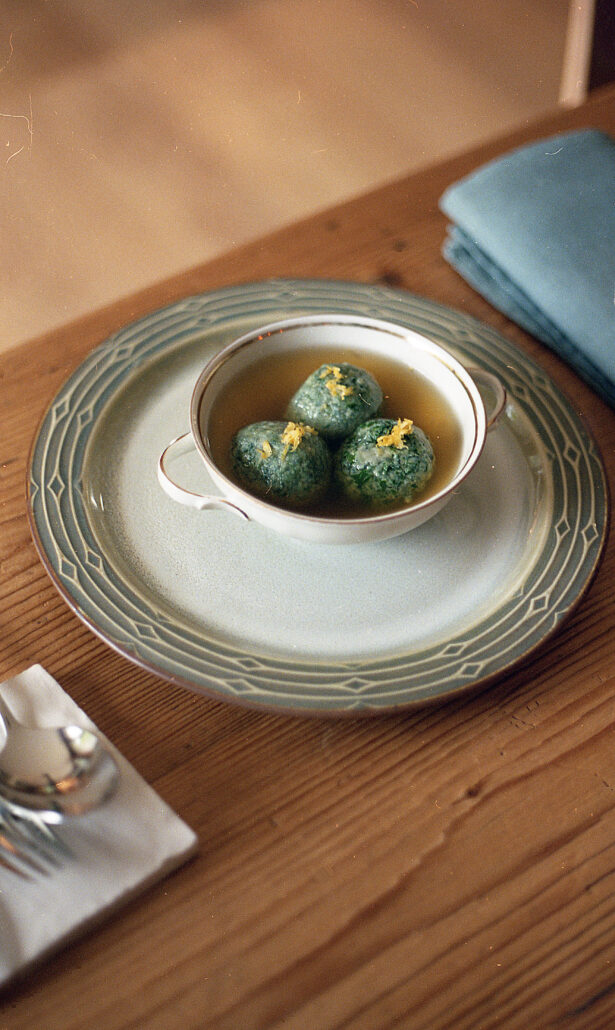
There is a first course, but it’s a pasta without pasta: nettle, spinach, and ricotta Gnudi (ricotta from Vittorio, the cheesemaker just a couple of bends away) served in a robust chicken bone broth scented with lemon zest. Simply moving—they hit straight to the heart. Then the free-range chicken: intense, meaty to the bite and melting on the tongue. And that complexity of flavours! “It’s dry-aged for 5 days in the fridge to lose water and concentrate the aromas,” explains Francesco, “then brined overnight, drained, and cooked at 90°C for around 40 minutes. We let it rest and then finish it in a pan.” That’s it—an out-of-this-world chicken, energised by young garlic in a light sauce, slightly bittered by chicory (freshly picked and sautéed), and served with a kind of white polenta that tastes like tacos. “We nixtamalised the flour from our white maize, boiling it in an alkaline solution with 1% slaked lime.” The result is a mind-blowing flavour and a more nutritious maize.
Rantan is home, and home is about sharing.
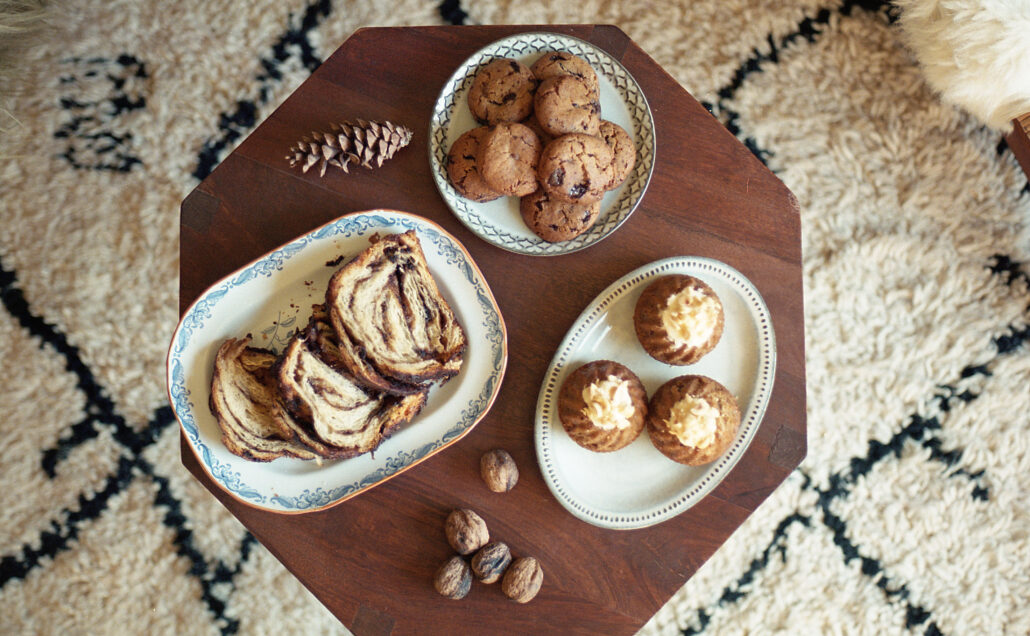
Everything sweet is a marvel by Carol, of course. The pure Rantan-made mascarpone, elevated with toasted almond cake, strawberries from a nearby producer, and the very first rhubarb from their garden, is sensational. We go to sleep blissful and wake up intoxicated by the smell of butter. Awaiting us is the Rantan Breakfast, a Breakfast to Heaven: a lavish selection of morning delights enjoyed guilt-free because it’s consumed straight in paradise. Carol’s bread, toasted with butter, plum jam, and hazelnut butter; ecstatic babka with sourdough (Carol’s new passion is working croissants, milk bread & co with natural leaven); chocolate cookies; mind-blowing carrot cake; valley yogurt with Carol-made granola and chestnut honey… and the mighty Croque-Madame with Vittorio cheese, chard, and a poached egg.

Rantan is a way of being, a lifestyle that is gradually attracting like-minded people; it is becoming a community. When they first arrived in the valley, the average age was 65; now many young people are moving there to bring new energy to local artisanal activities. Among them is Basil Blake, president of WWOOF Italy, with his vision of virtuous farming. “We’d like to join forces with him and many others to create an association, a network to exchange knowledge.” In June, the project for an agricultural hub was presented on that large green meadow where dreams grow. A bakery, workshop, and convivial space with a design blending Valchiusella and Korean influences, funded through a crowdfunding campaign launched at the end of the month, and one we are certain will be a success.
Love is all around in Valchiusella, truly.